
Restaurants are known for their razor-thin profit margins. That notion holds particularly true among affordable fast-casual and quick-service concepts. Add on pressures like rising real estate costs, unpredictable food prices, and minimum-wage hikes across the country, and operators are left with even less of a financial safety net.
In this climate, every penny counts. One often overlooked factor into your monthly costs comes from your utility bill. While something like a utility bill may seem like a fixed, somewhat inelastic cost, there are changes and improvements to your restaurant that can save you money and increase your bottom line. To help, we’ve asked an expert at SIB Fixed Cost Reduction to identify ways restaurants can lower their utility bill and save themselves money in the long run.
Cut Costs on Your Utility Bill
Make Sure You’re Using the Right Light Bulbs

If you are still using incandescent bulbs in one or more of your restaurants, it’s time to make the switch to LED. This is the fastest way to lower the electricity bill. Switching to LED bulbs can lower your costs by 50-75% per fixture.
The transition will require some upfront costs that take time to show results, but in the long run the ROI for a switch to LED will pay off.
For example, let’s say you have lights in your parking lot, and you replace one of the heads on those lights from incandescent to LED.
The initial cost may be around $300, but you save 10% per head per month, so in 3 years the project will pay for itself.
In addition, a cleaner and more well-lit parking lot attracts more customers to your business, which will help to accelarate the the break-even cost of switching the heads in the first place.
Upgrade Your Old HVAC System

This can be a drastic change, and a fairly large financial undertaking in the short term, but upgrading old and inefficient HVAC systems can do wonders towards energy efficiency, and ultimately, your savings on monthly utility costs.
These are savings you will begin to notice immediately following the upgrade. To ensure that your HVAC system is running at it’s most optimal, consult with a trusted contractor about what’s the best fit for your location.
Protect your investment by establishing a sound maintenance program.
This includes regular cleaning and inspection of your HVAC equipment by a qualified professional.
Add Tints to Exterior Windows
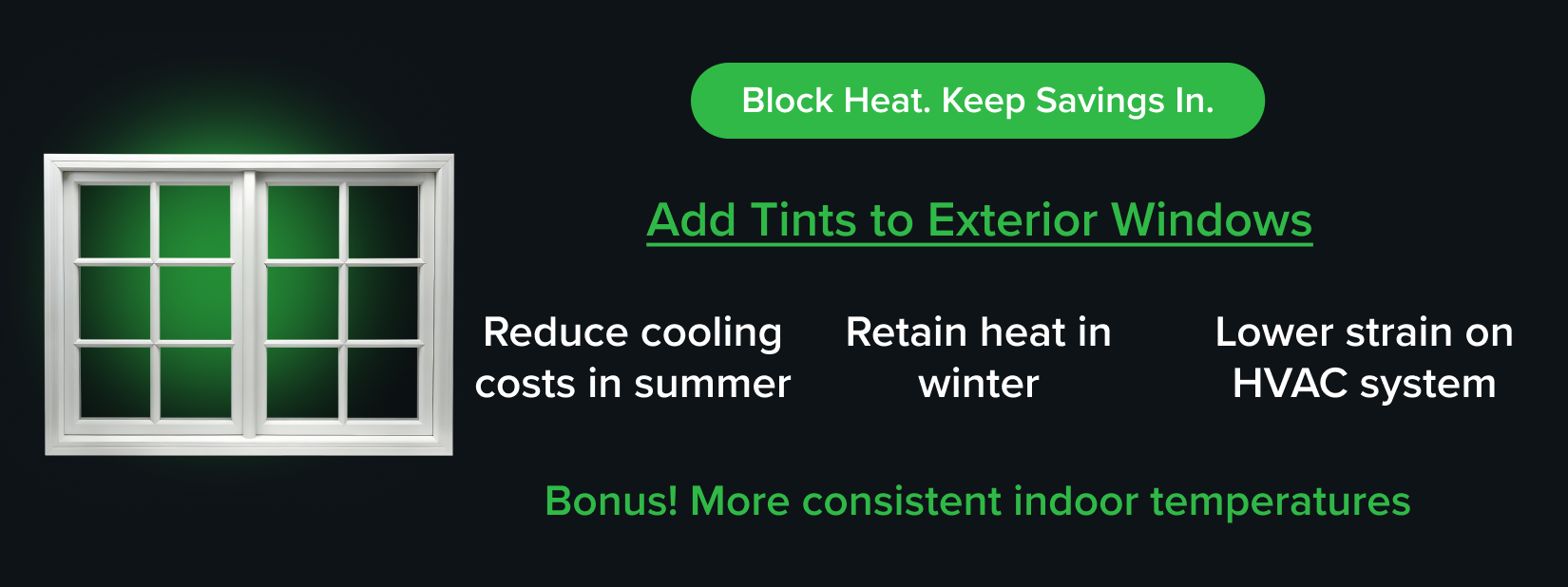
Adding tints to exterior windows is an effective way to save on heating and cooling your business, especially in the summer season.
The window tint acts as a barrier between the sun and your business, blocking out ultraviolet light and keeping the interior of your business cooler.
This will allow you to save on running the air conditioning, cutting down on the electric bill.
In the winter month’s the window tint can help to keep heat in. In addition to lowering your energy costs, this addition will also save wear and tear on your HVAC system, keeping your business at a more steady temperature.
Know Your Electricity Market

In the U.S, there are 2 types of electricity markets: regulated and deregulated.
In a regulated market, the utility company owns all of the infrastructure around electricity. These companies then sell directly to the consumers at fixed rates. The rates are set by a state’s public utility commissions. In regulated market there are different tiers, so it is important to ensure that your restaurant is being charged the correct rate. There are different industries rate structures.
For example, a restaurant’s rate structure may be different than that of a hotel or shopfront.
On the bill there is a code that says whatever rate structure you’re on.
You will have to call the regulated utility provider and tell them you’re doing an audit or confirm online that you are on the correct rate. 68% (34 states) are in a regulated electricity market.
In a deregulated market, private competitors buy and sell electricity by investing in power plants and transmission lines. Generators sell the wholesale electricity to retail suppliers, who then sell to consumers. In a deregulated market, the retail suppliers set the prices for consumers.
Areas with deregulated markets are: California, Connecticut, the District of Columbia, Delaware, Illinois, Massachusetts, Maryland, Maine, Michigan, Montana, New Hampshire, New Jersey, New York, Ohio, Pennsylvania, Rhode Island, and Texas.
If you operate in one of these areas, comparing bids from multiple brokers to ensure that you are getting the best price is an effective strategy to cut down your utility bill and save your business money.
Interested In Learning more? Enter your email address below to sign up for our Newsletter.