Most restaurant operators can spot a food cost problem when they see one. The harder part is figuring out why it’s happening.
Maybe one location is consistently paying more for the same products. Maybe another is throwing away more produce than expected. Maybe everyone’s buying from approved suppliers, but food costs still keep creeping up month after month. When you oversee multiple restaurants, those little issues don’t stay little for long.
That’s what makes learning how to control food costs so different for multi-unit operators. It’s not just about negotiating lower prices or running inventory more often. It’s about creating consistency across every restaurant so purchasing decisions, inventory practices, and supplier performance all move in the same direction. The more consistent your operation becomes, the easier it is to spot problems early and keep food costs from eating away at your margins.
Why Food Cost Control Is Critical for Multi-Unit Restaurants
Ask any restaurant operator where margins disappear, and food costs will probably make the list.
When you oversee multiple locations, though, the issue usually isn’t one bad purchasing decision. It’s dozens of little ones happening every day.
One store buys outside the approved contract because a manager needed product fast. Another consistently over-portions proteins during dinner service. A third orders too much produce before a slow week and ends up throwing half of it away.
None of those mistakes seem dramatic on their own.
Now multiply them across 15 or 50 restaurants.
That’s why learning how to control food costs isn’t just about negotiating better pricing. It’s about making sure every location follows the same purchasing strategy, the same inventory process, and the same operational standards. The more consistent those habits become, the easier it is to spot problems before they start showing up on your P&L.
Understanding Food Cost Percentage and Variance
Most operators know their food cost percentage.
Fewer know why it changes from one location to the next.
That’s where food cost variance becomes valuable. It helps explain the gap between what your food costs should be and what they actually are. Sometimes the answer is simple. Maybe produce prices jumped after bad weather. Maybe beef markets moved unexpectedly. Other times, the issue starts inside your own operation.
A location that’s ordering too much inventory, serving inconsistent portions, or missing inventory counts will usually see those problems reflected in its food cost numbers.
Looking at percentage alone only tells part of the story. Comparing locations, reviewing purchasing activity, and watching trends over time gives operators a much clearer picture of what’s really happening.
How to Calculate Food Cost Percentage
The formula itself hasn’t changed:
Food Cost Percentage = (Cost of Food Sold ÷ Food Sales) × 100
To find your cost of food sold, add beginning inventory to purchases, then subtract ending inventory.
The math isn’t difficult.
Keeping the numbers accurate is where restaurants run into trouble.
If inventory counts aren’t completed the same way every week, invoices aren’t entered on time, or products are counted differently from one location to another, the calculation starts losing value. Suddenly you’re making purchasing decisions based on numbers that don’t tell the whole story.
If you’d like a deeper look at the calculation, along with practical ways to improve your results, check out this guide to reducing restaurant food cost percentage.
Food Cost vs. Prime Cost
Food cost deserves attention, but it shouldn’t be viewed by itself.
Prime cost combines food and labor, giving operators a better understanding of where most operating dollars are going.
Think about two restaurants with identical food costs. One schedules labor efficiently and controls overtime. The other doesn’t. Even though food spending looks the same, profitability can be very different.
That’s why experienced operators rarely focus on one metric in isolation. Food cost and labor work together, and decisions affecting one often influence the other.
Common Causes of Food Cost Variance
When food costs start climbing, there’s usually more than one reason behind it.
Some of the most common contributors include:
- Buying products outside contracted supplier programs
- Portion sizes that vary from shift to shift
- Inventory counts that aren’t accurate
- Excess food waste or spoilage
- Theft or inventory shrinkage
- Supplier substitutions
- Commodity and produce market fluctuations
Sometimes one location stands out immediately. Other times, every restaurant is only slightly over budget. That’s often harder to catch because no single location looks alarming, even though the combined financial impact is significant.
Restaurant Food Cost Benchmarks
Operators ask all the time, “What’s a good food cost percentage?”
The honest answer is: it depends.
A pizza concept won’t have the same targets as a steakhouse. A fast-casual restaurant buying fresh produce every day shouldn’t expect the same numbers as a limited-service concept built around frozen ingredients.
Instead of chasing a generic industry benchmark, compare similar restaurants within your own organization.
If twelve locations run nearly identical menus but two consistently report higher food costs, that’s worth investigating. Those comparisons often reveal opportunities to improve purchasing habits, inventory practices, or kitchen execution that would never show up by looking at company-wide averages alone.
Identifying the Biggest Drivers of Food Costs
If food costs are running higher than expected, the first question to ask isn’t, “What are we paying for products?”
It’s, “What’s driving the increase?”
Sometimes the answer is obvious. A supplier raises prices or a key ingredient jumps because of market conditions. Other times, it’s several smaller issues working together. A little extra waste here. A few oversized portions there. A handful of products ordered outside your purchasing program.
Those things add up.
Finding the root cause is the first step in learning how to control food costs across multiple restaurant locations.
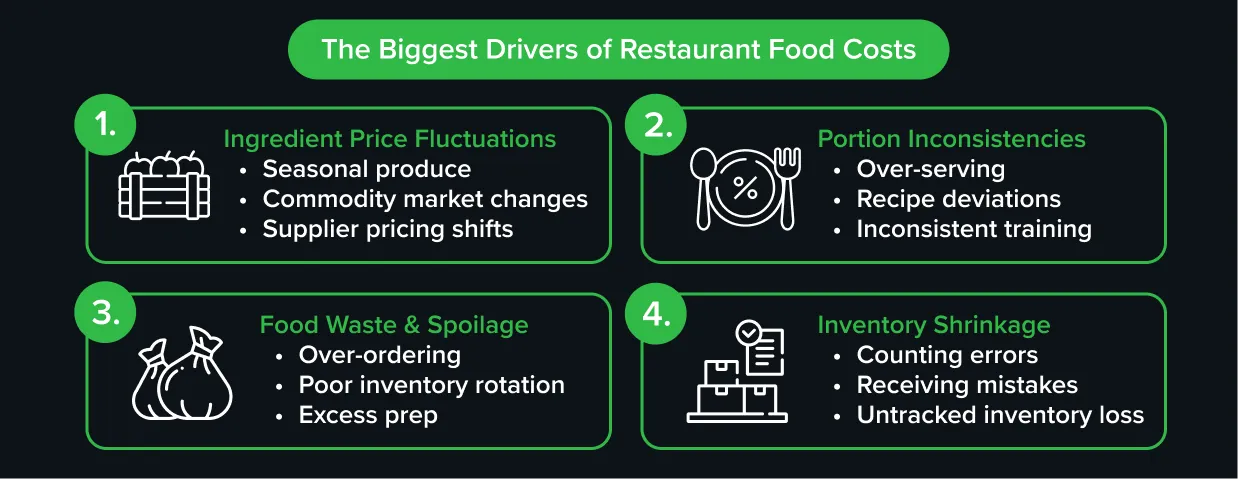
Ingredient Price Fluctuations
Some price increases are simply out of your control.
Produce is probably the best example. Heavy rain in one growing region, extreme heat in another, or transportation delays across the country can all change pricing almost overnight. Commodities like beef, poultry, dairy, cooking oils, and grains are just as unpredictable. Markets move, supply changes, and restaurants feel the impact.
That doesn’t mean operators have to play defense all the time.
The restaurants that manage food costs well keep a close eye on produce markets, commodity trends, and supplier communication. When they know what’s happening, they have time to adjust purchasing plans, evaluate seasonal alternatives, or shift menu features before higher costs start eating into margins.
Having access to market insights also makes conversations with suppliers much more productive. You’re making purchasing decisions based on what’s happening in the market, not just reacting after invoices arrive.
Portion Inconsistencies
Here’s a simple example.
If one cook serves a six-ounce chicken breast and another serves seven ounces, most guests won’t notice.
Your food cost will.
Now imagine that happening hundreds of times a week across multiple restaurants.
Recipe cards, portion tools, and regular kitchen training aren’t about making life harder for the staff. They’re there to protect consistency. Guests receive the same meal no matter which location they visit, and operators avoid paying for product that’s leaving the kitchen without generating additional revenue.
Food Waste and Spoilage
Every restaurant throws food away.
The goal is making sure it’s as little as possible.
Maybe prep levels were too aggressive before a slow weekend. Maybe produce wasn’t rotated correctly. Maybe inventory was ordered based on last month’s sales instead of this week’s forecast.
Whatever the reason, food that ends up in the trash has already been paid for.
Looking at waste reports by location can uncover patterns that aren’t obvious during a busy shift. One restaurant may consistently over-order fresh ingredients. Another may have strong purchasing habits but struggle with prep waste. Once you know where the losses are happening, they’re much easier to address.
Inventory Shrinkage
Not every missing case of product is the result of theft.
Sometimes inventory is received incorrectly. Sometimes counts are rushed at the end of the night. Sometimes products are transferred between locations but never recorded.
The end result is the same.
Your inventory says one thing. Your shelves say something else.
That’s why consistent inventory procedures matter so much in a multi-unit operation. When every location follows the same counting process and inventory schedule, unusual variances become much easier to spot before they turn into larger financial problems.
How to Improve Purchasing Practices to Reduce Food Costs
Purchasing is one of the few areas where small improvements can create savings every single week.
The goal isn’t simply finding the cheapest supplier. It’s building a purchasing strategy that’s consistent, transparent, and scalable across every restaurant you operate.
Negotiate Better Supplier Pricing
Pricing conversations shouldn’t only happen when contracts expire.
Markets change throughout the year, and supplier relationships should evolve with them. Reviewing purchasing volumes, understanding market conditions, and regularly discussing pricing opportunities can uncover savings that might otherwise be overlooked.
It’s also worth looking beyond price alone.
Freight charges, order minimums, delivery schedules, rebates, and product substitutions all affect your total food costs. The lowest case price doesn’t always produce the lowest overall spend.
Consolidate Vendors
Working with dozens of suppliers can create unnecessary complexity.
Every additional vendor brings another ordering process, another invoice, another delivery schedule, and another opportunity for pricing inconsistencies.
That doesn’t mean every product should come from one supplier. It does mean reviewing your vendor mix on a regular basis to identify opportunities for consolidation.
Many multi-unit operators find that reducing the number of vendors improves purchasing visibility, simplifies inventory management, and gives them more leverage during supplier negotiations.
Leverage Group Purchasing Programs
Independent negotiations can only take purchasing power so far.
Group purchasing programs give restaurant operators access to pricing, supplier agreements, and rebate opportunities that would be difficult to secure on their own.
For multi-unit restaurants, the benefits often go beyond lower costs. Standardized supplier programs help create greater consistency across locations, making it easier to control purchasing, reduce off-contract buying, and improve visibility into overall spend.
That’s an important part of how to control food costs over the long term. Lower prices certainly help, but consistent purchasing habits usually have an even bigger impact on protecting margins across an entire restaurant portfolio.
Strategies to Control Food Costs Across Multiple Restaurant Locations
There’s no single fix for high food costs.
Restaurants that consistently perform well usually aren’t doing one thing better than everyone else. They’re doing a lot of small things well, every day, at every location.
That’s really the difference. Consistency.
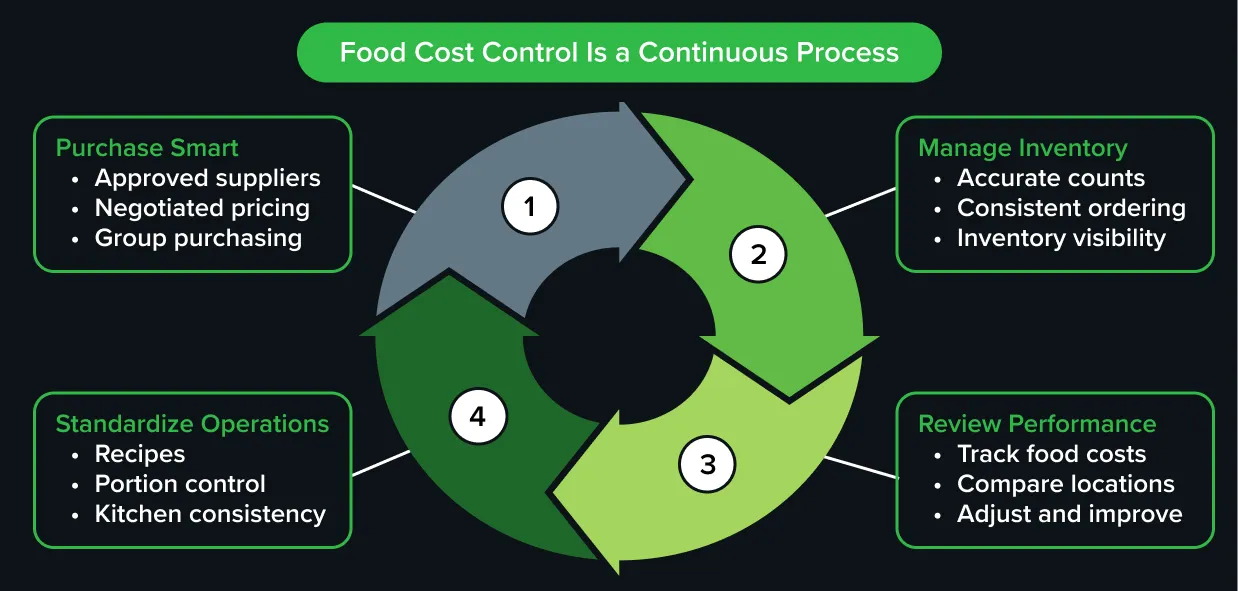
Strengthen Purchasing and Supplier Management
Purchasing works best when every location is pulling in the same direction.
If one restaurant follows approved supplier agreements while another regularly buys outside the program, it’s difficult to understand your true food costs. Even worse, you lose buying power every time spending becomes fragmented.
Review supplier performance regularly. Make sure locations understand approved purchasing processes. And don’t wait until there’s a pricing issue to evaluate vendor relationships.
The stronger those relationships become, the easier it is to navigate product shortages, commodity swings, and changing market conditions without scrambling to find solutions.
Improve Inventory Management Practices
Inventory counts aren’t anyone’s favorite task.
But they tell you a lot about what’s happening inside your restaurants.
If counts are rushed one week and detailed the next, your reports won’t tell a reliable story. The same goes for restaurants that count inventory on different days or use different procedures.
Consistency matters here, too.
Use the same counting process across every location, schedule counts at the same time each period, and investigate unusual variances while they’re still fresh. Small discrepancies are much easier to explain on Monday than they are three weeks later.
Standardize Operations to Reduce Food Cost Variance
You don’t want every restaurant to have its own version of a menu item.
Recipes should be followed the same way. Portion sizes should be consistent. Prep procedures should look familiar whether you’re visiting your newest location or your oldest one.
That doesn’t just improve the guest experience. It helps control purchasing, reduces waste, and makes food cost reports much easier to compare from one restaurant to another.
When every location operates differently, food cost variance becomes much harder to explain.
Reduce Food Waste Across Restaurant Locations
Waste usually leaves clues.
Maybe one restaurant consistently throws away fresh herbs. Another regularly over-preps proteins before slower weekdays. A third keeps ordering products that don’t move fast enough.
Those patterns are worth paying attention to.
Instead of looking at waste as one company-wide number, review it location by location. You’ll often find that one solution doesn’t fit every restaurant. Some teams need better forecasting. Others may need additional kitchen training or adjustments to ordering habits.
The sooner those trends are identified, the sooner they can be corrected.
Use Menu Engineering to Improve Food Cost Performance
Sometimes the easiest way to improve food costs isn’t buying differently. It’s selling differently.
Menu engineering helps operators understand which items guests love, which ones generate the strongest margins, and which menu items may be costing more than they’re contributing.
That doesn’t automatically mean removing lower-performing dishes.
It may mean adjusting portion sizes, changing ingredients, increasing prices, or simply giving higher-margin items more visibility on the menu. Small menu changes often have a bigger financial impact than operators expect.
How to Monitor and Improve Food Cost Performance
Managing food costs isn’t something you do once a quarter.
The operators with the strongest numbers are looking at performance consistently. They’re asking questions, comparing locations, and making adjustments before small issues become expensive habits.
Build Food Cost Reporting Dashboards
Good reports save time.
Great reports help you make decisions.
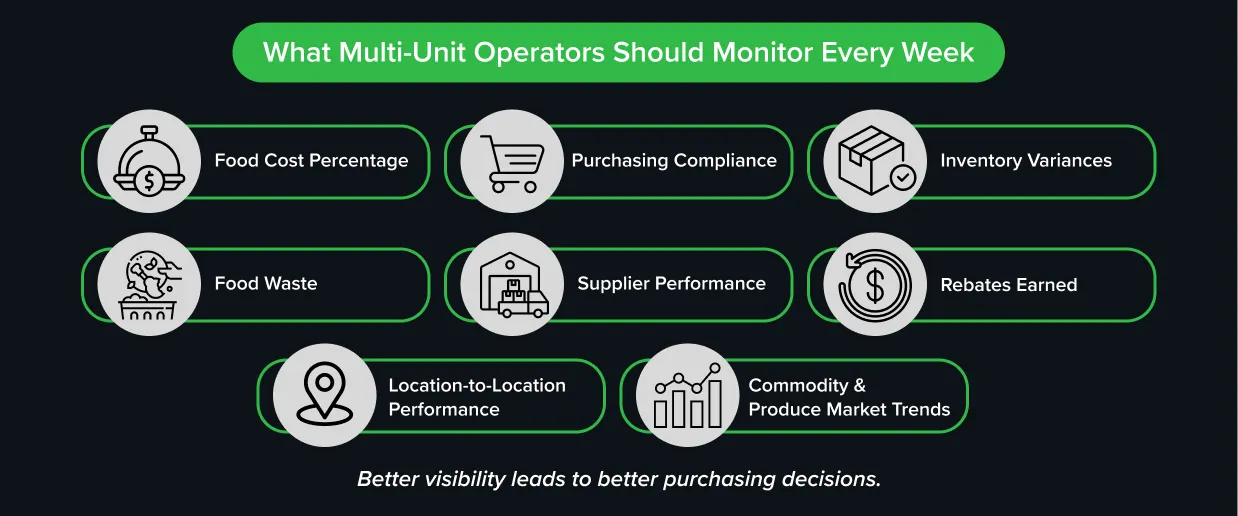
Instead of digging through spreadsheets from every location, create dashboards that pull together the numbers you care about most. Food cost percentage, purchasing trends, inventory variance, waste, rebates, and supplier performance all become much easier to monitor when they’re in one place.
The goal isn’t more data.
It’s clearer data.
Track Variances by Location
Company-wide averages can hide a lot.
If your overall food cost looks healthy, it’s easy to assume everything is running smoothly. Meanwhile, two or three restaurants could be struggling without anyone noticing.
Looking at each location individually helps those issues surface much faster.
Maybe one restaurant has consistently higher produce costs. Another may have larger inventory adjustments every month. Finding those differences early gives operators a chance to solve the problem before it spreads.
Benchmark Restaurant Performance
The best benchmark is often your own operation.
Compare restaurants with similar menus, similar sales volumes, and similar service styles. Those comparisons usually tell you much more than a generic industry average ever could.
When one location consistently outperforms the rest, don’t just celebrate it.
Figure out what they’re doing differently, then look for ways to apply those best practices across the organization.
Create Continuous Improvement Plans
Food cost management isn’t about chasing perfection.
Markets change. Menus evolve. New managers come on board. Supplier pricing shifts throughout the year.
That’s why successful operators build regular reviews into their process instead of waiting for problems to appear.
Even small improvements made consistently can produce meaningful savings over time, especially when they’re repeated across every restaurant in your portfolio.
Final Thoughts
Learning how to control food costs across multiple restaurant locations isn’t about finding one magic solution.
It’s about creating better habits.
The restaurants that consistently protect margins usually have a few things in common. They build strong supplier relationships. They follow consistent purchasing practices. They pay attention to inventory. And they use data to understand what’s happening before food costs start moving in the wrong direction.
Those improvements may seem small on their own, but across multiple locations, they can make a measurable difference in profitability.
Ready to gain more control over food costs across every location?
Consolidated Concepts helps multi-unit restaurant operators strengthen purchasing strategies, improve supplier management, and uncover opportunities to reduce costs while creating greater consistency across every restaurant.
FAQs
What Is a Good Food Cost Percentage for a Restaurant?
There really isn’t one universal number that fits every restaurant.
A pizza concept is going to look different from a steakhouse, and a fast-casual brand with lots of fresh ingredients won’t have the same target as a limited-service concept built around a different menu mix.
For most multi-unit operators, the better question is whether similar locations are performing similarly. If two restaurants are running the same menu but one is carrying noticeably higher food costs, that’s usually where the real opportunity is.
How Do Restaurants Calculate Food Costs?
The basic formula is straightforward: take your cost of food sold, divide it by food sales, and multiply by 100.
What matters more is whether the numbers going into that formula are reliable. If inventory counts are inconsistent, invoices are late, or one location counts product differently than another, the final percentage won’t tell you much.
Accurate food cost reporting starts with consistent processes.
What Causes High Food Costs?
Usually, it’s not just one thing.
High food costs tend to come from a mix of issues happening at the same time — rising ingredient prices, over-portioning, spoilage, inaccurate inventory, supplier substitutions, or locations buying outside approved programs.
That’s what makes food cost issues so frustrating. On the surface, the percentage goes up, but the real problem often takes a little digging to uncover.
How Can Restaurants Reduce Food Waste?
The first step is figuring out where the waste is actually happening.
In some restaurants, it comes from over-ordering. In others, it’s poor rotation, over-prepping, or products that just aren’t moving fast enough. Once you can see the pattern, it becomes much easier to fix.
Better forecasting, tighter prep habits, and more consistency in inventory practices usually make a big difference.
How Does Menu Engineering Improve Food Cost Control?
Menu engineering helps you look beyond what sells and pay closer attention to what actually contributes to margin.
Sometimes a popular item is doing exactly what you want it to do. Other times, it’s more expensive than it should be and quietly dragging down performance. Looking at profitability and popularity together helps operators decide whether to adjust pricing, change ingredients, refine portion sizes, or spotlight stronger-margin items a little more strategically.
Small changes on the menu can have a bigger impact than most people expect.
How Often Should Food Costs Be Reviewed?
For most operators, food costs should be reviewed every week at a minimum.
That said, many of the strongest teams keep an eye on purchasing, inventory, and variance trends throughout the week, especially across multiple locations. The sooner something looks off, the easier it is to address before it turns into a bigger margin problem.
Regular review is what helps food cost control stay proactive instead of reactive.