Is buying foods in bulk actually saving your multi-unit restaurant money—or quietly creating waste, storage headaches, and hidden costs across every location?
If you run more than one restaurant, you’ve probably had this conversation with yourself at least once: “Should we just buy this stuff in bulk?” Maybe it was a pallet of canned tomatoes. Maybe it was a deal on frozen chicken breasts that seemed too good to pass up.
When you run a multi-unit restaurant group, saving a dollar or two on a case of canola oil or chicken breast isn’t just nice; it compounds fast. Multiply those savings across five, fifteen, or fifty locations, and suddenly your prime costs look a whole lot healthier.
That’s why buying foods in bulk is a core strategy for growing operators. But here’s the catch: purchasing at volume isn’t as simple as loading up the walk-in and calling it a day. Without a clear game plan, bulk buying can quickly turn into tied-up cash flow, crowded storage rooms, and food waste that wipes out your paper savings.
Here is what multi-unit restaurant operators need to know about making bulk food purchasing work across every store.
How Bulk Buying Works for Multi-Unit Restaurants
Buying foods in bulk in a multi-location setup isn’t just about ordering extra cases. It requires a synchronized system where store-level usage feeds into a master purchasing plan. For a multi-unit group, it means combining the usage of every location into one bigger order, which usually unlocks better pricing tiers from your distributor.
Reading your menu and usage
The first step is understanding what your restaurants actually use. Pull actual consumption data from your POS and inventory tracking systems instead of relying on gut feelings. Look at your velocity report. Which core ingredients appear across multiple menu items or locations? If three of your concepts or location formats use the same diced tomatoes or blended fry oil, those high-turnover items are your prime candidates for volume purchasing.
Looking at ingredient overlap can also uncover opportunities beyond bulk buying. Existing SKUs can often be used in new ways across the menu, giving guests more variety without adding unnecessary inventory or complexity. 3 Strategic Ways Multi-Unit Restaurants Can Reduce Menu Fatigue explores how operators can refresh their menus by getting more creative with ingredients they already purchase.
The goal is to identify products with predictable usage across locations so you can buy at higher volumes without taking on unnecessary risk.
Placing volume orders
Distributors reward consistency and scale. Once you’ve identified the items to buy in bulk, it’s time to place your order. When you order high case counts or aggregate your purchases across multiple units to meet higher drop-size minimums, distributors save money on freight and handling—and they pass part of that savings on to you. Setting up volume-based contracts or tiered pricing agreements ensures that every location benefits from the collective purchasing power of the entire brand. Make sure to talk to your suppliers about lead times, minimums, and flexibility.
Storing and rotating stock
Buying foods in bulk only pays off if the product actually makes it onto the customer’s plate. That means strict First-In, First-Out (FIFO) inventory management is non-negotiable. Walk-in coolers and dry storage shelves need clear labeling, accessible layout design, and strict date-tracking so team members always use older inventory first. If you’ve got multiple locations, make sure these storage and rotation rules are standardized everywhere.
Where Bulk Buying Costs More Than It Saves
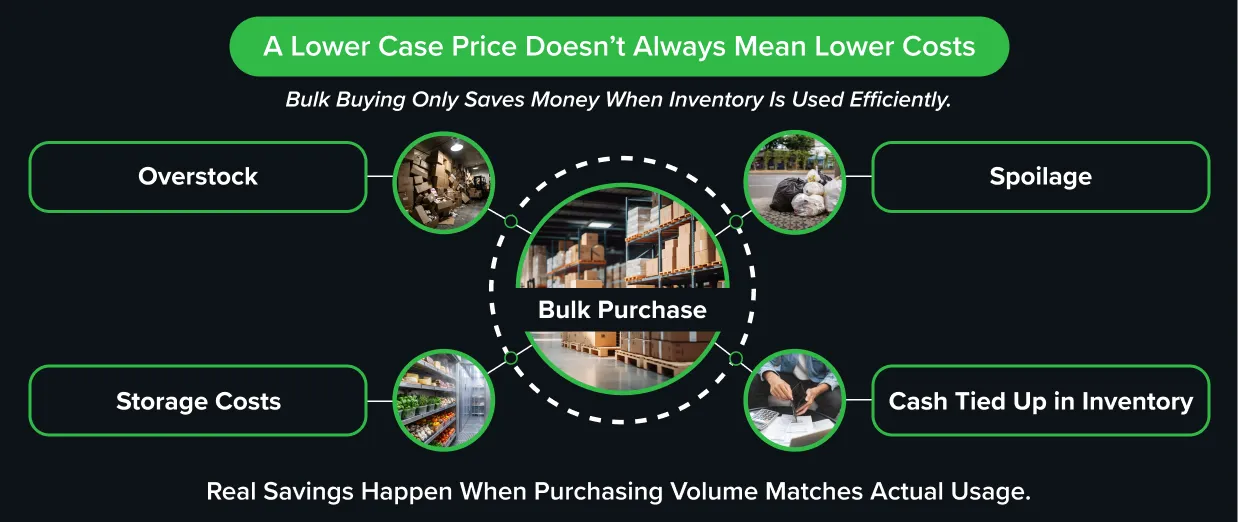
It is easy to get blinded by a great case price. But if buying in bulk creates operational friction, those upfront savings vanish real fast. Bulk buying is only cheaper when the math actually works out after you account for spoilage, storage, and how consistently your locations are ordering.
Over-purchasing and spoilage
Cash sitting on a shelf isn’t helping your business. Worse, if that inventory spoils, expires, or goes stale before you can use it, you didn’t save 15%—you lost 100% of that purchase price. Over-purchasing perishable items or slow-moving specialty goods is one of the quickest ways to erode your food margins. Even dry goods have a shelf life: flour goes rancid, oil goes bad, and spices lose potency.
Running out of storage space
Bulk orders take up real square footage, and most restaurant kitchens weren’t designed with pallet storage in mind. If your store managers are stacking boxes of paper goods in hallways or jamming dry storage to the ceiling, you have a problem. Overcrowded storage leads to damaged packaging, safety hazards, longer prep times because line cooks can’t find ingredients, and improper airflow in walk-in coolers (which raises temperatures and spoils food faster).
Buying the wrong items in bulk
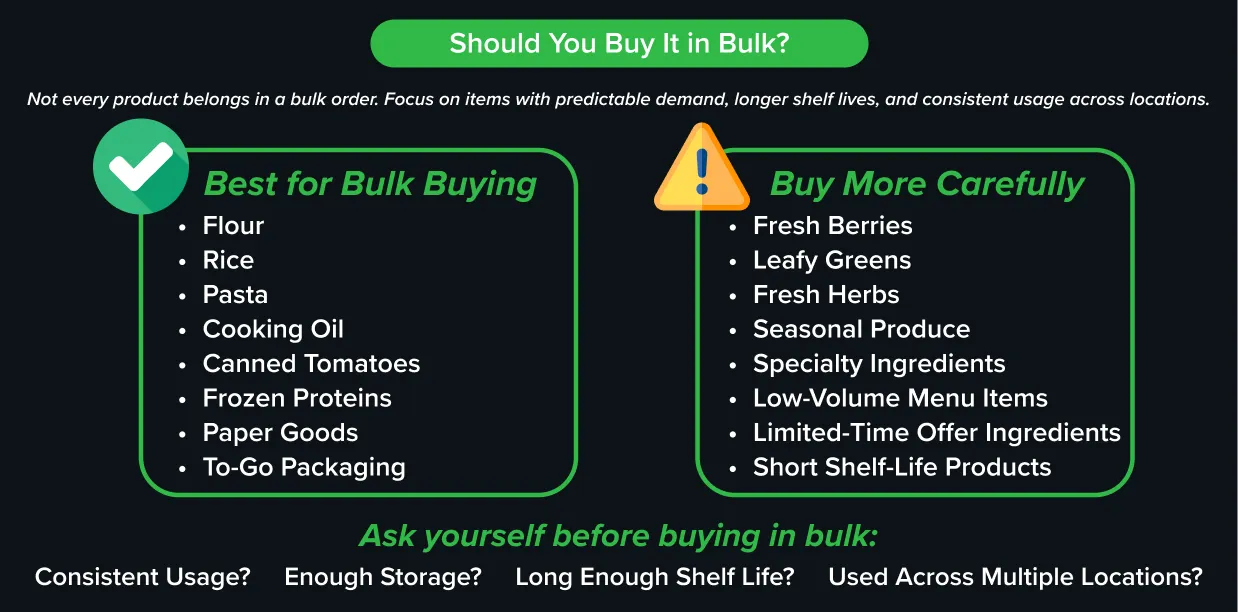
Not every ingredient belongs in a bulk contract. Seasonal produce, specialty items with short shelf lives, or ingredients used in only one low-selling menu item should generally be bought as needed. Bulk buying should be reserved for high-velocity, shelf-stable, or heavily utilized core products.
Inconsistent ordering across locations
When General Manager A buys Brand X olive oil from Distributor 1, and General Manager B orders Brand Y olive oil from Distributor 2, your total volume gets fractured. Different pack sizes, off-contract items, and substitute brands can all weaken your buying power. You end up paying tier-one prices at both stores because neither location generates enough individual volume to hit better pricing thresholds, making true usage tracking nearly impossible.
Which Foods Are Worth Buying in Bulk
To maximize your margin potential without bloating your inventory, focus your bulk purchasing efforts on categories with predictable usage and manageable shelf life.
Dry and pantry staples
These are your safest bets for volume purchasing. Products like flour, sugar, rice, dried pasta, cooking oils, canned tomato products, and dried spices have long shelf lives and predictable usage rates. As long as your dry storage is clean, temperature-controlled, and pest-free, these items can sit safely while you work through inventory.
Produce and proteins
Bulk buying in these categories requires tighter operational execution, but the payoff can be huge. For proteins, buying whole subprimals or bulk-frozen vacuum-sealed meat and seafood often yields substantial savings over portion-cut alternatives if you have adequate freezer space and a system for portioning and using them on schedule. For produce, stick to heavy, high-velocity items with longer shelf lives—like potatoes, onions, and citrus—unless you operate a centralized commissary kitchen that can process bulk produce immediately.
Paper, packaging, and to-go supplies
Takeout containers, cups, napkins, bags, and disposable cutlery carry zero spoilage risk and usage tends to be extremely predictable. Since these supplies take up considerable physical space, negotiating scheduled drop-ship deliveries or holding agreements with your distributor lets you lock in volume pricing on packaging without turning your back-of-house into a warehouse.
How Smart Bulk Buying Improves Margins
Margin growth in the restaurant industry comes down to incremental gains. Shaving a few percentage points off your center-of-plate proteins or packaging through volume discounts directly drops to your bottom line.
Smart bulk buying also protects your margins against inflation and market volatility. Locking in contract pricing on bulk commodities stabilizes your food cost percentage, making cash flow far more predictable across all your units. It reduces order frequency, minimizes stockouts, and gives your team more predictability—turning purchasing from a cost center into a quiet profit driver.
How to Build a Bulk Purchasing Strategy Across Locations
Moving from reactionary ordering to a disciplined bulk purchasing strategy takes structure and the right tools.
Check consumption before you order
Analyze your consumption patterns across locations to determine which items to buy in bulk and how much to order. Base your orders on historical sales data and real usage numbers rather than gut feel, ensuring you never stack fresh bulk orders on top of existing surplus stock.
Standardize storage and rotation
Create uniform back-of-house organization rules for all locations. Every unit should organize dry storage and walk-ins using the exact same layout principles, dunnage rack placements, and FIFO rotation protocols. This makes store audits faster and helps cross-trained staff operate smoothly at any location.
Know what to negotiate with suppliers
Case cost isn’t the only metric that matters. When negotiating bulk deals with distributors and manufacturers, look at the full picture: volume tiers, drop-size incentives, fuel surcharges, payment terms, and delivery frequency. Knowing what levers you have to pull is the difference between accepting a quoted price and getting the deal your volume deserves.
Align ordering across units
Aligning ordering across units is crucial to maximizing the benefits of bulk buying. At Consolidated Concepts, we help our clients achieve this by providing expert guidance, shared ordering calendars, standardized par levels, synchronized delivery days, and centralized approval workflows. Instead of every unit doing its own thing, we help you streamline ordering processes, reduce waste, and ensure seamless coordination across locations so your brand realizes the maximum volume discounts you qualify for.
How GPO Helps Lower Bulk Food Costs
Partnering with a Group Purchasing Organization (GPO) like Consolidated Concepts gives you instant enterprise-level leverage to manage buying foods in bulk purchasing agreements across dozens of manufacturers and distributors.
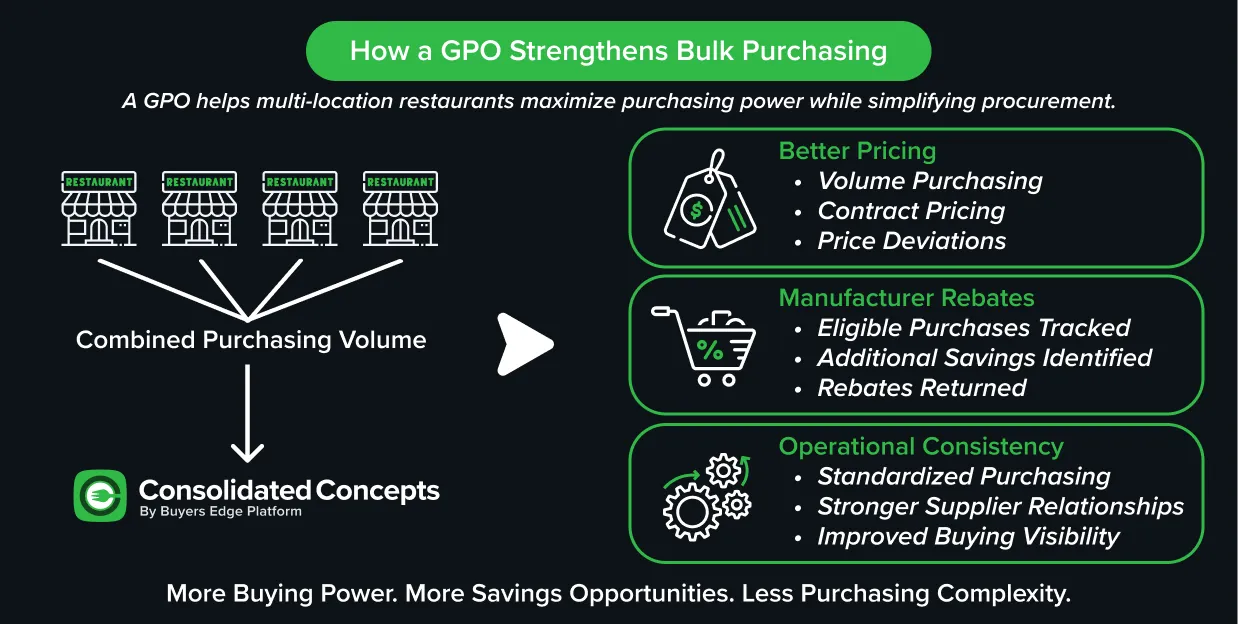
Better pricing through combined volume
By pooling our members’ purchasing power, we aggregate the buying power of thousands of restaurant locations. Even if your brand operates 10 or 20 units, buying through a GPO instantly gives you the negotiating leverage of a national multi-thousand-unit chain, securing wholesale case prices and distributor volume discounts you couldn’t reach on your own.
Access to rebates and contract savings
One of the biggest financial advantages of working with a GPO comes from manufacturer rebates and contract pricing.
- Rebates: Manufacturers offer cash-back incentives on qualifying products when purchasing thresholds are met. A GPO helps track eligible purchases across your locations so you can capture rebate dollars that might otherwise go unclaimed.
- Contract price deviations: A deviation is a negotiated price that is lower than a distributor’s standard list price. Instead of paying standard pricing, qualifying operators receive reduced pricing on eligible products directly on their distributor invoice.
For Consolidated Concepts members, those savings become much easier to access. Through rebate and deviation contracts with more than 350 foodservice manufacturers covering over 175,000 line items, members can unlock discounted pricing and manufacturer rebates across a wide range of products. Our team also reviews purchasing activity to help identify additional rebate and savings opportunities, making it easier to maximize the value of every order.
Stronger distributor relationships
When you leverage a GPO’s established distributor contracts, you aren’t just getting better prices—you get priority service. Distributors value GPO-aligned restaurant groups because the ordering patterns are predictable, contract compliance is high, and operational headaches are minimal. This helps secure better service, faster issue resolution, and dedicated support for our members.
Conclusion
Buying foods in bulk can be a valuable strategy for multi-location restaurants, but it requires careful planning, operational discipline, and execution. By following the guidelines outlined in this post, you can make the most of bulk buying and improve your restaurant’s profit margins.
If you are ready to stop leaving money on the table and want to unlock corporate-level bulk pricing across all your locations, Consolidated Concepts is here to help. Click here to contact our restaurant experts and learn how to analyze your current spend and see how much your locations can save.
FAQs
Is it cheaper to buy food in bulk for a restaurant?
Buying food in bulk can be cheaper for restaurants, but it depends on various factors, including the type of food, storage facilities, and usage patterns. It is only truly cheaper if your locations actually use the product before it spoils or gets damaged in storage.
What foods last longest in bulk storage?
Dry and pantry staples like rice, pasta, flour, sugar, dried beans, canned goods, and cooking oils tend to last longest in bulk storage due to their long shelf lives. Frozen meats and vacuum-sealed seafood also offer long shelf lives, while paper goods and packaging supplies are exceptional bulk items since they never spoil.
How much storage space do you need to buy in bulk?
The amount of storage space needed depends entirely on your delivery schedule, packaging format, and usage velocity. Always measure your usable shelving and storage space, leaving at least a 20% buffer for airflow and safety. Many multi-unit operators negotiate structured delivery schedules with distributors rather than requiring massive physical warehouses.
Does buying in bulk work for a small or single-location restaurant?
While buying foods in bulk can be beneficial for larger restaurant groups, single-location operators can still benefit on non-perishable goods and high-turnover staples, though they often lack the storage space and volume required to unlock top-tier discounts on their own. Joining a GPO allows smaller operations to access bulk pricing without having to physically hoard excess inventory.
How do restaurants get better bulk pricing from distributors?
Restaurants can get better bulk pricing by consolidating their SKU count, increasing drop sizes, standardizing order guides across all locations, communicating regularly with their reps, and leveraging the collective purchasing power of a Group Purchasing Organization like Consolidated Concepts to negotiate direct manufacturer rebates and contract price deviations.