
Food purchasing becomes significantly more complicated when a restaurant grows from one location to five, 25, or 100. What once involved a manageable list of products and a few supplier relationships can quickly turn into a web of contracts, distributors, invoices, delivery schedules, substitutions, and location-level pricing differences.
For multi-unit restaurant operators, an effective food purchasing strategy must do more than secure products at an acceptable price. It needs to support consistency across locations, protect product quality, simplify operations, and give leadership a clear view of where every purchasing dollar is going.
That is not always easy. Ingredient prices move. Supplier performance varies by market. Individual locations develop their own ordering habits. A product approved for one recipe may be substituted without anyone at the corporate level realizing it.
A more strategic approach to food purchasing can help operators uncover savings, strengthen supplier relationships, and create standards that support the entire organization.
What Is Food Purchasing for Multi-Unit Restaurants?
Food purchasing is the process of sourcing, negotiating, ordering, receiving, and monitoring the food and beverage products a restaurant needs to operate. In a multi-unit organization, it also includes coordinating those activities across locations, suppliers, distribution centers, and markets.
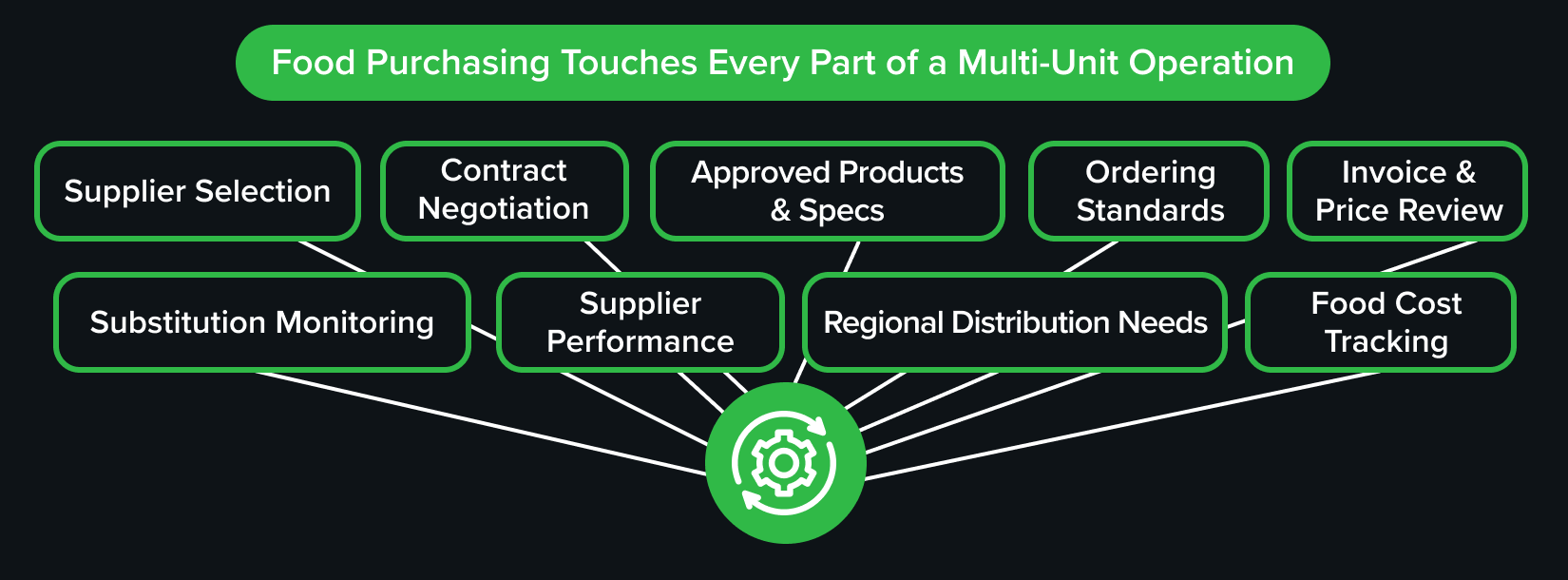
The process may cover:
- Selecting suppliers and distributors
- Negotiating prices and contract terms
- Establishing approved products and specifications
- Creating purchasing and ordering standards
- Monitoring product substitutions
- Reviewing invoices and pricing
- Measuring supplier performance
- Tracking food costs and purchasing savings
- Managing regional availability and delivery requirements
A strong food purchasing program connects these responsibilities instead of treating them as separate tasks. Sourcing decisions affect menu consistency. Product specifications affect recipe costs. Contract terms affect invoice pricing. Supplier performance affects whether locations receive the products they need on time.
When those connections are managed strategically, food purchasing becomes more than a back-office responsibility. It becomes a tool for protecting margins and supporting growth.
Food Purchasing Challenges Facing Multi-Unit Restaurants
Every restaurant deals with fluctuating costs and supplier issues. Multi-unit operations face the added challenge of managing those pressures across different locations, menus, markets, and distribution networks.
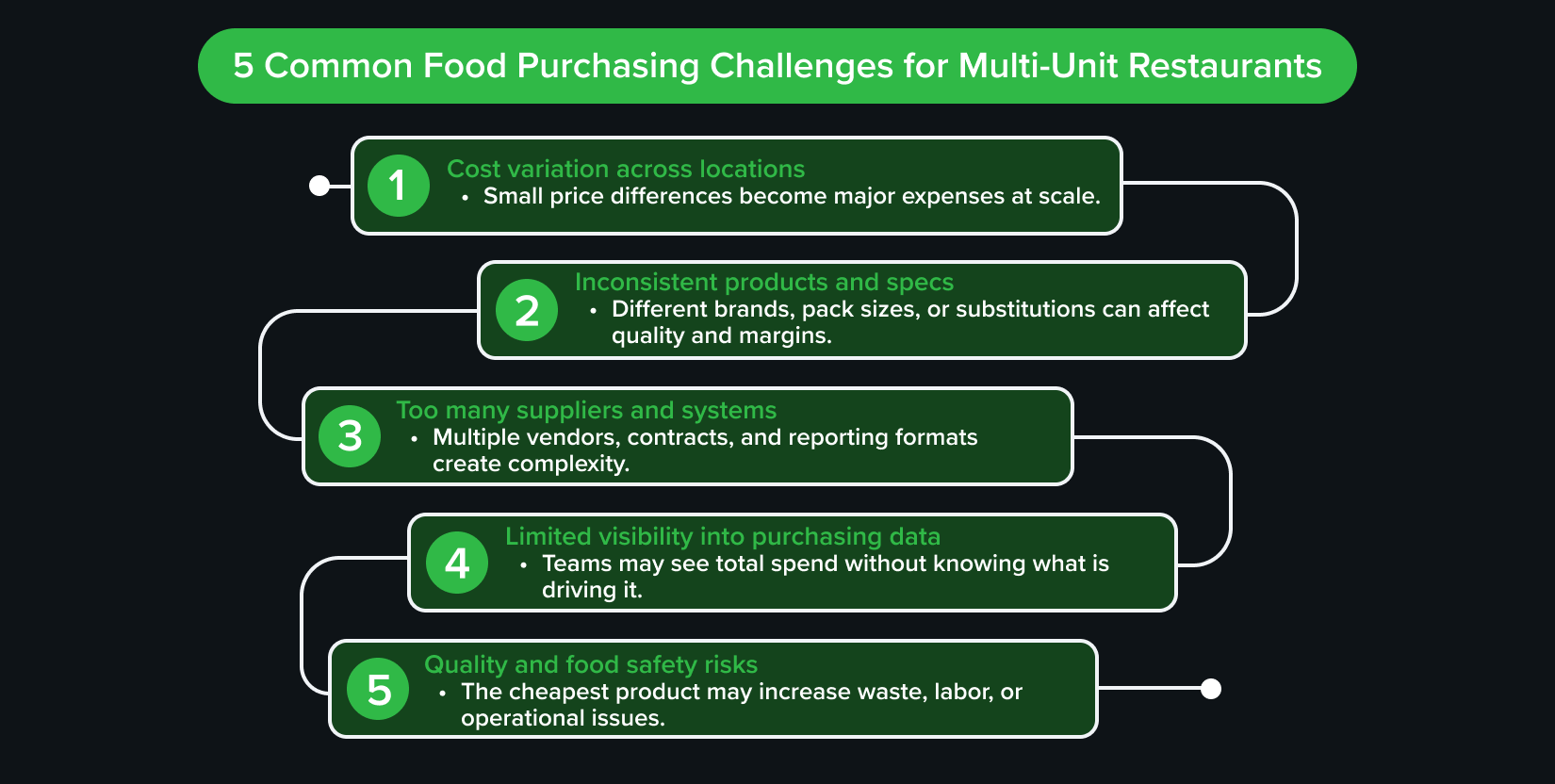
Managing Food Costs Across Multiple Locations
Food costs can vary considerably between restaurant locations. Freight, regional availability, distributor markups, order volume, and local supplier relationships can all affect what an operator pays for the same or similar products.
Even small differences matter at scale. A location paying a few cents more per case may not raise an immediate concern, but that variance can become a meaningful expense when it is repeated across hundreds of products, orders, and locations.
Operators need a reliable way to compare purchases, identify unusual price changes, and understand whether higher costs are caused by the market, the distributor, a product substitution, or a breakdown in contract pricing.
Maintaining Consistent Pricing and Product Specifications
Consistency is one of the biggest priorities for a multi-unit restaurant brand. Guests expect a menu item to look and taste the same regardless of which location they visit.
That consistency begins with food purchasing. If locations order different brands, pack sizes, grades, or formulations, recipe costs and guest experiences can change. An unapproved substitution might appear harmless, but it can affect flavor, portion yield, preparation time, allergen information, and profitability.
Clear product specifications and an approved item list help locations purchase the correct products. Operators must also monitor actual purchasing activity to make sure those standards are being followed.
Managing Multiple Suppliers and Distribution Partners
A growing restaurant organization may work with broadline distributors, specialty suppliers, produce companies, local vendors, and manufacturers. Different regions may require different distribution relationships based on product availability or delivery coverage.
Managing those relationships takes time. Each partner may have its own pricing structure, contract terms, reporting format, ordering system, and service expectations.
Without a coordinated food purchasing strategy, operators can end up with overlapping supplier agreements, inconsistent pricing, missed contract opportunities, or products being purchased outside approved programs.
Limited Visibility Into Purchasing and Price Differences
Restaurant operators often have plenty of purchasing data. The problem is turning that information into something useful.
Invoices, credits, order histories, contract files, and distributor reports may live in different systems. Leadership might see total food costs without being able to determine which products, locations, or suppliers are driving an increase.
Limited visibility also makes it harder to spot:
- Incorrect pricing
- Off-contract purchases
- Unapproved substitutions
- Unusual price differences between locations
- Missed credits
- Changes in purchasing volume
- Underperforming supplier agreements
Accurate, consolidated purchasing data gives operators a clearer picture of what is happening throughout the organization.
Maintaining Product Quality and Food Safety
The lowest-priced product is not necessarily the right product. Food purchasing decisions must account for quality, food safety, consistency, availability, and the effect a product will have on restaurant operations.
A lower-cost ingredient may create more waste, require additional preparation, deliver fewer usable portions, or fail to meet the restaurant’s standards. Those hidden costs can erase the savings listed on an invoice.
Operators also need processes for reviewing supplier qualifications, tracing products, managing recalls, monitoring substitutions, and confirming that food safety requirements are being met throughout the supply chain.
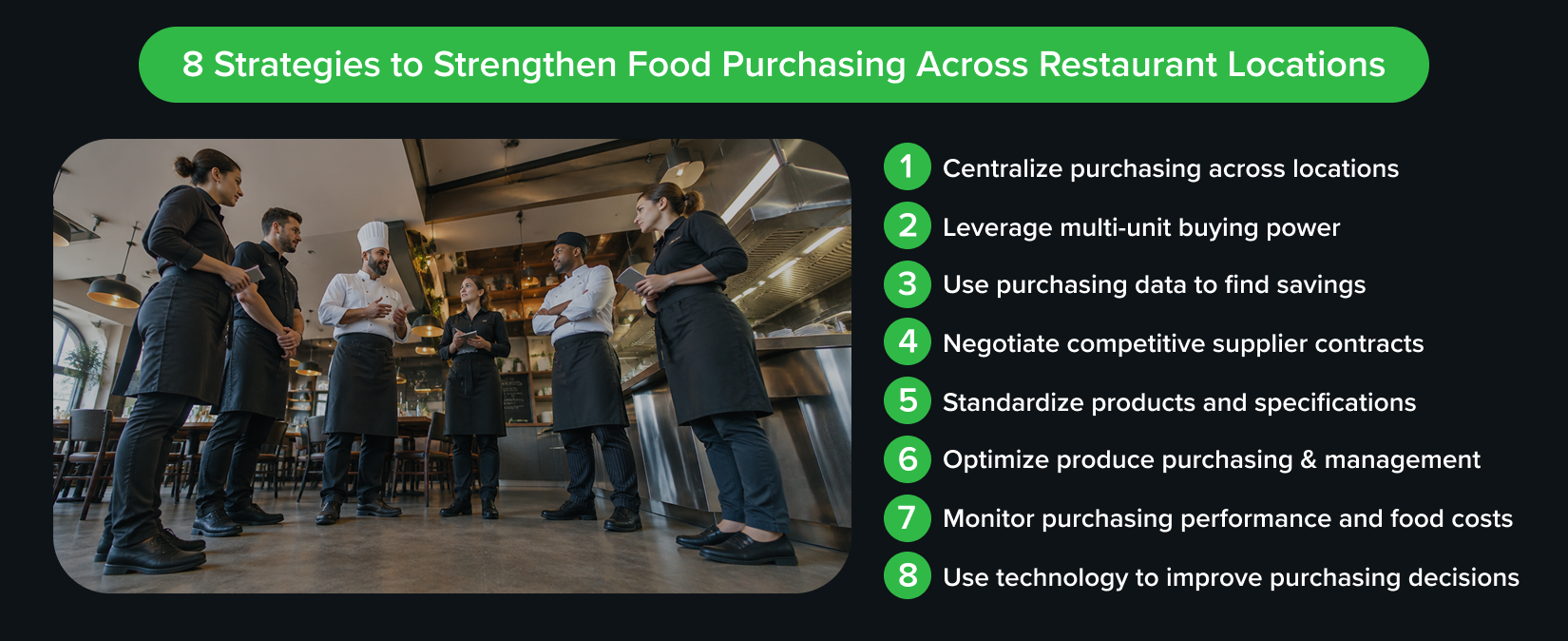
8 Food Purchasing Strategies for Multi-Unit Restaurants
A successful strategy creates enough structure to control costs without making it difficult for restaurant teams to get the products they need. These eight food purchasing strategies can help multi-unit operators bring greater control and visibility to the process.
Centralize Purchasing Across Restaurant Locations
Centralizing food purchasing does not mean every decision must be made by one person. It means creating shared standards, approved suppliers, defined responsibilities, and a consistent process across the organization.
Restaurant leaders can establish which products locations should purchase, which suppliers they should use, and when exceptions are allowed. This reduces unnecessary variation while still giving regional and location teams a clear path for addressing local needs.
Centralization also gives the organization a more complete view of its total purchasing activity. That makes it easier to evaluate suppliers, negotiate agreements, and measure results.
Leverage Multi-Unit Buying Power
Multi-unit restaurants purchase a larger volume of products than individual locations do on their own. Combining that volume can create stronger negotiating leverage with manufacturers, distributors, and other suppliers.
The first step is understanding the organization’s true purchasing volume. Similar products may be listed under different descriptions, item numbers, or pack sizes, which can make total demand difficult to calculate.
Once purchasing data is organized, operators can identify opportunities to consolidate volume, reduce unnecessary product duplication, and pursue pricing or program benefits that reflect their overall scale.
Use Purchasing Data to Identify Cost-Saving Opportunities
Food purchasing data can reveal savings opportunities that are difficult to see on an individual invoice.
Operators can use their data to compare prices between locations, review purchasing patterns, identify high-cost categories, and determine where teams are buying outside approved programs. It may also reveal products that have experienced gradual price increases without receiving much attention.
The goal is not simply to collect more data. It is to identify the information that deserves action. A useful analysis should help an operator answer questions such as:
- Which categories account for the most spending?
- Where are prices increasing fastest?
- Are locations purchasing approved products?
- Are contract prices reaching restaurant invoices?
- Which items are being substituted most often?
- Where could product volume be consolidated?
Negotiate Competitive Supplier Contracts
A strong supplier contract should clearly define more than the base price of a product. Operators should review freight, delivery requirements, service fees, payment terms, substitutions, price-change procedures, volume commitments, and reporting expectations.
Before entering negotiations, restaurants need a clear understanding of their purchasing history and future needs. Accurate volume, item, and market data create a much stronger negotiating position than estimates.
Contracts also need to be monitored after they are signed. A negotiated price only creates value if it is accurately applied to purchases.
Standardize Products and Specifications
Product standardization helps multi-unit restaurants control costs and protect the guest experience.
Each approved item should have a clear specification that may include its brand, manufacturer, grade, formulation, pack size, portion size, and acceptable substitute. The right level of detail will depend on how the product is used and how much variation the operation can reasonably accept.
Standardization can also reduce the number of similar products being purchased throughout the organization. Consolidating those items may simplify inventory, strengthen buying power, and make it easier for restaurant teams to follow approved purchasing practices.
Optimize Produce Purchasing and Management
Produce presents a unique food purchasing challenge. Quality, yield, seasonality, weather, growing regions, and local availability can all affect price and performance.
A well-managed produce program should consider more than the delivered case price. Operators should evaluate usable yield, shelf life, product condition, delivery frequency, quality specifications, and rejection rates.
Clear specifications are especially important. Terms such as “large” or “premium” may not provide enough direction on their own. More precise requirements help suppliers understand expectations and give restaurant teams a consistent standard for receiving products.
Multi-unit operators can also benefit from monitoring seasonal availability and evaluating alternate growing regions or approved substitutes before a shortage occurs.
Monitor Purchasing Performance and Food Costs
Food purchasing performance should be reviewed regularly, not only when food costs rise beyond expectations.
A routine review can help operators determine whether locations are following purchasing standards, suppliers are meeting their commitments, and negotiated programs are delivering the expected value.
When a metric changes, the next question should be why. A higher food cost percentage might be tied to ingredient inflation, waste, portioning, menu mix, pricing, theft, or off-contract purchasing. Looking at purchasing performance alongside operational data provides a more complete explanation.
Use Technology to Improve Purchasing Decisions
Technology can help operators consolidate data from multiple locations, distributors, and suppliers into a more useful view.
Instead of manually comparing spreadsheets and invoices, restaurant teams can use purchasing and supply chain technology to identify price discrepancies, track contract compliance, monitor item usage, and evaluate supplier performance.
Technology does not replace the need for an experienced purchasing team. It gives that team better information and more time to focus on sourcing, negotiations, supplier relationships, and operational improvements.
How to Build an Effective Food Purchasing Strategy
An effective food purchasing strategy begins with understanding the current operation. From there, restaurant leaders can prioritize opportunities, establish standards, and create a process for measuring results.
Assess Current Purchasing Spend
Start by gathering purchasing data from every restaurant location, supplier, and distributor. The analysis should include products, quantities, prices, pack sizes, suppliers, locations, and purchasing dates.
This process establishes a baseline. It shows what the organization is buying, how much it is spending, and where purchasing activity is concentrated.
The data may require cleanup before it can be analyzed. The same ingredient might appear under different supplier descriptions or item numbers, so products may need to be matched and grouped into consistent categories.
Analyze Suppliers and Food Categories
Next, review spending by supplier and category. Look at both the size of the spend and the operational importance of the product.
High-volume categories may offer the most visible savings opportunities, but smaller categories should not automatically be ignored. A specialized ingredient, frequently substituted item, or unreliable supplier can create problems that extend beyond its total dollar value.
The analysis should consider price, service, quality, availability, delivery performance, and the number of suppliers providing similar products.
Identify Pricing and Sourcing Opportunities
Once the purchasing picture is clear, operators can identify practical opportunities for improvement.
These may include:
- Consolidating similar products
- Combining volume across locations
- Moving purchases onto existing contracts
- Correcting price discrepancies
- Renegotiating supplier terms
- Evaluating alternate suppliers
- Reducing unnecessary substitutions
- Adjusting product specifications
- Pursuing available rebates or purchasing programs
Each opportunity should be evaluated for its financial and operational impact. A change that looks attractive on paper may not be worthwhile if it creates new labor, quality, or supply challenges.
Establish Purchasing Standards
Document the rules that restaurant locations and purchasing teams should follow. These standards may cover approved suppliers, approved products, ordering schedules, substitutions, receiving procedures, invoice review, and exception management.
The process should be detailed enough to create consistency but practical enough for restaurant teams to follow during a busy shift.
Operators should also define who has the authority to approve new products, suppliers, or exceptions. Without clear ownership, temporary workarounds have a way of becoming permanent purchasing habits.
Set Performance Metrics
Select metrics that connect purchasing activity to the organization’s goals. If the priority is improving contract compliance, measure the percentage of eligible purchases made through approved agreements. If reducing cost variation is the goal, track purchase price variance by item and location.
Avoid measuring everything simply because the data is available. A focused set of metrics is more likely to lead to action.
Measure Results and Continuously Improve
Food purchasing strategies need to evolve as the restaurant organization grows, menus change, and market conditions shift.
Review performance regularly and investigate unexpected results. Speak with restaurant teams about product quality, ordering challenges, and supplier service. Their experience can explain issues that are not immediately visible in purchasing reports.
When changes are made, compare performance against the original baseline. This helps leadership demonstrate what worked, identify what needs further attention, and decide where to focus next.
Key Metrics for Multi-Unit Restaurant Purchasing
The right metrics give operators an early indication of where food purchasing performance is improving and where costs may be slipping.
Purchasing Spend
Purchasing spend tracks the total amount spent over a defined period. It can be reviewed by location, supplier, category, product, or region.
A change in spending is not automatically good or bad. Operators should compare it with sales, product volume, menu changes, new restaurant openings, and market conditions to understand what is driving the difference.
Purchase Price Variance
Purchase price variance measures the difference between the expected price of a product and the amount actually paid.
The expected price may be based on a contract, budget, prior period, market benchmark, or standard cost. Tracking this variance can help operators identify pricing errors, market increases, product substitutions, and differences between locations.
Supplier Performance
Supplier performance measures how reliably each supplier meets the restaurant’s expectations.
Common factors include:
- On-time delivery
- Order accuracy
- Product availability
- Fill rates
- Product quality
- Credit resolution
- Substitution frequency
- Responsiveness
Price matters, but consistently poor service can create additional labor, waste, menu outages, and guest dissatisfaction.
Contract Compliance
Contract compliance measures whether purchases follow negotiated supplier and product agreements.
Operators can review whether locations are buying from approved suppliers, selecting contracted products, and receiving the correct contract prices. Low compliance may indicate a training issue, an availability problem, an incorrect price file, or an agreement that does not match the operation’s actual needs.
Purchasing Savings
Purchasing savings measure the financial effect of sourcing, negotiation, compliance, or product changes.
Savings should be defined clearly. Operators may track reductions against a previous price, an initial supplier proposal, a market benchmark, or a projected cost increase.
Documenting the method used prevents confusion and creates a more credible view of the value produced by the food purchasing program.
Food Cost Percentage
Food cost percentage compares the cost of food used with the food sales generated during the same period.
The formula is:
Food Cost Percentage = Cost of Food Used ÷ Food Sales × 100
This metric gives operators a high-level view of food cost performance, but it should not be used alone. Purchasing prices, waste, recipe execution, portion control, discounts, menu mix, and sales prices can all influence the result.
How Consolidated Concepts Helps Multi-Unit Restaurants Improve Food Purchasing
Multi-unit restaurant operators should not have to choose between controlling food costs and giving their teams the products they need to serve guests.
Consolidated Concepts helps restaurant groups bring greater visibility, consistency, and strategic control to food purchasing. Our team works with operators to understand their purchasing activity, identify cost-saving opportunities, and strengthen the processes behind sourcing and supplier management.
Depending on an organization’s needs, that support may include:
- Purchasing data analysis
- Strategic sourcing
- Contract and price review
- Distributor relationship management
- Produce program management
- Product and specification evaluation
- Price verification
- Supplier and category analysis
- Compliance monitoring
- Access to manufacturer programs and purchasing opportunities
There is no single food purchasing strategy that works for every restaurant group. A regional concept with ten locations faces different challenges than a national brand with hundreds of restaurants and several distribution partners.
That is why our approach begins with the operation itself. We help restaurant leaders understand what they are buying today, where unnecessary costs may be hiding, and which changes can create measurable value without disrupting the business.
FAQs
How Can Multi-Unit Restaurants Reduce Food Purchasing Costs
Multi-unit restaurants can reduce food purchasing costs by centralizing purchasing standards, consolidating product volume, negotiating supplier agreements, monitoring contract compliance, and using purchasing data to identify price discrepancies.
Operators should also evaluate product yield, quality, labor requirements, and waste. The product with the lowest case price may not deliver the lowest actual cost.
What Is Centralized Food Purchasing for Restaurants?
Centralized food purchasing is an approach in which a restaurant organization establishes shared suppliers, product specifications, contracts, and purchasing procedures for multiple locations.
Locations may still place their own orders, but those orders follow standards established at the organizational level. This creates more consistency and gives leadership a clearer view of total purchasing activity.
How Does Buying Power Affect Restaurant Food Purchasing?
Buying power can give restaurant organizations greater leverage when negotiating prices, service terms, manufacturer programs, and product availability.
Multi-unit operators can strengthen their buying power by combining purchasing volume across locations and reducing the number of similar products purchased from different suppliers. Suppliers can then evaluate the restaurant’s total business instead of viewing each location separately.
How Can Purchasing Data Help Restaurants Save Money?
Purchasing data can show restaurant operators where prices differ, which products account for the most spending, and whether locations are following approved contracts and specifications.
It can also reveal gradual price increases, unapproved substitutions, product duplication, and opportunities to consolidate volume. The more complete the data, the easier it becomes to prioritize opportunities that can make a meaningful financial difference.
How Should Restaurants Choose Food Suppliers?
Restaurants should evaluate food suppliers based on pricing, product quality, availability, service, delivery coverage, food safety practices, reporting capabilities, and their ability to support the organization as it grows.
References and product samples can be helpful, but operators should also define measurable service expectations. A supplier should be evaluated on its day-to-day performance after the agreement begins, not just on the strength of its original proposal.
What Should Restaurants Consider When Negotiating Supplier Contracts?
Restaurant operators should review product pricing, freight, fees, payment terms, volume commitments, delivery requirements, price-change procedures, substitutions, service expectations, data access, and dispute-resolution processes.
They should also determine how contract pricing will be verified. Even well-negotiated terms need ongoing monitoring to confirm that locations receive the expected value.
What Is the Role of Procurement in Restaurant Operations?
Procurement connects a restaurant’s operational needs with its suppliers and purchasing strategy. The function may include sourcing products, negotiating contracts, managing suppliers, establishing specifications, monitoring compliance, and analyzing purchasing performance.
An effective procurement team works closely with culinary, operations, finance, quality assurance, and supply chain teams. Its decisions affect food costs, menu execution, restaurant labor, product availability, and the guest experience.
How Can Restaurants Improve Produce Quality While Controlling Costs?
Restaurants can improve produce quality by establishing detailed specifications, monitoring supplier performance, reviewing seasonal availability, and evaluating usable yield rather than focusing only on case price.
Operators should track recurring quality issues, rejection rates, substitutions, and shelf life by location or supplier. Working with produce specialists can also help restaurant groups plan for seasonal changes and identify suitable alternatives when markets become volatile.