Restaurant operators spend a lot of time looking at percentages. Food cost is up. Labor is down. One location is right on target while another is suddenly several points off.
The tricky part is figuring out what those numbers are actually telling you.
Food cost and prime cost are two of the most important numbers to watch because they deal with the expenses at the heart of running a restaurant. They’re closely related, but they don’t measure the same thing. Food cost focuses on what you spend on the products you sell. Prime cost takes a wider view by combining those costs with labor.
For a single restaurant, understanding the difference can help uncover where margins are slipping. For multi-unit operators, it becomes even more important. A percentage that looks reasonable across the company can hide a very different story at the location level.
Overview
The simplest way to separate food cost from prime cost is this:
Food cost measures how much of your restaurant’s sales are being spent on food and ingredients. Prime cost combines your cost of goods sold (COGS) with your labor costs.
So, if you’re trying to understand whether ingredient costs are eating into margins, food cost is the number to watch. If you want a broader picture of the major controllable costs involved in running the restaurant, prime cost tells you more.
Both matter. They just answer different questions.
Food Cost vs. Prime Cost at a Glance
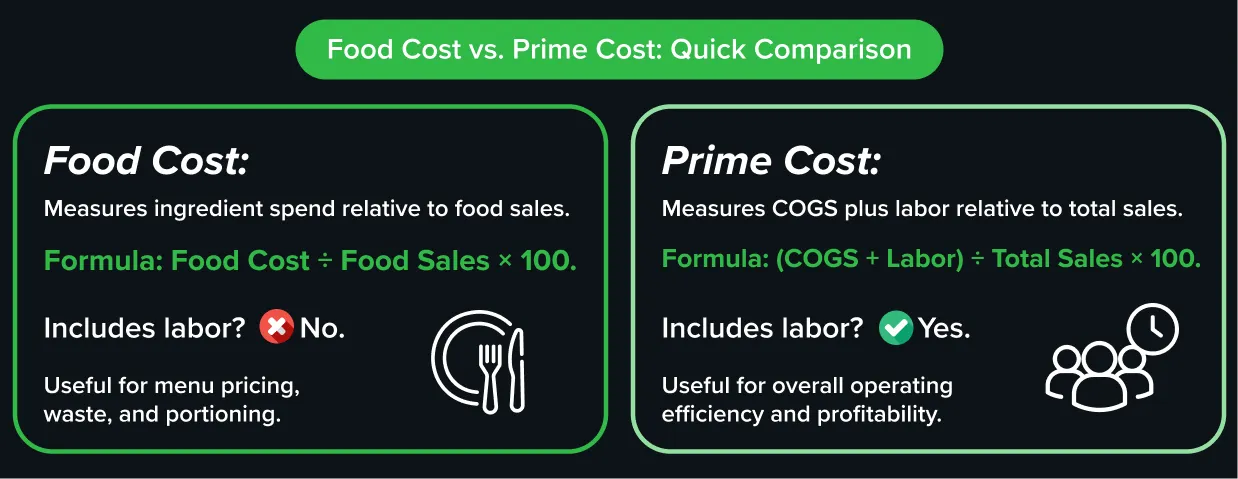
| Food Cost | Prime Cost | |
| What it measures | Cost of food and ingredients relative to food sales | COGS plus labor relative to total sales |
| Basic formula | Food Cost ÷ Food Sales × 100 | (COGS + Labor) ÷ Total Sales × 100 |
| Includes labor? | No | Yes |
| Useful for | Menu pricing, purchasing, portioning and waste control | Overall operating efficiency and profitability |
| Common problems it can reveal | Rising ingredient prices, waste, overportioning, purchasing issues | High labor, excessive overtime, scheduling problems, and rising COGS |
| How often to monitor it | At least weekly | At least weekly |
Looking at the two together is usually more useful than treating either number as a standalone score.
What Is Food Cost?
Food cost tells you how much a restaurant spends on food compared with the revenue generated from selling it.
It sounds straightforward, but the number is affected by quite a bit: supplier pricing, portion sizes, waste, spoilage, menu mix, theft, inventory practices, and even how consistently recipes are followed.
That’s why an increase in food cost doesn’t automatically mean your supplier raised prices. Maybe portions have gotten heavier at one location. Maybe too much product is being prepped and thrown away. And maybe an expensive menu item is suddenly selling much more often.
The percentage tells you something changed. The next job is figuring out what.
The Food Cost Formula
A common way to calculate food cost percentage is:
Food Cost Percentage = Cost of Food Sold ÷ Food Sales × 100
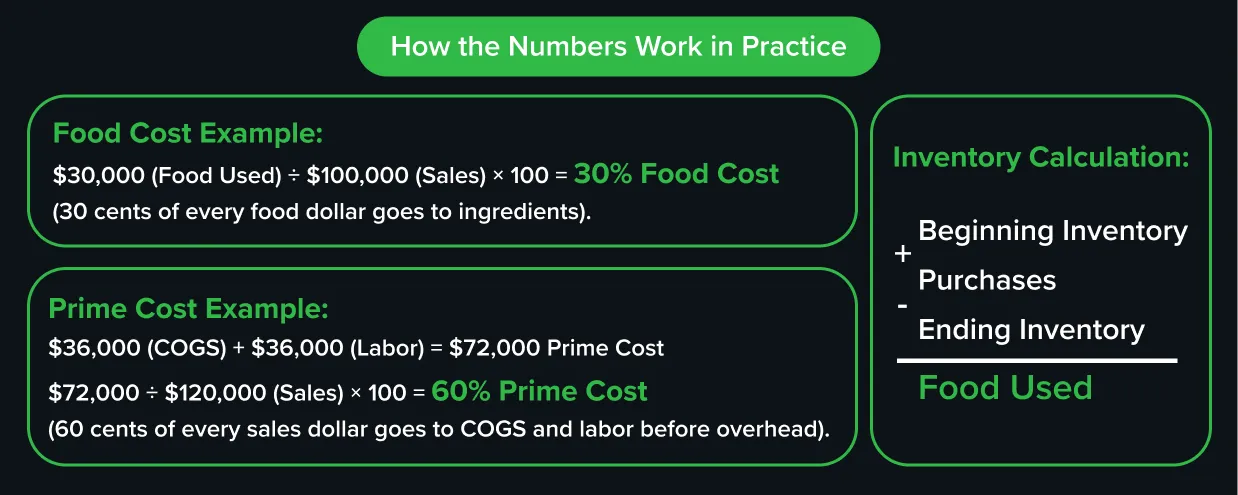
Say a restaurant has $100,000 in food sales for the month and the food used to generate those sales costs $30,000.
$30,000 ÷ $100,000 × 100 = 30% food cost
In this example, 30 cents of every dollar in food sales went toward the food itself.
When calculating actual food cost, operators typically determine the cost of food used during the period with inventory:
Beginning Inventory + Purchases – Ending Inventory = Food Used
Using actual inventory rather than simply looking at purchases gives you a better picture of what was really consumed during that period.
What Is Prime Cost?
Prime cost goes beyond ingredients.
It combines a restaurant’s cost of goods sold and labor costs, which are typically two of the largest operating expenses a restaurant can actively manage.
COGS may include food, beverages and other products sold to guests, depending on how the restaurant structures its accounting. Labor can include hourly wages, salaries, payroll taxes and employee benefits.
Because prime cost brings these expenses together, it can catch problems that food cost alone won’t show.
Imagine a location with a 29% food cost. On paper, that might look great. But if labor is running at 38%, the larger cost picture is much less comfortable.
That’s exactly why operators watch prime cost.
The Prime Cost Formula
The basic formula is:
Prime Cost = COGS + Total Labor Cost
To calculate it as a percentage of sales:
Prime Cost Percentage = (COGS + Labor) ÷ Total Sales × 100
For example, say a restaurant generates $120,000 in sales during the month.
Its costs are:
- $36,000 in COGS
- $36,000 in labor
Prime cost would be:
$36,000 + $36,000 = $72,000
Then:
$72,000 ÷ $120,000 × 100 = 60% prime cost
That means 60 cents of every sales dollar is going toward COGS and labor before the restaurant accounts for expenses such as rent, utilities, insurance, and other overhead.
What Is Included in Food Cost vs. Prime Cost?
This is where the terminology can get confusing.
Food cost is one component of COGS. It generally includes the ingredients used to prepare the food sold to guests.
Depending on the restaurant, COGS may be broader and include:
- Food
- Alcohol
- Nonalcoholic beverages
- Packaging or disposables directly tied to sales
- Other products sold to guests
Prime cost includes COGS plus labor.
Labor may include:
- Hourly wages
- Salaried restaurant employees
- Payroll taxes
- Employee benefits
- Overtime
- Other direct labor expenses
The exact accounting categories can vary by restaurant group. What matters most is consistency. If one location calculates labor or COGS differently from another, comparing prime cost across the group becomes much less useful.
How Food Cost and Prime Cost Are Connected
Food cost feeds into prime cost through COGS, which means changes on the food side can push prime cost higher even when labor stays exactly the same.
Suppose food cost rises two percentage points because beef prices increase. If nothing else changes, that increase is going to show up in prime cost too.
But the reverse isn’t necessarily true.
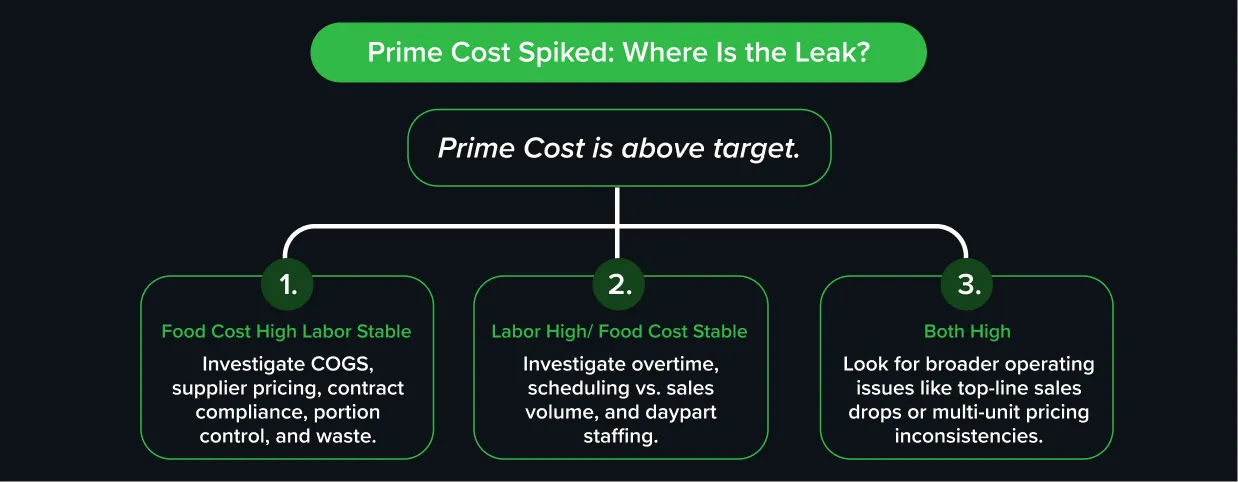
Prime cost can climb while food cost stays steady.
A location might be doing an excellent job managing purchasing, portions and waste while spending too much on overtime. Or sales may have softened while staffing levels remained the same.
This is why looking at prime cost without breaking it apart can send operators in the wrong direction.
If prime cost is high, the first question should be: What’s driving it?
Is it food? Labor? Beverages? A combination?
Once you know that, you know where to start digging.
Why the Difference Actually Matters
Restaurants operate on tight margins. A couple of percentage points may not sound dramatic until you put real sales behind them.
Take a restaurant doing $2 million in annual sales. A two-point cost increase represents $40,000.
Multiply that across 10, 25 or 100 locations, and a seemingly small variance becomes a much bigger financial problem.
Knowing whether that increase is coming from food cost or labor also changes the response.
If food cost is rising, you might investigate supplier pricing, purchasing compliance, inventory, waste, recipes or menu pricing.
If labor is responsible, the conversation shifts to scheduling, overtime, productivity and staffing.
And if both are moving in the wrong direction, you have a larger prime cost issue to address.
The distinction gives operators somewhere to look instead of simply knowing that margins are getting tighter.
What’s a Good Food Cost and Prime Cost Percentage?
There isn’t one percentage every restaurant should hit.
Concept, menu, service model, geography, and sales volume all affect what a healthy range looks like. A steakhouse carrying expensive proteins won’t necessarily have the same food cost structure as a pizza concept, and a full-service restaurant has a very different labor model from a QSR.
That said, operators often use general ranges as a starting point.
| Restaurant Type | Typical Food Cost Range |
| Quick Service | 25% – 30% |
| Fast Casual | 28% – 32% |
| Full Service | 28% – 35% |
| Fine Dining | 30% – 40% |
These numbers should be treated as benchmarks, not rules.
A restaurant running a 32% food cost can be more profitable than one running at 28%. Menu pricing, labor, sales mix, overhead and dozens of other factors affect the final result.
The more useful comparison is often against your own targets and comparable locations. If nine similar restaurants are running a 30% food cost and one is at 35%, that outlier deserves attention.
How to Lower Food Cost and Prime Cost
Lowering prime cost doesn’t mean simply cutting expenses wherever possible. Cutting too deeply can create other problems, especially if it affects food quality, service or staffing.
A better approach is to identify the specific cost that’s out of line and work from there.
Lower the Labor Side
If labor is driving prime cost higher, look closely at when and where those hours are being used.
That may mean reviewing:
- Scheduling against expected sales
- Overtime by location
- Staffing during slower dayparts
- Employee productivity
- Cross-training opportunities
- Opening and closing labor
- Manager scheduling
- Sales per labor hour
A schedule that made sense six months ago may not make sense today. Traffic patterns change. Dayparts change. Sales change.
Labor plans need to change with them.
Lower the COGS Side
When food cost or COGS is the problem, there are several places to investigate before resorting to across-the-board menu price increases.
Start with purchasing.
Are locations buying contracted products? Are they purchasing from approved suppliers? Have prices changed? Are locations substituting items without anyone noticing?
Then look inside the restaurant.
Portioning, recipe execution, inventory counts, spoilage and waste can all quietly move food cost in the wrong direction.
Operators can also review:
- Supplier pricing
- Contract compliance
- Order guides
- Product substitutions
- Purchase quantities
- Menu mix
- Recipe costing
- Portion control
- Waste logs
- Inventory variance
- Menu pricing
Sometimes the fix isn’t one big change. It’s five small leaks that have been happening at the same time.
How to Manage Food Cost and Prime Cost Across Multiple Locations
Managing food cost at one restaurant is challenging enough. Managing it across dozens or hundreds of locations introduces another problem: consistency.
One restaurant may follow the approved order guide closely while another routinely buys off contract. One kitchen may portion a protein correctly while another consistently serves an extra ounce. One manager may schedule tightly to sales while another adds labor “just in case.”
Individually, those decisions can look small. Across a restaurant group, they add up.
Multi-unit operators need visibility at both the company and location level.
That includes being able to compare:
- Food cost by location
- COGS by category
- Labor percentage
- Prime cost
- Actual versus theoretical food cost
- Purchasing compliance
- Supplier pricing
- Inventory variance
- Waste
- Location-to-location performance
The goal isn’t simply to find the worst-performing restaurant. It’s to understand why locations with similar menus and sales profiles are producing different results.
That comparison can also reveal what high-performing locations are doing right and give operators a model they can replicate elsewhere.
For multi-unit restaurant groups, Consolidated Concepts helps operators gain greater control over food cost and purchasing through strategic sourcing, supplier programs, data and procurement expertise. Better visibility into where money is being spent makes it easier to uncover inconsistencies, evaluate purchasing decisions and identify opportunities across the organization.
Common Mistakes When Calculating Food Cost and Prime Cost
The formulas aren’t especially complicated. The inputs are where things tend to go sideways.
One common mistake is using purchases as food cost without accounting for inventory. A large delivery at the end of the month can make costs appear unusually high even though much of that product hasn’t been used yet.
Another is comparing locations that categorize expenses differently.
Other mistakes include:
- Leaving payroll taxes or benefits out of labor
- Mixing food sales with total restaurant sales when calculating food cost
- Counting inventory inconsistently
- Ignoring transfers between locations
- Failing to account for waste
- Using different accounting periods across reports
- Comparing unlike restaurant concepts or locations
- Looking only at monthly averages
That last one can be particularly costly.
By the time a monthly report shows food cost has jumped, the restaurant may have been overspending for four weeks. Weekly monitoring gives operators a much better chance of catching problems while they’re still manageable.
Weekly Checklist for Monitoring Food Cost and Prime Cost
A weekly review doesn’t have to become another giant reporting exercise. The point is to create a consistent rhythm so unusual changes stand out quickly.
- Calculate food cost percentage.
- Calculate total COGS.
- Calculate labor percentage.
- Calculate prime cost percentage.
- Compare results with the prior week.
- Compare results with budget or target.
- Review major food price changes.
- Check purchasing and contract compliance.
- Review inventory variance.
- Review waste and spoilage.
- Check overtime and unusual labor expenses.
- Compare similar locations.
- Investigate meaningful outliers rather than waiting for month-end.
For multi-unit groups, consistency matters just as much as frequency. Every location should be working from the same definitions, reporting periods and expectations.
Otherwise, you’re comparing numbers that look alike but aren’t actually measuring the same thing.
Final Thoughts
Food cost tells you what’s happening with the products you’re buying and selling. Prime cost puts those costs together with labor to give you a wider view of restaurant performance.
Neither number tells the entire story on its own.
A strong food cost percentage can be offset by runaway labor. A prime cost problem might have very little to do with labor and everything to do with purchasing. And a companywide average can look perfectly healthy while individual locations are moving in opposite directions.
The real value comes from tracking both, understanding what is driving the numbers and acting when something changes.
For multi-unit operators, that requires more than another spreadsheet. It requires consistent purchasing practices, reliable data and visibility across locations.
Consolidated Concepts helps multi-unit restaurant groups identify savings opportunities, strengthen purchasing programs and gain better visibility into food cost across their operations. Click here to learn more about how Consolidated Concepts can support your restaurant group.
FAQs
What’s the biggest difference between food cost and prime cost?
Food cost looks specifically at the cost of the food used to generate food sales. Prime cost is broader. It combines COGS with labor, giving operators a better look at two of the largest costs involved in running a restaurant.
Is labor included in COGS for restaurants?
Usually, no. Restaurant COGS generally covers the products sold to guests, such as food and beverages. Labor is tracked separately and then combined with COGS when calculating prime cost.
What is the 30/30/30 rule for restaurants?
The 30/30/30 rule is a general restaurant budgeting guideline that assigns roughly 30% of sales to food cost, 30% to labor and 30% to operating expenses, leaving about 10% for profit. Real restaurant numbers rarely divide that neatly, so it’s better used as a rough reference than a target every concept should follow.
Can your food cost be good but your prime cost still be bad?
Yes. A restaurant might have food cost exactly where it wants it while labor is running well above target. Because prime cost includes both COGS and labor, high labor can push prime cost up even when food cost is under control.
Does prime cost include manager salaries? food
Generally, yes. Salaries for restaurant managers who are part of day-to-day operations are typically included in labor when calculating prime cost. Restaurant groups should define which labor expenses they include and use the same method across every location.
How do multi-unit operators keep prime cost consistent across locations?
Start by making the inputs consistent. Locations should follow the same approach to purchasing, inventory, labor reporting and cost categorization. From there, operators can compare similar restaurants and investigate locations that move outside expected food cost, labor or prime cost ranges.
How often should a restaurant calculate prime cost?
Weekly is a useful cadence for most restaurants. Waiting until the end of the month can allow a purchasing, food cost or labor problem to continue for weeks before anyone sees it. A weekly review gives managers time to investigate and make adjustments sooner.