When a single unvetted replacement part can silently derail a multi-unit brand’s entire operational consistency, how confident is your commercial kitchen equipment checklist in bridging the gap between a blueprint and a profitable reality?
There’s a lot to think about when outfitting a restaurant kitchen. The cooking equipment is the obvious place to start, but then there’s refrigeration, prep equipment, storage, smallware, dishwashing, safety equipment, installation requirements, and plenty of other details that have to come together before the kitchen can actually operate.
For a multi-unit restaurant group, there’s another challenge: making sure those decisions make sense across more than one location. What works in one kitchen may not work in another, and small differences in equipment can eventually turn into bigger issues with training, maintenance, purchasing, and day-to-day operations.
A commercial kitchen equipment checklist can help keep all of those moving pieces organized. It gives teams a way to plan what each kitchen needs, decide where equipment should be standardized, and catch potential gaps before orders are placed.
Below, we’ll walk through the equipment most commercial kitchens need, what multi-unit operators should consider before purchasing, and how taking a more consistent approach across locations can make equipment planning and purchasing easier.
How to Use This Commercial Kitchen Equipment Checklist
Not every kitchen needs the exact same setup. A fast-casual concept will look very different from a full-service restaurant, and even locations within the same brand may have differences in volume, footprint, or utility capacity.
Think of this checklist as both an operations tool and a purchasing guide. Start by identifying what every location must have, then determine which items may need to change based on menu mix, square footage, sales volume, and service style.
For multi-unit brands, this exercise is also an opportunity to create consistency. Rather than letting every location make equipment decisions independently, a shared commercial kitchen equipment checklist gives operations, culinary, facilities, and procurement teams a common standard to work from.
As you work through it, ask:
- What equipment is essential at every location?
- Which items depend on menu or production volume?
- Are brand-approved models or specifications already in place?
- Which purchases could be consolidated across locations?
- Have installation, maintenance, and eventual replacement been considered?
The strongest equipment plans bring the right teams into the conversation early. A fryer might look like a straightforward purchase until facilities flags an electrical issue or operations realizes the capacity won’t work during peak volume.
What Every Commercial Kitchen Needs
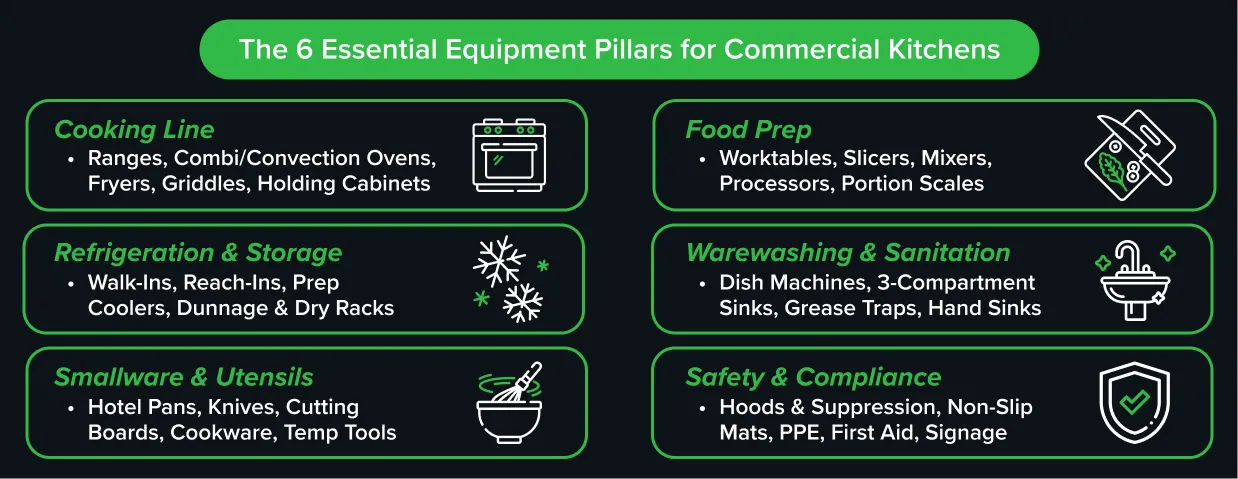
Every restaurant kitchen is different, but certain categories belong on nearly every commercial kitchen equipment checklist. The exact models and quantities will vary, but these are the core areas most operators need to consider.
Cooking equipment
Cooking equipment is the backbone of most commercial kitchens. Your lineup will depend on your menu, ticket times, and production volume, but it may include:
- Ranges
- Ovens
- Convection ovens
- Combi ovens
- Grills
- Griddles
- Fryers
- Salamanders
- Broilers
- Holding cabinets
- Steamers
- Microwaves for limited applications
For multi-unit restaurants, cooking equipment is one of the most important areas to standardize. If locations use different equipment to produce the same menu, training becomes harder, repairs become less predictable, and food quality can start to vary from one market to another.
Food prep equipment
Prep equipment may not get the same attention as the cookline, but it has a huge impact on speed, consistency, and labor efficiency.
Depending on the menu, your list might include:
- Prep tables
- Cutting tables
- Food processors
- Mixers
- Slicers
- Blenders
- Portion scales
- Dough equipment
- Can openers
- Ingredient bins
If your concept relies heavily on fresh prep, pay particularly close attention here. Too little prep capacity or a poorly designed workstation can create bottlenecks before food ever reaches the line.
Refrigeration and storage
Cold storage supports food safety, inventory management, and everyday kitchen flow. Common needs include:
- Walk-in coolers
- Walk-in freezers
- Reach-in refrigerators
- Reach-in freezers
- Undercounter refrigeration
- Refrigerated prep tables
- Ice machines
- Shelving units
- Dry storage racks
- Dunnage racks
Capacity matters, but so do placement and accessibility. Think about how deliveries arrive, where ingredients are stored, and how employees move product from storage to prep and service.
For restaurant groups, keeping those systems relatively consistent can also make inventory procedures and employee training easier across locations.
Dishwashing and sanitation
A great cookline won’t do much good if dishes are stacked halfway across the kitchen during the dinner rush.
Make sure your commercial kitchen equipment checklist accounts for the full cleaning and sanitation setup, including:
- Commercial dishwashers
- Three-compartment sinks
- Hand sinks
- Mop sinks
- Grease traps
- Drying racks
- Sanitizer systems
- Waste and recycling containers
Poor planning in the dish area can create workflow problems quickly. The equipment and layout need enough capacity to keep pace with the busiest parts of the day, not just average volume.
Smallware and utensils
This is where the little things become a big expense.
Smallware is easy to push toward the end of the purchasing process because individual items seem inexpensive compared with ovens or refrigeration. Multiply those items across several kitchens, though, and the numbers add up quickly.
Plan for items such as:
- Pots and pans
- Sheet pans
- Hotel pans
- Mixing bowls
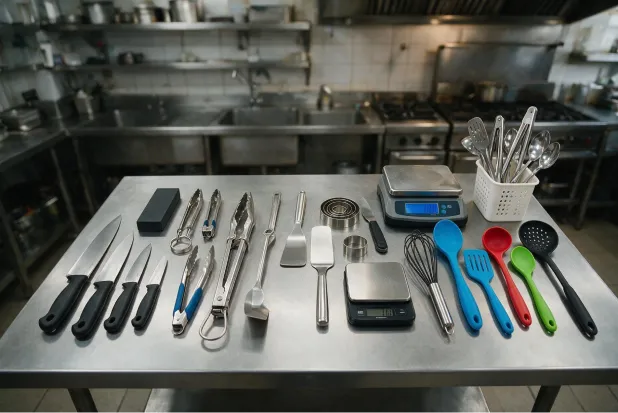
- Tongs
- Ladles
- Spatulas
- Whisks
- Knives
- Cutting boards
- Measuring cups and spoons
- Storage containers
- Thermometers
Standardizing smallware can also support consistent portioning, prep procedures, and line execution. If a recipe calls for a specific pan, scoop, or container, every location should ideally have the same tools available to execute it.
Safety and compliance equipment
Safety and compliance equipment may not be the most exciting part of an opening budget, but it certainly isn’t optional.
Depending on the kitchen and local requirements, this category may include:
- Fire suppression systems
- Vent hoods
- First aid kits
- Non-slip mats
- PPE
- Temperature monitoring tools
- Fire extinguishers
- Safety signage
- Shelving restraints where required
Equipment selections also need to align with applicable health, building, and fire codes. Requirements can vary by jurisdiction, so verify local standards before purchases and installation plans are finalized.
Where Equipment Planning Goes Wrong Across Locations
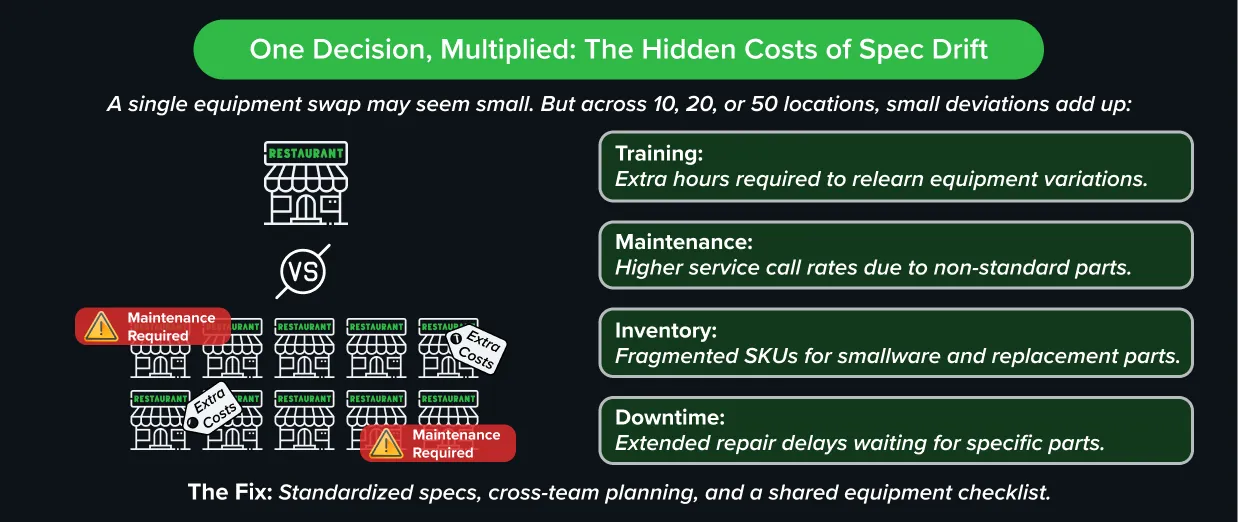
Multi-unit growth creates opportunities for efficiency, but it can also multiply mistakes. One small purchasing problem at a single restaurant is frustrating. Repeat it across 10 new locations and it becomes an expensive operational problem.
Specs that drift between kitchens
Spec drift can happen surprisingly easily.
A fryer is unavailable, so someone approves another model. A cooler gets swapped for a different size. One market starts ordering a different mixer because the preferred model has a longer lead time.
None of those decisions may seem significant on their own. Over time, however, locations that were designed to operate the same way can end up with very different kitchens.
That affects training, maintenance, replacement parts, purchasing, and even menu execution. Documented specifications and approved alternates can help teams make necessary changes without slowly losing brand standards.
Overbuying or underbuying
Equipment planning can go wrong in both directions.
Overbuy, and capital gets tied up in equipment that rarely gets used. Underbuy, and the kitchen may struggle with production bottlenecks, extra labor, or equipment running beyond its intended capacity.
Build your commercial kitchen equipment checklist around real menu needs and expected production volume rather than assumptions. Historical data from existing locations can be especially useful when planning the next opening.
Overlooked smallware
Large equipment naturally gets most of the attention during a buildout. Then opening day gets closer and someone realizes the kitchen still needs hundreds of basic operational items.
Because smallware costs are spread across so many line items, they can quietly push budgets higher than expected.
Treat smallware as its own purchasing category from the beginning. Establish par levels, quantities, approved products, and replacement needs just as you would for larger equipment.
Skipping space and infrastructure needs
You can pick the perfect piece of equipment and still end up with the wrong purchase if the building can’t support it.
Dimensions, doorways, clearances, ventilation, electrical requirements, gas connections, drainage, and water access should all be verified before orders are finalized.
Your checklist shouldn’t contain only an item and quantity. For major equipment, include dimensions, utility requirements, installation considerations, and other specifications that could affect the buildout.
What to Sort Out Before You Buy
Before purchase orders start flying, pressure-test your equipment plan against the realities of the location.
A little extra homework now is usually much cheaper than discovering a problem when an installer is standing in the kitchen.
Space and kitchen layout
A kitchen may work beautifully on a floor plan and feel completely different once employees are moving through it during a Friday-night rush.
Consider:
- Equipment footprint
- Employee traffic flow
- Prep-to-cook line movement
- Storage access
- Dish return and sanitation flow
- Service station placement
The goal isn’t simply to make everything fit. Equipment should support the way food, employees, and supplies actually move through the kitchen.
Budget and financing
Equipping multiple kitchens can put significant pressure on capital budgets, so separate genuine must-haves from nice-to-haves early.
Look beyond the sticker price, too. Your equipment budget may need to account for:
- Purchase price
- Installation
- Freight
- Utility work
- Warranties
- Service agreements
- Ongoing maintenance
- Replacement planning
Financing or leasing may make sense for certain operators or equipment categories, particularly when balancing expansion plans with cash flow.
New vs. used equipment
There isn’t a universal answer to the new-versus-used question.
New equipment can offer warranty protection, predictable condition, and easier standardization across a growing portfolio. Used equipment may lower upfront costs, particularly for less critical items.
Evaluate the decision category by category. The savings on a used piece of equipment aren’t much of a bargain if an early failure shuts down a key part of production.
Energy efficiency and warranties
A small difference in operating costs may not look significant for one restaurant. Across dozens of locations and several years, it can be a very different story.
Consider energy and water usage when comparing refrigeration, cooking, and warewashing equipment. The purchase price is only one part of what that equipment will ultimately cost the business.
Warranty coverage, service availability, and access to replacement parts matter as well. Saving upfront doesn’t help much if the equipment is difficult or expensive to repair.
How to Standardize Equipment Across Multiple Kitchens
For growing restaurant brands, standardization is one of the biggest advantages of maintaining a consistent commercial kitchen equipment checklist.
The goal isn’t to make every kitchen identical regardless of circumstances. It’s to establish clear standards so differences are intentional rather than accidental.
Build consistent equipment specs
Start by documenting approved specifications for major equipment categories.
That can include:
- Preferred manufacturer
- Model number
- Dimensions
- Capacity
- Utility requirements
- Required features
- Approved alternates
Now your checklist isn’t simply a shopping list. It becomes an operational standard that can be used by procurement, operations, facilities, construction teams, and suppliers.
Clear specs also make it easier to compare pricing because vendors are quoting against the same requirements.
Standardize equipment across every location
Creating standards is the easy part. Following them is what matters.
Use the same equipment standards for new openings, remodels, and planned replacements whenever possible. When a location needs an exception, document why.
Consistency can simplify employee training, maintenance, replacement parts, supplier management, and purchasing. Employees who move between locations also spend less time learning an entirely different kitchen setup.
Plan for maintenance and replacement
Equipment planning shouldn’t end once the installation crew leaves.
Track equipment age, service history, repair costs, warranty information, and expected replacement timing across the portfolio. This gives operators better visibility into what’s likely to need attention next.
It can also help answer an important question: when does another repair stop making financial sense?
Planning ahead gives procurement teams more time to source replacements strategically instead of making an emergency purchase because the walk-in went down on Tuesday morning.
How Buying Power Reduces Equipment and Supply Costs
The more locations you’re purchasing for, the more opportunity there is to approach equipment and supplies strategically.
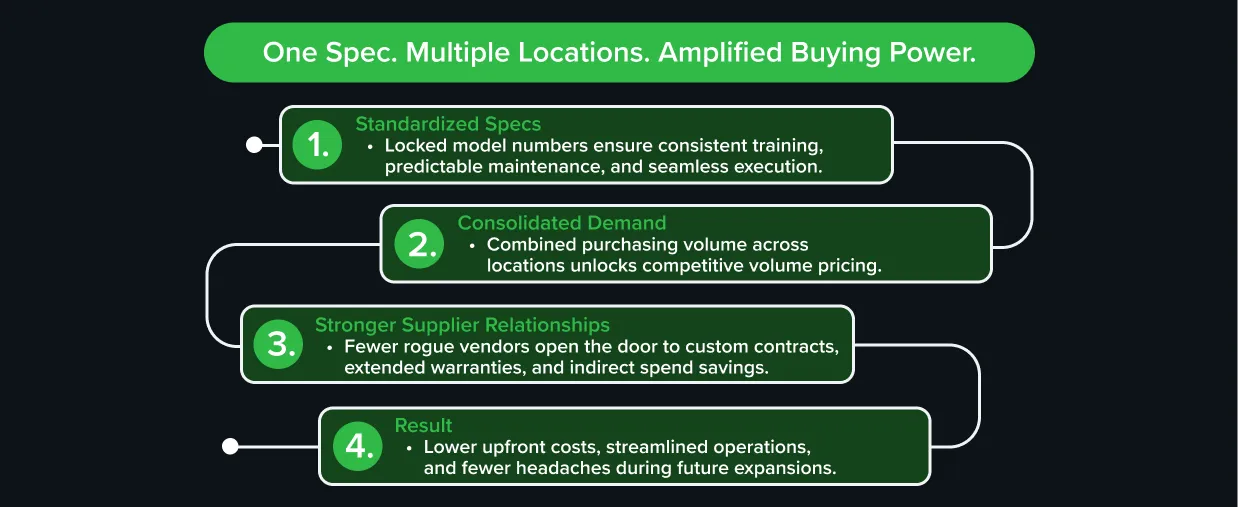
Multi-unit operators don’t necessarily have to buy every oven, smallware item, or cleaning product as an isolated transaction. Consolidating purchasing and leveraging the buying power of the larger organization can open the door to better pricing and stronger supplier relationships.
Better pricing through custom contracts
One of the biggest advantages of scale is purchasing leverage.
When equipment specifications are standardized, multi-unit operators can consolidate demand instead of negotiating each opening or replacement independently. That can create opportunities for more competitive pricing, custom contracts, and better purchasing terms.
Consolidated Concepts helps multi-unit restaurant operators identify opportunities to use their purchasing volume more strategically, including areas where custom contracts can help reduce costs.
A detailed commercial kitchen equipment checklist makes that process easier because the organization has a clearer picture of what it buys, how often it buys it, and what should be standardized.
Savings on indirect spend
The equipment itself is only part of the spending happening inside a restaurant.
Smallware, cleaning supplies, disposables, uniforms, pest control, waste services, and other indirect categories can add up quickly across a multi-unit organization.
These expenses are also easy to fragment when individual locations purchase from different vendors or operate outside preferred programs.
Looking at equipment planning as part of the larger procurement picture can help operators uncover savings beyond the initial buildout. Consolidated Concepts helps restaurant groups evaluate purchasing across both food and non-food categories, giving operators greater visibility into areas where costs may be reduced.
Build long-term supplier relationships
Strong supplier relationships become increasingly important as a restaurant group grows.
Suppliers that understand your specifications, locations, purchasing patterns, rollout plans, and service expectations are better positioned to support the business consistently.
Instead of treating every purchase as a one-time transaction, multi-unit operators can work toward relationships that support future openings, replacement cycles, and ongoing operational needs.
A repeatable commercial kitchen equipment checklist gives suppliers a clearer understanding of what the brand needs while helping operators keep expectations consistent from one project to the next.
Conclusion
A well-built commercial kitchen equipment checklist does more than make sure someone remembered the fryers and sheet pans.
For multi-unit restaurant operators, it can become a tool for creating consistency, simplifying expansion, improving purchasing decisions, and managing both upfront and long-term costs.
The most effective approach connects equipment planning with the bigger picture. What does the menu require? How does the kitchen actually operate? Which specifications should stay consistent? Where can purchasing volume create leverage? And what will happen when that equipment eventually needs to be serviced or replaced?
Answer those questions before purchasing begins, and the next opening, remodel, or replacement cycle becomes a whole lot easier to manage.
FAQs
What equipment do you need to open a commercial kitchen?
Start with what you need to safely prep, cook, store, and serve the food on your menu. For most restaurants, that means cooking equipment, refrigeration, prep tables and tools, storage, sinks and dishwashing equipment, smallware, and required safety equipment. Your commercial kitchen equipment checklist will get more specific from there based on the menu and how the kitchen is set up.
How much does it cost to equip a commercial kitchen?
There’s no standard number because two restaurant kitchens can have completely different equipment needs. A smaller concept with a limited menu may need far less equipment than a high-volume, full-service location. And the equipment itself isn’t the only expense. Freight, installation, utility hookups, smallware, and other opening costs need room in the budget too. For multi-unit groups, standardizing what you buy can make those costs easier to plan from one opening to the next.
Should you buy new or used commercial kitchen equipment?
It really depends on what you’re buying. Used equipment can be a way to stretch the budget, but the lower price isn’t much help if the unit needs frequent repairs or has to be replaced sooner than expected. For equipment your kitchen depends on every day, buying new may be worth the added warranty coverage and peace of mind. Many operators use a mix of both rather than taking an all-or-nothing approach.
How can multi-unit operators keep equipment costs down?
One of the best places to start is consistency. When locations are buying the same types of equipment and following approved specs, restaurant groups have a better opportunity to combine purchasing volume and negotiate pricing. It also helps prevent individual locations from making unnecessary one-off purchases. Keeping a shared commercial kitchen equipment checklist gives everyone a clear starting point for what should be purchased and from where.
How long does commercial kitchen equipment typically last?
Some equipment can stay in a kitchen for many years, while other pieces take enough daily abuse that they need attention much sooner. How often the equipment is used, how well it’s maintained, and the quality of the unit all play a part. Instead of relying on a set replacement age, keep an eye on repair frequency and costs. If you’re continually putting money into the same piece of equipment, it may be time to look at replacement rather than another repair.