If you operate multiple restaurant locations, food procurement can get complicated pretty quickly.
What works perfectly well for one restaurant doesn’t always work when you have ten, twenty, or fifty. One manager has a supplier they swear by. Another location orders a slightly different product. Prices change. New vendors get added. Before long, purchasing looks a little different everywhere.
That’s where having a food procurement strategy matters.
It’s not simply about getting ingredients through the back door on time. It’s about creating a purchasing approach that gives your restaurants enough consistency to control costs, work effectively with suppliers, and grow without making procurement harder every time you add a location.
What Is Food Procurement?
Food procurement covers the work that happens before products ever reach the kitchen.
Which suppliers should you work with? What should you be paying? Which products are approved? Are locations actually buying those products? Those are all procurement decisions.
For a single restaurant, some of this can be handled fairly informally. With a multi-unit operation, that gets much tougher. A small difference in the price of one case may not seem particularly concerning at one restaurant. Multiply it across dozens of locations and hundreds of orders, though, and suddenly it matters.
Good food procurement puts some structure around those decisions. The goal isn’t to make purchasing unnecessarily complicated. It’s to make sure locations are buying in a way that makes sense for the larger business.
Food Procurement vs. Food Purchasing
Although people often use these terms interchangeably, they aren’t the same thing.
Food purchasing is the actual transaction. Someone places an order, the restaurant receives the product, and the supplier gets paid.
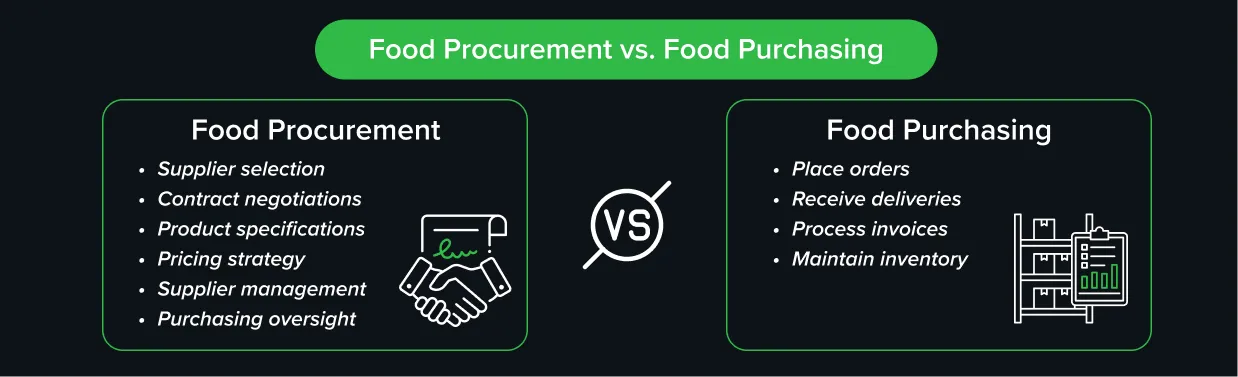
Food procurement is the broader strategy behind those purchases. It answers questions like:
- Which suppliers should we use?
- Are we receiving negotiated pricing?
- Are all locations buying approved products?
- How do supplier decisions affect profitability over time?
Purchasing happens every day. Procurement is what helps make sure all of those individual purchases are moving in the same direction.
Centralized vs. Decentralized Food Procurement
One of the bigger decisions for a restaurant group is how much purchasing control should sit with a central team and how much should stay at the location level.
There isn’t one model that works for everybody. A concept with a highly standardized menu may want tighter control. A restaurant group with regional menus or strong local supplier relationships may need more flexibility.
The important part is knowing what you gain, and what you give up, with either approach.
Benefits of Centralized Purchasing
For many multi-unit restaurant brands, centralized purchasing makes life easier simply because everyone is working from the same playbook.
Locations buy approved products. Supplier relationships can be managed across the organization. Pricing is easier to compare. And when there’s a contract in place, the purchasing team has a much better chance of knowing whether restaurants are actually buying against it.
Centralization can also give a restaurant group more leverage with suppliers because negotiations are based on the purchasing power of the organization rather than one location at a time.
Other advantages often include:
- Better buying power with suppliers
- More consistent product quality
- Fewer duplicate vendors
- Easier contract management
- Greater visibility into company-wide purchasing
- Simpler oversight across locations
That consistency becomes especially valuable during growth. Adding restaurant number 21 is a lot easier when you aren’t rebuilding the purchasing process from scratch.
Challenges of Decentralized Procurement
There are plenty of situations where giving individual restaurants purchasing flexibility makes sense. Menus may differ by market. Certain products may only be available regionally. Local sourcing may even be an important part of the concept.
The trouble usually starts when flexibility quietly turns into inconsistency.
Maybe one location switches products because something else is a few dollars cheaper. Another manager brings in a new supplier. Somewhere else, a restaurant keeps ordering the right product but pays a different price for it.
None of those decisions necessarily looks alarming by itself. Across a restaurant group, though, they can lead to:
- Different ingredients being used across locations
- Higher overall purchasing costs
- Less negotiating leverage with suppliers
- More vendors to manage
- Limited visibility into where purchasing dollars are going
And this usually doesn’t happen overnight. Purchasing habits drift little by little, which is exactly why the problem can be difficult to spot until the cost or operational impact becomes noticeable.
How to Choose the Right Procurement Model
The best procurement model is the one your team can realistically manage.
Some restaurant groups benefit from very tight purchasing controls. Others need room for regional suppliers, market-specific menus, or local products. Trying to force either extreme can create more work than it solves.
Look at what’s happening in your restaurants now. If managers constantly need exceptions to the purchasing rules, the process may be too rigid. If every restaurant seems to be buying its own products from its own suppliers at its own prices, you probably need more consistency.
For a lot of growing restaurant groups, the answer lands somewhere in between. Standardize the products and purchasing decisions that have the biggest impact on the business, then leave room for local flexibility where it actually serves a purpose.
Build an Effective Food Procurement Strategy
There’s plenty of advice out there about building the “perfect” procurement strategy. In reality, most operators need something much more practical: a process people can actually follow, and one that won’t fall apart as the restaurant group grows.
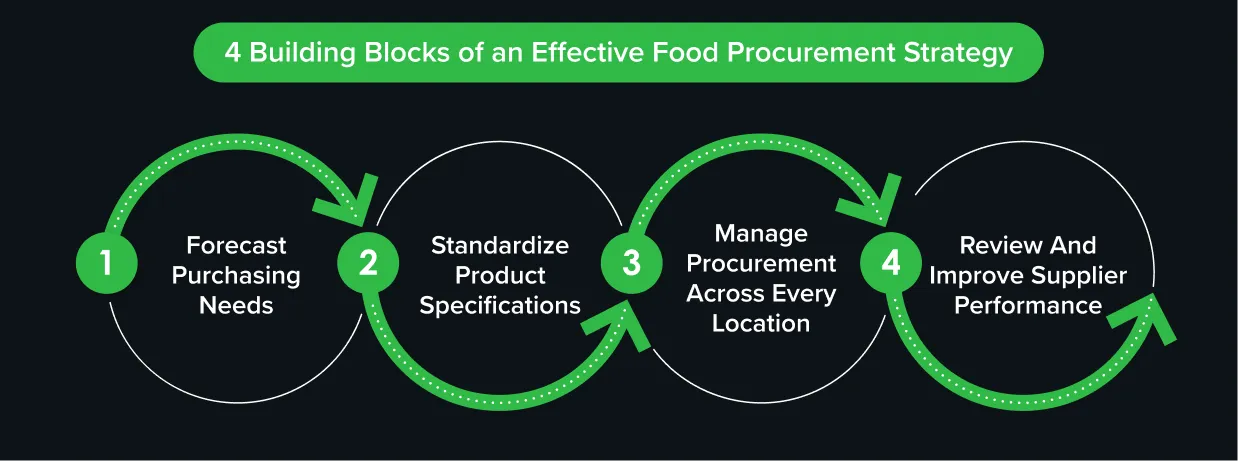
That usually starts with a few fundamentals.
Forecast Purchasing Requirements
Nobody has a crystal ball for next month’s sales. But that doesn’t mean your purchasing team should be flying blind.
Historical sales, seasonal patterns, promotions, holidays, local events, and upcoming menu changes can all give you a better idea of what restaurants are likely to need.
The closer purchasing is tied to expected demand, the easier it becomes to avoid both sides of the inventory problem: running short on something you need or sitting on too much of something you don’t.
It can also reduce those last-minute “we need it tomorrow” orders that tend to be expensive and stressful for everyone involved.
Standardize Product Specifications
Ask ten restaurant managers to order “burger buns” without giving them a product specification and you may get ten slightly different answers.
That’s the problem specifications solve.
Clear standards tell locations and suppliers exactly what should be purchased, whether that includes brand, pack size, grade, weight, quality requirements, or another important product characteristic.
When restaurants are ordering the same approved items, there’s less room for costly substitutions and fewer surprises in the kitchen. Suppliers know what’s expected, managers know what they should buy, and guests are more likely to get the same experience regardless of which location they visit.
Manage Procurement Across Multiple Locations
Procurement gets harder to see as restaurant groups get bigger.
At five locations, someone may still be able to catch inconsistencies by reviewing invoices or talking with managers. At fifty locations, that’s a very different proposition.
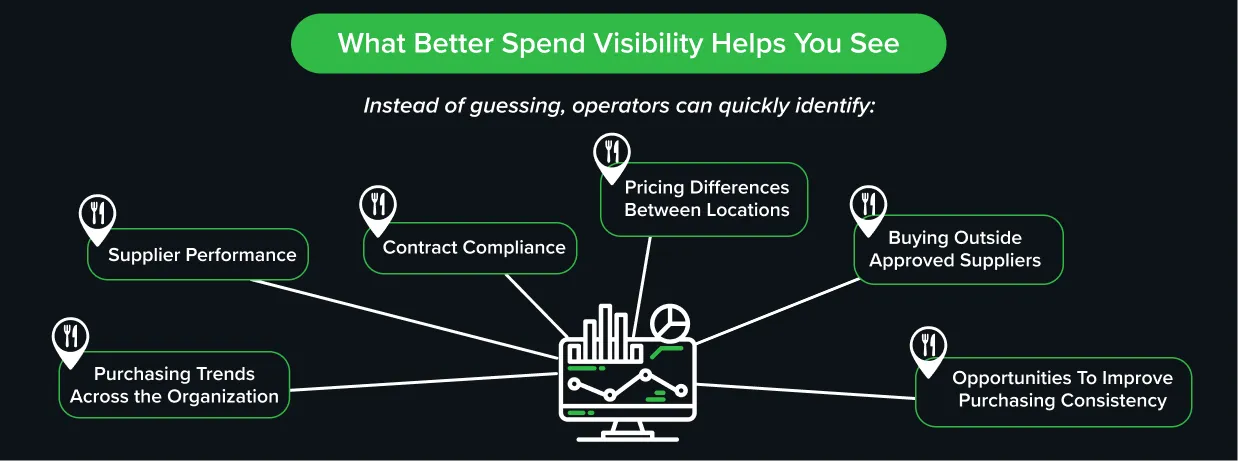
Operators need visibility across the organization so they can see where money is going, how suppliers are performing, whether pricing is consistent, and where purchasing behavior has started to drift.
Looking at locations one at a time only tells you part of the story. Looking across the business is where patterns start to become obvious, and where purchasing teams can find opportunities that would otherwise be easy to miss.
Supplier Relationship Management in Food Procurement
Restaurants depend on suppliers every single day, but not every supplier relationship is equal.
Some suppliers become genuine partners in the business. They understand your operation, know what matters to your restaurants, and communicate when something could affect an upcoming order. Others simply deliver the product.
That difference matters, particularly when you’re purchasing for multiple locations.
Price obviously deserves attention, but the lowest price on a case doesn’t mean much if deliveries are regularly late, substitutions are constant, or your team spends hours fixing invoice problems.
Evaluating Supplier Performance
There isn’t one magic number that tells you whether a supplier is doing a good job.
You have to look at the relationship as a whole.
Questions worth asking include:
- Are products arriving in the condition you expect?
- Are orders complete, or are substitutions becoming more common?
- Are deliveries showing up when they’re supposed to?
- When something goes wrong, how quickly does the supplier respond?
- Are fill rates staying consistent from week to week?
- Would your restaurant managers describe the supplier as easy to work with?
One late delivery probably isn’t enough to rethink a relationship. Five late deliveries might be.
That’s why trends matter. Looking at supplier performance over time gives you a much better picture than judging a vendor based on one particularly good or particularly bad order.
Managing Supplier Communications
A surprising number of purchasing problems give you some warning first.
A supplier knows availability is getting tight. Your team knows a promotion is going to drive unusually high demand. A distributor sees a transportation issue coming.
The problem is what happens when nobody talks about it until an order is already affected.
Regular communication gives both sides a chance to plan. It doesn’t need to mean another two-hour meeting on everyone’s calendar. Even short, consistent check-ins can surface potential issues while there’s still time to do something about them.
Strengthening Long-Term Supplier Partnerships
The strongest supplier relationships usually get better with time.
Suppliers learn your ordering patterns, seasonal demand, menu changes, and which products matter most to your operation. Your restaurant team learns how the supplier works, where they excel, and what to expect when something unexpected happens.
That familiarity won’t prevent every supply issue. What it can do is make problems much easier to work through when they happen.
Trusted suppliers become business partners who understand the operation, communicate early, and work with your team instead of simply taking the next order. Over time, those relationships can contribute to better service, more consistent purchasing, and greater stability.
Common Food Procurement Challenges
Even a well-run procurement program is going to hit some bumps.
Prices move. Products become difficult to source. Deliveries get delayed. Suppliers have performance issues. That’s foodservice.
The goal isn’t to somehow eliminate every procurement challenge. It’s to put enough structure and visibility around purchasing that your team can respond without turning every issue into an operational fire drill.
Price Volatility
Anyone who has spent time purchasing food has watched a perfectly reasonable price become not-so-reasonable a week later.
Commodity markets move, and restaurant operators can’t control that. What they can control is how quickly they notice changes and how prepared they are to respond.
Regularly reviewing pricing and purchasing trends makes it easier to catch increases, compare what locations are paying, and understand where food costs may be under pressure before the impact gets buried in the P&L.
Supply Chain Disruptions
Not every delivery issue is the supplier’s fault.
Weather, transportation problems, labor shortages, production delays, and regional availability can all affect whether a product shows up when you need it.
When that happens, options matter. Having approved alternatives and solid supplier relationships can make the difference between a manageable substitution and a kitchen scrambling to figure out what it can serve that night.
Supplier Performance Issues
A supplier can perform well for months and then suddenly start missing delivery windows, shorting orders, or sending inconsistent products.
Sometimes it’s a temporary issue. Sometimes it’s the beginning of a pattern.
That’s why supplier performance should be reviewed before complaints start piling up from individual restaurants. The earlier your team sees a trend, the more opportunity you have to address it before it becomes a larger operational headache.
Limited Spend Visibility
Here’s a scenario that happens more often than operators might think.
One restaurant is paying more for the same product than every other location. Nobody catches it because each restaurant reviews its own invoices. A few months pass, hundreds of cases are purchased, and what looked like a small pricing difference has quietly turned into real money.
That’s what makes limited spend visibility so costly. When purchasing information lives in different invoices, systems, spreadsheets, or locations, nobody has a clean view of what’s happening across the business.
Tools like InsideTrack bring that purchasing information together so operators can compare activity across locations, review pricing, and identify inconsistencies sooner.
Final Thoughts
Food procurement tends to get harder one location at a time.
Another restaurant means another set of orders, invoices, managers, supplier conversations, pricing changes, and opportunities for something small to slip through the cracks. Eventually, trying to manage all of it location by location stops being practical.
A strong food procurement strategy gives restaurant groups a better way to manage that complexity. It creates consistency where consistency matters, gives teams better visibility into purchasing, and makes it easier to catch issues before they become expensive habits.
And that’s really the point. Procurement shouldn’t create more work for operators. It should help the business buy smarter as it grows.
Looking to strengthen your food procurement strategy across every location? Click here to contact Consolidated Concepts and learn how our team can help improve purchasing performance, supplier management, and operational consistency.
FAQs
What Is the Difference Between Food Procurement and Food Purchasing?
Purchasing is one piece of procurement. It’s the actual ordering and buying of food. Procurement starts before the order is ever placed and covers decisions around suppliers, pricing, product standards, contracts, and how purchasing is managed across locations.
Why Is Food Procurement Important?
Because what restaurants buy, where they buy it, and what they pay can look very different from one location to another. A good procurement process helps keep those decisions in check, giving operators more control over costs, suppliers, and consistency as they grow.
How Do Restaurants Build a Procurement Strategy?
A good place to start is with what you’re already buying. Look at suppliers, pricing, products, and where purchasing varies between locations. From there, you can decide what should be standardized, where you need flexibility, and which supplier relationships make the most sense for the business.
What Technology Is Used for Food Procurement?
It varies by restaurant group. Some use purchasing or inventory systems, while others rely on tools that pull together spend, pricing, supplier, and contract information. For a multi-unit operator, the bigger question is whether the technology makes it easier to see what’s being purchased across all of your locations.
How Can Restaurant Chains Reduce Procurement Costs?
Start by looking for the small inconsistencies that tend to get expensive at scale. Different pricing between locations, off-contract purchases, too many suppliers, and unnecessary product variation can all add cost. Cleaning up those everyday purchasing habits can make a meaningful difference across dozens of restaurants.