
One location pays more for the same case of oil. Another misses a rebate because the wrong item was ordered. Meanwhile, your team is trying to protect margins without changing what guests love about your restaurants. These are everyday purchasing problems for multi-unit operators. So, what is a GPO, and where does it fit? A group purchasing organization gives restaurant groups access to supplier agreements built around collective buying power. The right fit can help you control costs, reduce purchasing headaches, and keep your locations working from the same playbook.
What Is a Group Purchasing Organization (GPO)?
A GPO ( group purchasing organization ) is an entity that combines the purchasing power of several businesses in an effort to negotiate supplier contracts. For restaurateurs, this can mean access to contracted pricing, eligible rebates, and programs covering food, supplies, and services.
A GPO negotiates the purchasing framework and does not sell or deliver each product itself. Your restaurants order through participating suppliers or distributors under the program’s terms. You still run your operation, but the GPO gives you buying leverage and backing for the purchases you make.
Supply Chain Challenges Facing Multi-Unit Restaurant Operators
Every additional restaurant adds purchasing volume, but it also adds moving parts. Different delivery schedules, ordering habits, and local supplier relationships can make a growing group harder to manage than its spend totals suggest.
Rising Food and Operating Costs
Pressure isn’t only from food. Labor, packaging, repairs, utilities and delivery charges all fight for the same margin. When costs change faster than menu prices, operators need to consider buying without compromising portions, quality or the guest experience.
Supplier Complexity and Management Burden
A busy purchasing team may work with broadline distributors, specialty vendors, service providers and equipment partners. Instead of tracking contacts, price changes, substitutions and renewal dates, you could spend your time opening restaurants or supporting your managers.
Limited Negotiating Power
Your restaurant group may be a relevant local business, but not have enough volume in a category to get better terms. Splitting purchases by location and vendor can further dilute that leverage, particularly if no one has visibility into total spend.
Inconsistent Pricing Across Locations
Freight, distribution arrangements or purchasing practices may mean that the same product has different delivered costs in different markets. Some variation is permitted. Others deserve a second look. It’s hard for operators to tell the difference or to identify locations buying outside of approved programs without the item-level comparisons.
How Does a GPO Work for Multi-Unit Restaurants?
A restaurant GPO connects collective purchasing demand with supplier programs. The process should fit how your restaurants buy, not create a second ordering system nobody wants to use.
Join a GPO
Begin with the membership terms, the suppliers that are covered and how the organization is paid. Give us your restaurant footprint, buying priorities and relevant spend information so the team can assess fit. Ask what participation entails before signing anything.
Combine Purchasing Volume
The GPO aggregates the demand of the participating businesses. Suppliers can evaluate that collective opportunity instead of treating each restaurant group as an isolated account. The actual leverage varies with the category, supplier, participation, and purchasing commitments.
Negotiate Supplier Agreements
The GPO negotiates eligible products, pricing structures, rebates, and other terms with participating suppliers. Those agreements may operate alongside distributor arrangements, so clarify which parts of your delivered cost each agreement covers.
Access Contract Pricing and Rebates
Once your accounts and eligible items are linked to the appropriate programs, contracted pricing or rebate opportunities can be applied under the agreement. Review and confirm effective dates, eligible products, reporting requirements and when payment will be made. Just because you’re enrolled doesn’t mean every purchase counts.
Purchase Through GPO Suppliers
Your locations order through the approved process from participating suppliers or distributors. Existing relationships could be retained where they match the programs available. From there, regularly review invoices, purchasing compliance and rebate activity. It’s not access to the agreements that’s the value, it’s use of the agreements. Find an internal person to communicate changes to location teams for items and programs.
What Are the Benefits of a GPO for Multi-Unit Restaurants?
For multi-unit operators, the benefit is more than just a better number on a price sheet. It’s a more structured way to buy across the business, while keeping restaurant teams focused on execution.
Reduce Food and Operating Costs
Eligible rebates and negotiated agreements can help lower the cost of purchases your restaurants already make. Compare total delivered cost including fees and distribution charges. A lower dollar price is of little use to you if it carries higher freight charges or a product that produces more waste.
Improve Purchasing Power
Collective demand can spark conversations that are difficult for an individual restaurant group to start on its own. That leverage can help get better terms, although results vary by supplier, category and the amount of product members actually buy through a program.
Simplify Supplier Management
A GPO can be a springboard to test supplier programs, rather than having your team source each agreement separately. You want clear responsibilities for things like ordering, delivery, invoice disputes and supplier performance. Ask them where the GPO support starts and stops.
Standardize Products Across Locations
Shared product specifications and approved purchasing options help locations stay aligned. That matters when a substitution changes recipe yield, portion cost, or presentation. Standardization should support your concept, not force every restaurant into an item that fails in the kitchen.
Gain Access to More Suppliers and Products
Participating programs may introduce suppliers or categories your team has not explored. Evaluate availability in each market, minimum orders, and delivery requirements before adding a new partner. More options are useful only when they work operationally.
Increase Purchasing Visibility
When program reporting and usable purchasing data is available, operators can compare locations, identify off-program buying and monitor eligible rebates. Better visibility provides your team with specific questions to research instead of explaining every variance with a combined food-cost percentage.
What Types of Products and Services Can a Restaurant GPO Provide?
Coverage varies by organization and supplier networks. Look at the categories that matter to your business; not every GPO has the same lineup or serves every market in the same way.
Food and Beverage
Programs can offer proteins, dairy, produce, dry goods, frozen products and nonalcoholic beverages. Check specific brands, sizes of packs, specifications and eligible distributor channels. That doesn’t mean that a similar item is an interchangeable ingredient in your recipes.
Restaurant Equipment and Supplies
Categories might include cooking equipment, refrigeration, smallwares, disposables and cleaning supplies. When purchasing big-ticket items, consider not only the purchase price, but also installation, warranties, service availability and lead times. Such details can alter the economics of an equipment selection.
Technology and Business Services
Some GPOs offer access to programs for payment processing, software, telecommunications or other business services. Look at costs of implementation, integration, length of contract, and ongoing support. Even a subscription at a discounted price still has to work with the systems your restaurants use.
Operational and Facility Services
Depending on the coverage, options could include waste management, pest control, linen service, maintenance and other facility needs. Check local service capacity and anticipated response times. A national agreement is only worthwhile if the provider can reliably support your specific locations, including new openings and restaurants outside your core market.
How Do GPO Supplier Contracts and Pricing Work?
The agreement details matter as much as the headline opportunity. Know how the program will affect invoices, rebates and commitments your restaurant group makes before you move spend.
Negotiated Contract Pricing
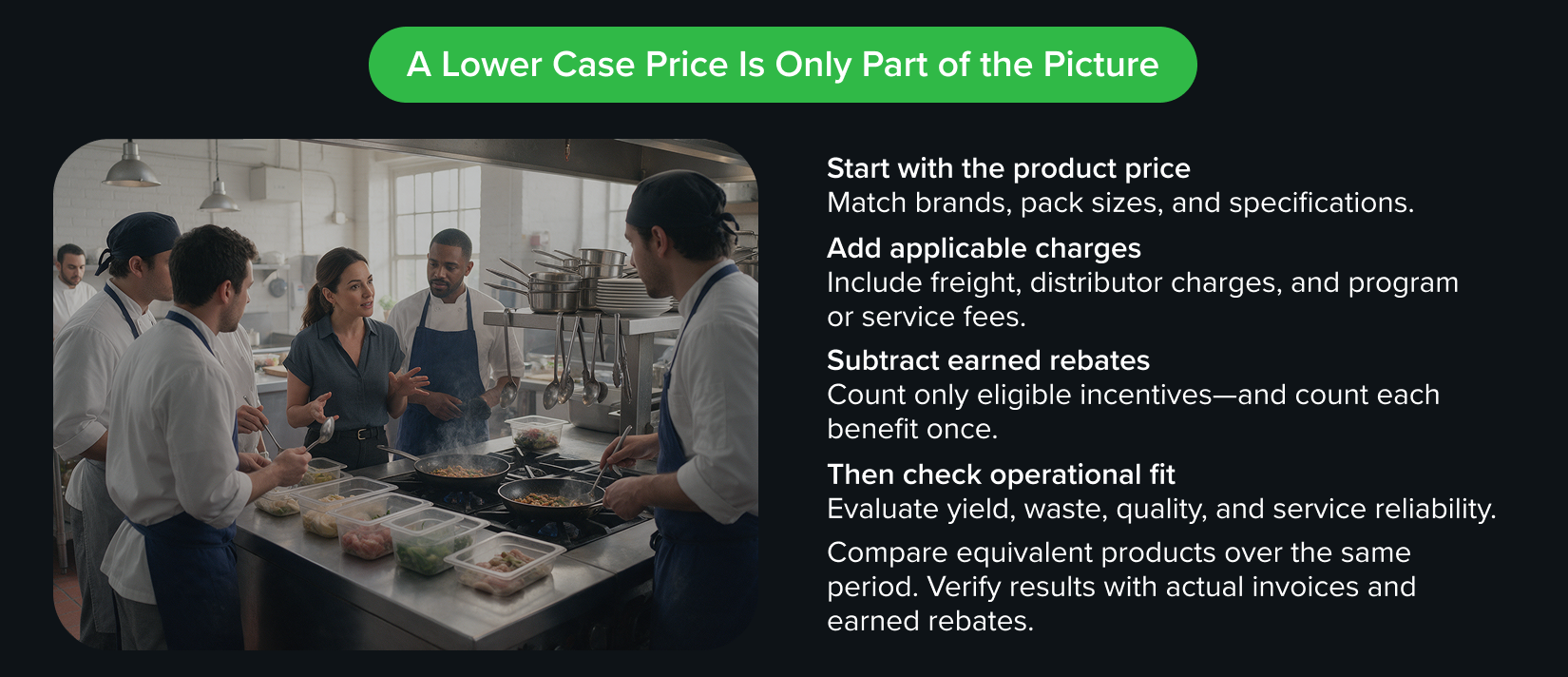
They may provide for fixed prices for a period, discounts or formulas based on changing market costs. Ask what products and locations qualify, how often prices are updated, and if there are separate charges for distributor markups or delivery. Access to contracts does not provide the same delivered prices in all markets.
Rebates and Incentive Programs
Rebates may be earned on eligible purchases of certain products, on volume or on other conditions. Please confirm how the purchases are tracked, who gets paid and when the money is paid out. Don’t double count the same benefit in your savings estimate – earned rebates should be tracked separately from projected incentives.
Contract Terms and Supplier Commitments
Please review the length of the agreement, renewal terms, minimum purchases, exclusivity and termination rights, as applicable. Find out what they do with substitutions, out-of-stock items and service problems. Also, explain any membership or administration fees paid by suppliers. You should make your GPO arrangement simple enough that your purchasing and finance teams can review it together. If there’s an existing supplier contract that overlaps with an agreement, resolve that conflict before moving purchases. Getting the details right upfront means avoiding expensive surprises after rollout.
GPO vs. Independent Purchasing: What’s the Difference?
Both approaches can work. The better choice depends on your buying volume, internal resources, supplier relationships, and the agreements already in place. Compare equivalent products and service levels rather than assuming one model always wins.
| Purchasing factor | Through a GPO | Independent purchasing |
| Negotiating leverage | Uses collective demand across participating businesses; value depends on supplier participation and program terms. | Relies on your group’s own volume, relationships, and ability to negotiate directly. |
| Pricing and rebates | Provides access to eligible contracted pricing and incentives, with requirements that need ongoing attention. | Your team negotiates prices and incentives, then monitors whether suppliers apply them correctly. |
| Supplier relationships | May work alongside existing suppliers or introduce participating alternatives; compatibility must be confirmed. | Your team sources, evaluates, and manages each supplier relationship without a GPO intermediary. |
| Internal workload | Can reduce some sourcing work, but enrollment, ordering discipline, and invoice checks still matter. | Your team handles sourcing, negotiations, contract reviews, and purchasing oversight using internal resources. |
| Flexibility and commitments | Choice depends on membership rules and supplier agreements; check any volume or exclusivity requirements. | Flexibility depends on your own agreements, including minimum orders, commitments, and termination terms. |
| Measuring value | Compare delivered costs, earned rebates, fees, product performance, and implementation effort against your baseline. | Use the same measures to determine whether your direct agreements provide better overall value. |
Common GPO Myths for Restaurant Operators
A GPO is a purchasing option, not a one-size-fits-all answer. Clearing up a few assumptions makes it easier to evaluate whether a program belongs in your operation.
GPOs Are Only for Large Restaurant Chains
Collective buying power can also work for smaller restaurant groups. More useful questions are whether your purchases qualify, suppliers cover your locations, and whether the programs available meet your needs. Value is not a function of size.
GPOs Limit Supplier Choice
Some programs are flexible and others require purchase commitments or designated suppliers. Don’t assume that participation means replacing every vendor. Check the actual terms. Include operational requirements and key specialty products in the discussion.
GPOs Take Control of Purchasing Decisions
A GPO typically negotiates access to programs and operators make purchasing decisions within the terms they accept. Know what you are getting into before you sign up. Your team still needs to figure out what meets your quality, service and financial requirements.
GPO Pricing Is Always the Lowest Price
It is not a guarantee. A local agreement, promotion, or existing contract may beat a particular program on a particular item. Compare total delivered costs, realistic rebates, product performance, and service. The goal is a stronger purchasing position overall, not winning every line-item comparison.
How to Choose the Right GPO for a Multi-Unit Restaurant Group
Start with your operation, not a savings claim. A useful evaluation connects supplier programs to what your restaurants actually buy and what your teams can realistically implement.
Evaluate Supplier Coverage
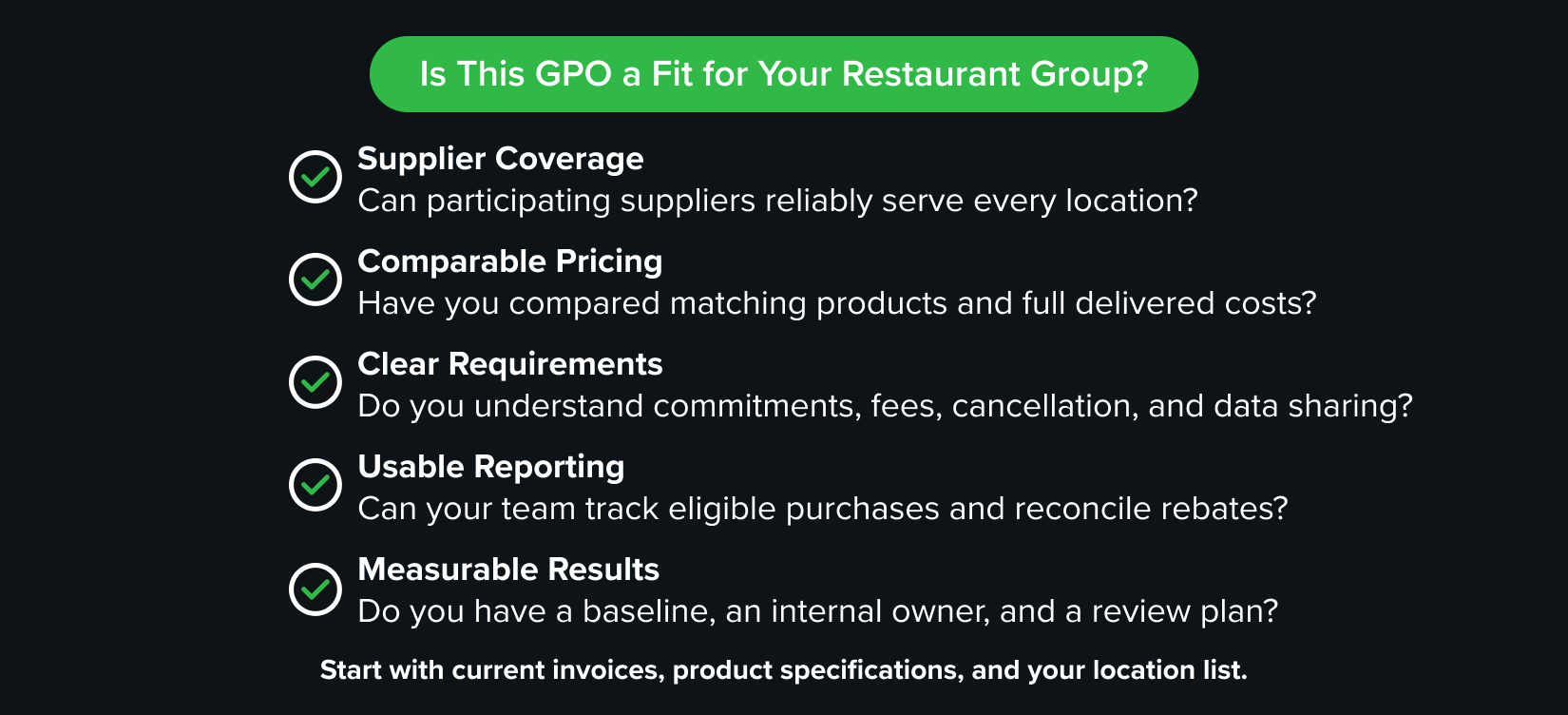
Map every location, including those planned to open, against the available suppliers. Verify distribution reach, delivery schedules, product availability and service capacity. Ask how the GPO manages markets where its preferred programs don’t work well for your restaurants.
Compare Pricing and Rebate Programs
Build a representative basket using current invoices and matching specifications. Include freight, distributor charges, fees, and rebates you can reasonably earn. Compare the same time periods, and separate recurring savings from temporary promotions or one-time incentives.
Review Program Requirements
Read the terms of membership and the relevant supplier agreements. Look at purchase commitments, enrollment process, data-sharing requirements, cancelation terms, compensation agreements. Ask who is responsible for setting up accounts and how quickly eligible purchases can begin to receive the appropriate program treatment.
Consider Technology and Reporting
Request a walkthrough that includes examples that relate to your business. Can your team identify qualifying purchases, compare locations, and reconcile rebates? Understand what data feeds are needed and who is responsible for maintaining accurate account and item information.
Measure Potential Cost Savings
Use your own purchase history to set a baseline. “Distinguish opportunities from proven results, and consider the switching costs, the training and yield of product. Start with a few categories, assign an owner, and then look at actual invoices after implementation. A smaller opportunity that your restaurants consistently execute can be more valuable than a larger estimate that never hits the bottom line.
How Consolidated Concepts Helps Multi-Unit Restaurants
At Consolidated Concepts, we know purchasing decisions do not happen in a vacuum. A product has to work for the kitchen. A supplier has to reach your locations. And a savings opportunity has to show up in the numbers, not just in a presentation.
We help multi-unit restaurant operators explore purchasing opportunities through group buying power and supplier programs. The starting point is your business: where you operate, what you buy, and which relationships matter to your concept.
That means looking beyond a single price comparison. As you evaluate membership, bring your current purchasing challenges, supplier questions, and growth plans. We can discuss where available programs may fit and what to review before making changes.
Your team should have a clear understanding of the opportunity, the requirements, and the next steps. The goal is practical purchasing support that fits the way your restaurant group operates, without losing sight of your brand.
FAQs
What does a GPO do for restaurants?
A GPO negotiates supplier programs using the collective purchasing demand of participating businesses. Restaurants can access eligible pricing, rebates, and other agreement benefits. The operator still needs to select suitable products, enroll eligible accounts, and follow program requirements to realize value.
How does a restaurant GPO make money?
Many GPOs receive administrative fees from participating suppliers, often tied to member purchases. Others charge membership or service fees, or use a combination. Ask how compensation works, whether fees affect your costs, and what support is included. Free membership does not mean the organization receives no compensation.
Do restaurants have to change suppliers when joining a GPO?
Not necessarily. Existing suppliers or distributors may already participate in relevant programs. Other opportunities may require a new supplier or product. Review compatibility with current agreements, service needs, and menu specifications before making a change. Requirements vary by program.
Are GPOs only beneficial for large restaurant groups?
No. Smaller multi-unit groups may gain access to agreements they could not negotiate independently. Larger groups may find value in selected categories or additional purchasing support. The right test is whether the available programs improve your specific operation after requirements and costs are considered.
How much can a restaurant save with a GPO?
There is no universal savings percentage. Results depend on current pricing, purchasing volume, product mix, location coverage, and program participation. Compare a representative sample of invoices with proposed terms, then verify actual delivered costs and earned rebates after implementation. Treat projections as estimates, not guarantees.