Running multiple restaurants means keeping track of a lot of moving pieces. One location might be having its best month of the year while another is struggling to cover rising food and labor costs. And just when you think you’ve accounted for everything, a supplier increases prices or a piece of kitchen equipment needs replacing.
That’s where restaurant budgeting comes in. Having a realistic budget for each location gives you a better handle on spending, helps you catch problems early, and makes it easier to plan for what’s ahead.
What is Restaurant Budgeting?
Restaurant budgeting is simply planning how much money your restaurant expects to bring in and how much it will cost to operate.
That includes everything from food purchases and payroll to rent, utilities, and equipment repairs.
For multi-unit restaurant groups, there’s another layer to consider. You’re not just looking at the finances of one restaurant. You’re managing several locations, each with its own sales patterns, expenses, and operating challenges.
A good budget gives you something to measure performance against. When spending starts moving in the wrong direction, you have a way to see it before it becomes a bigger issue.
Why Restaurant Budgeting is Critical for Multi-Unit Operators
A few extra dollars on a supplier invoice might not raise any concerns at one restaurant. But when that same increase shows up across 20 locations, the numbers start looking very different.
That’s one reason restaurant budgeting matters so much for multi-unit groups.
Without a clear picture of what each restaurant should be spending, it’s easy for unnecessary costs to slip through. One location may be overstaffed during slower shifts. Another might be paying more for ingredients than the rest of the group.
A budget gives you a starting point for asking the right questions. More importantly, it helps you figure out where changes are needed without making assumptions about how every restaurant is performing.
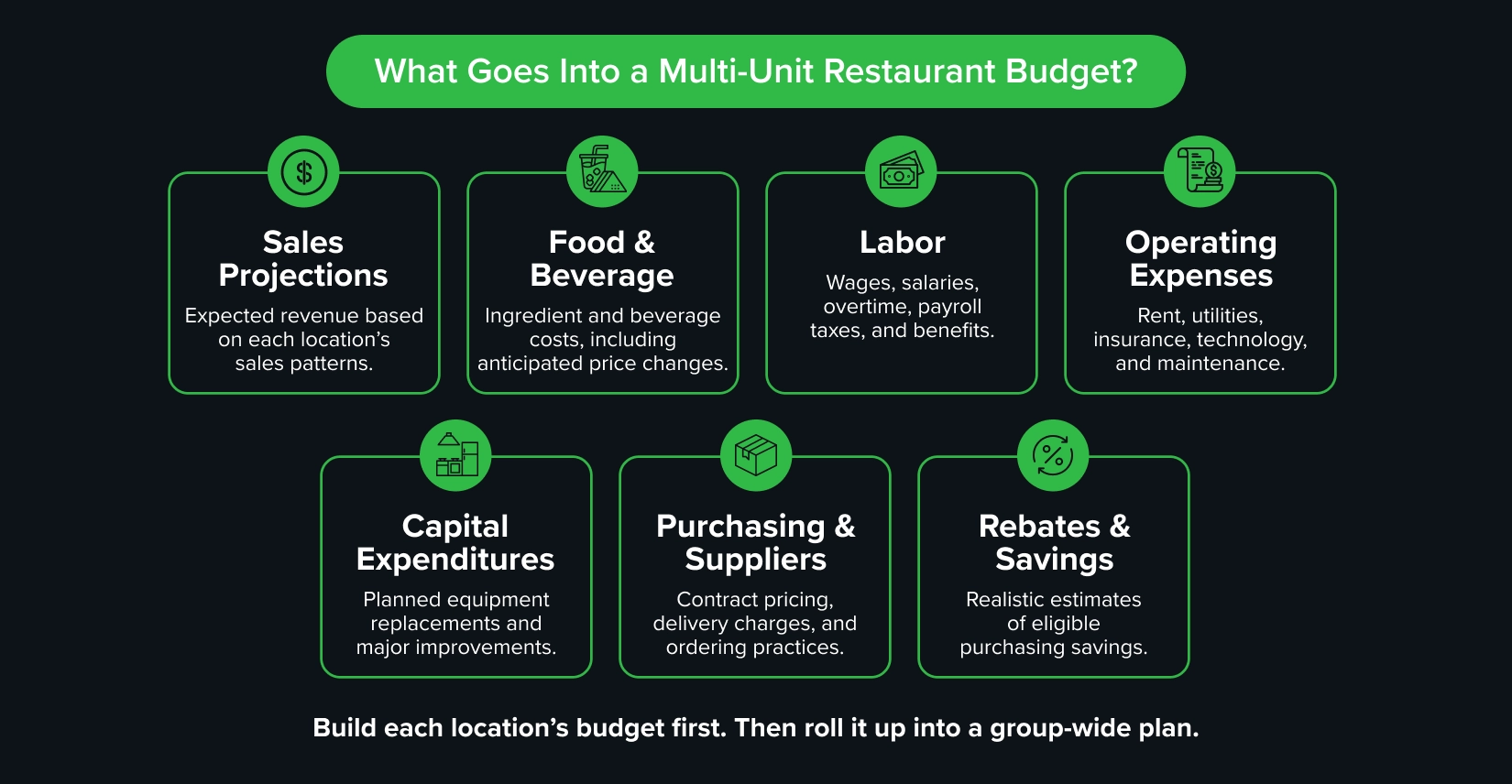
What Should a Multi-Unit Restaurant Budget Include?
A restaurant budget needs to reflect what it actually costs to run the business. That sounds obvious, but expenses have a way of getting overlooked, especially when you’re managing several locations.
Food and labor usually get the most attention. They’re major expenses, and they’re constantly changing. But there are plenty of other costs that deserve a place in your restaurant budgeting process.
Sales and Revenue Projections
Before you can figure out what a restaurant should spend, you need a realistic idea of what it’s going to earn.
Look at previous sales, customer traffic, average check amounts, and any changes that might affect business.
A location near a college campus, for example, probably won’t have the same sales patterns as one in a busy shopping district.
Build projections around what’s actually happening at each restaurant rather than assuming the entire group will grow at the same rate.
Food and Beverage Costs
Food costs can change quickly, sometimes without much warning.
Chicken prices go up. Produce becomes more expensive. A distributor adjusts pricing on products your kitchens order every week.
Your budget should reflect what you’re currently paying for ingredients and beverages, along with reasonable expectations for price changes.
For multi-unit groups, it’s also worth comparing what different locations pay for the same products. Those differences can reveal purchasing issues that aren’t immediately obvious.
Labor Costs
Payroll involves more than hourly wages.
You’ll also need to account for salaries, overtime, payroll taxes, benefits, and other employee-related expenses.
Staffing needs can vary quite a bit between restaurants. A high-volume location may need additional kitchen coverage, while another might have slower periods where scheduling can be adjusted.
Use each restaurant’s sales patterns and staffing requirements to build a labor budget that makes sense.
Operating Expenses
Think about everything your restaurants need to keep the doors open.
Rent, utilities, insurance, repairs, technology, cleaning services, and maintenance all belong in the budget.
Some expenses are predictable. Others aren’t.
Review previous spending and make sure you’re accounting for costs that don’t necessarily show up every month.
Capital Expenditures
Eventually, equipment needs to be replaced.
Whether it’s a new walk-in cooler, an oven, or a dining room renovation, major purchases can put pressure on cash flow if they haven’t been planned for.
Include expected equipment replacements and improvements in your financial planning.
It’s much easier to prepare for a large expense when you know it’s coming.
Purchasing and Supplier Costs
What your restaurants pay suppliers can have a major impact on the budget.
Take a look at existing contracts, product pricing, delivery charges, and purchasing habits across locations.
Are restaurants buying from approved suppliers? Are they ordering the same products at different prices?
These are the kinds of questions worth asking before finalizing purchasing budgets.
Rebates and Procurement Savings
If your restaurant group participates in manufacturer rebate programs or negotiated purchasing agreements, those savings deserve attention.
Review which programs your locations qualify for, how much they’ve earned historically, and whether rebates are being captured.
Just be careful about counting savings before they’re earned.
Rebates can improve your purchasing economics, but your budget should reflect realistic expectations rather than assuming every possible dollar will come through.
How to Build a Multi-Unit Restaurant Budget
There’s no single budget that works for every restaurant in a group.
Even locations operating under the same brand can have very different expenses. One might have higher rent, another could face greater labor costs, and a third may be dealing with lower sales volume.
The best place to start is with what you already know about each restaurant.
Start With Historical Sales and Cost Data
Pull your sales reports, purchasing records, payroll expenses, and operating costs from previous periods.
Look beyond the totals.
Did food spending increase because ingredient prices went up, or because the restaurant purchased more product? Was overtime unusually high during certain weeks?
Understanding what happened in the past makes it easier to build a budget around what you can reasonably expect going forward.
Set Budgets for Each Restaurant Location
Avoid giving every restaurant the same spending targets just because they’re part of the same group.
A location doing $150,000 in monthly sales isn’t going to have the same needs as one bringing in $80,000.
Build each budget around the restaurant’s actual sales, operating expenses, and market conditions.
You can still establish financial expectations for the group as a whole, but individual locations need numbers that reflect how they operate.
Establish Food and Labor Cost Targets
Food and labor costs are worth watching closely because they account for a large share of restaurant expenses.
Set targets using historical performance, menu costs, staffing requirements, and expected sales.
And make sure those targets are realistic.
If a restaurant has consistently operated at a certain food cost percentage, expecting a dramatic reduction without changing purchasing or operations probably isn’t going to work.
Account for Seasonality and Local Factors
Not every month looks the same in the restaurant business.
A coastal restaurant might be packed during tourist season and much quieter a few months later. A location near an office district could see business drop during holiday weeks.
These patterns should influence your sales projections, staffing plans, and purchasing budgets.
Otherwise, you risk planning for revenue that isn’t likely to materialize.
Set Group-Level Financial Targets
Once you’ve built budgets for individual restaurants, look at the bigger picture.
What does total revenue look like across the group? How much are you expecting to spend? Are projected profits where they need to be?
This is also a good time to identify locations that may need additional support or closer financial monitoring.
Include a Contingency Budget
Something unexpected will eventually happen.
A refrigerator breaks. A supplier increases prices. A location needs repairs that weren’t on the calendar.
Set aside room in the budget for expenses you can’t predict.
You may not know exactly what will happen, but you can avoid being completely unprepared when it does.
Restaurant Budgeting Strategies for Multiple Locations
Building a budget is one thing. Keeping 10, 20, or 50 restaurants on track is another.
The more locations you’re managing, the more important it becomes to have consistent financial practices without ignoring the differences between individual restaurants.
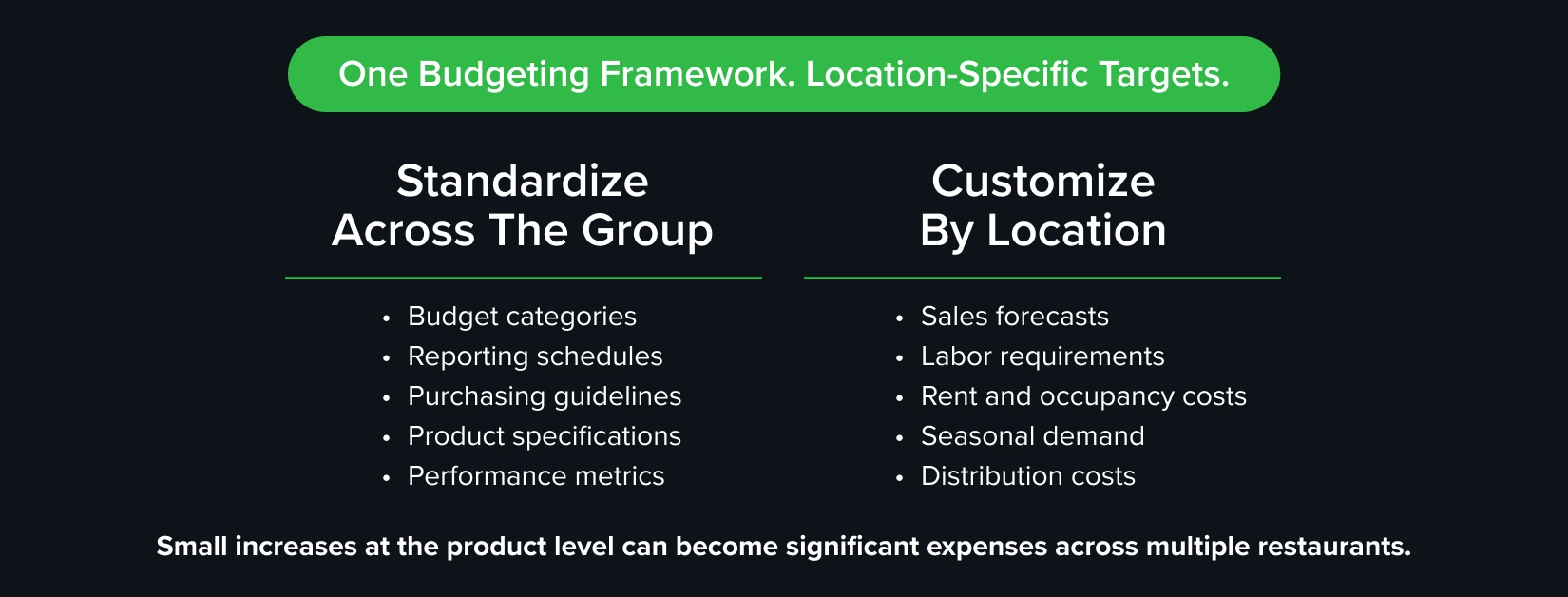
Standardize Budgeting Across Locations
If every restaurant tracks expenses differently, comparing financial performance becomes frustrating.
One manager might categorize a purchase as supplies while another puts the same expense under operating costs.
Establish common budget categories and reporting practices across your locations.
You’ll spend less time trying to make sense of inconsistent reports and more time reviewing what the numbers are telling you.
Use Location-Level Sales Forecasts
Sales forecasts should be based on the restaurant, not just the overall performance of the company.
Look at previous sales, local demand, upcoming events, and changes in customer traffic.
A location that’s been steadily losing weekday lunch business shouldn’t have the same growth assumptions as one that’s consistently increasing sales.
Leverage Group Purchasing Power
Purchasing is one area where multi-unit restaurant groups have an advantage.
When you’re buying products for several locations, you may have more negotiating power than a single restaurant purchasing on its own.
Review whether your locations can combine purchasing volume to access better supplier pricing, contracts, or rebate opportunities.
Even modest savings on frequently ordered products can make a difference when those purchases are happening across the entire group.
Set Consistent Purchasing and Cost Standards
Are your restaurants ordering the same ingredients from different suppliers? Are some locations buying products that cost more than the approved alternatives?
Establish purchasing guidelines that make sense for the group.
That could include preferred suppliers, approved product specifications, and procedures for handling substitutions.
The idea isn’t to make purchasing difficult for restaurant managers. It’s to reduce unnecessary differences in what locations are spending.
Adjust Budgets for Location-Specific Conditions
Standardizing your budgeting process doesn’t mean every restaurant should have identical targets.
Labor costs may be higher in one market. Another location might have more expensive distribution arrangements.
Give managers financial goals that reflect those differences.
Otherwise, you could end up penalizing a well-run restaurant for expenses it has little control over.
Review Underperforming Locations
When a restaurant isn’t meeting its budget, find out what’s happening before jumping to conclusions.
Maybe sales are down. Maybe labor scheduling hasn’t adjusted to slower traffic. Or perhaps the location is paying more for products than it should.
Look at the numbers, talk to the people running the restaurant, and identify what’s actually driving the problem.
How to Manage Budget vs. Actual Performance
A budget is useful only if you’re comparing it against what’s really happening.
Restaurant budgeting should be an ongoing process, not something you work on once a year and forget about.
Track Variances by Location
Compare what each restaurant was expected to earn and spend against its actual results.
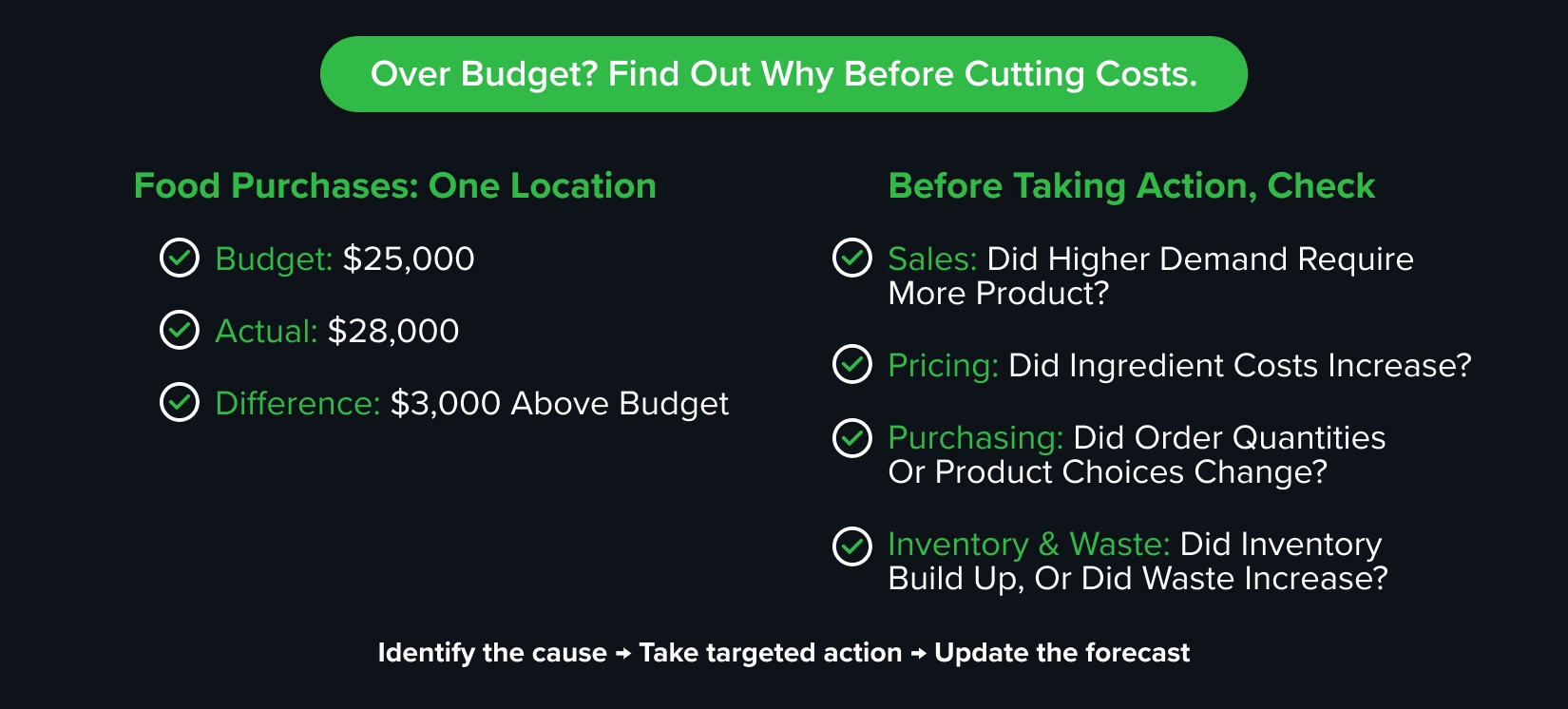
Say a location budgeted $25,000 for food purchases but spent $28,000.
That $3,000 difference is worth investigating. But before treating it as overspending, check whether sales were higher than expected or ingredient prices changed.
Identify the Causes of Budget Variances
The numbers tell you where to look. They don’t always tell you what went wrong.
Higher labor expenses could mean poor scheduling, but they could also reflect increased sales or temporary staffing needs.
Take time to understand what’s behind the difference.
Take Corrective Action
Once you know what’s causing a problem, make a plan to address it.
That might involve changing order quantities, reviewing supplier agreements, adjusting schedules, or finding ways to reduce food waste.
Focus on changes that address the actual issue rather than cutting expenses without understanding the consequences.
Update Budgets Based on New Data
Things change during the year.
If sales aren’t meeting expectations or supplier costs have increased, your forecasts should reflect that.
Keep the original budget for comparison, but update your financial outlook so you’re making decisions based on current information.
Key Metrics to Track in a Multi-Unit Restaurant Budget
You don’t need to track every possible number to understand how a restaurant is performing.
But there are a handful of metrics that deserve regular attention, particularly when you’re comparing financial results across multiple locations.
Revenue
Revenue tells you how much money a restaurant is bringing in through sales.
Compare actual sales with projected revenue, and look at changes over time.
A location missing its revenue target for several months may need a closer look at customer traffic, average check size, or local market conditions.
Food Cost Percentage
Food cost percentage measures how much of your food sales revenue goes toward the cost of food sold.
To calculate it, divide food cost by food sales and multiply by 100.
If that percentage starts climbing, review ingredient pricing, waste, portioning, and purchasing practices to see what’s changed.
Labor Cost Percentage
Labor cost percentage shows how much of your revenue goes toward employee-related expenses.
Divide total labor costs by total revenue and multiply by 100.
This number can help you spot scheduling inefficiencies or identify restaurants where staffing expenses are increasing faster than sales.
Prime Cost
Prime cost combines your cost of goods sold and labor expenses.
It’s one of the more useful numbers to monitor because it brings together two major areas of restaurant spending.
If prime cost is increasing, take a closer look at whether the change is coming from purchasing, labor, or both.
Operating Expenses
Rent, utilities, insurance, maintenance, and other operating expenses should be reviewed regularly.
Some costs won’t change much from month to month, but others can creep up.
Comparing actual expenses against budgeted amounts helps you catch increases that might otherwise go unnoticed.
Profit Margin
Profit margin tells you how much revenue remains after expenses.
A restaurant might be generating strong sales but still struggling to make money because its costs are too high.
Looking at profit margins alongside revenue gives you a more complete understanding of financial performance.
Purchase Price Variance
Purchase price variance measures the difference between what you expected to pay for a product and what you actually paid.
If a restaurant normally pays $40 for a case of product and the price increases to $45, that difference matters.
Multiply it across weekly orders and several locations, and the additional spending can become substantial.
Rebate Capture and Savings
If your restaurants participate in rebate programs, keep track of what they’re eligible to earn and what they’ve actually received.
Missed rebates can mean missed savings.
Regular reviews can help ensure locations are purchasing qualifying products and meeting program requirements.
Common Multi-Unit Restaurant Budgeting Mistakes
Even well-managed restaurant groups can run into budgeting issues.
Sometimes it’s a matter of working with outdated numbers. Other times, it’s overlooking purchasing expenses or assuming every location should perform the same way.
These are a few mistakes that can make restaurant budgeting more difficult than it needs to be.
Using the Same Budget for Every Location
Two restaurants can operate under the same brand and still have completely different financial needs.
One might pay significantly more in rent. Another could have higher labor costs or lower customer traffic.
Using identical budgets doesn’t account for those differences.
Set expectations based on each restaurant’s operating conditions instead of applying the same numbers across the board.
Relying on Outdated Sales and Cost Data
Restaurant expenses don’t stand still.
Supplier prices change, wages increase, and customer demand shifts.
If your budget is built around numbers that no longer reflect what your restaurants are experiencing, it’s going to be difficult to manage spending accurately.
Review current costs before making projections.
Overlooking Supplier Price Changes and Negotiation Opportunities
It’s easy to focus on the total amount of a supplier invoice without paying much attention to individual product prices.
But small increases can add up quickly, particularly on items your restaurants order every week.
Review pricing regularly and make sure your locations are using the purchasing agreements available to them.
Failing to Monitor Location-Level Variances
When you only look at financial results for the entire restaurant group, individual problems can get buried.
One location might be performing well enough to offset losses at another.
Review each restaurant’s actual spending against its budget so you can identify issues before they become larger financial concerns.
Setting Revenue Targets Without Cost Considerations
More sales are great, but only if the restaurant can manage the expenses that come with them.
A location might increase revenue while also spending significantly more on food, labor, and other operating costs.
Make sure your revenue goals account for what it will cost to achieve them.
Creating a Budget and Not Revisiting It
A lot can happen between January and December.
Food prices increase. Sales slow down. Staffing needs change.
If you’re still relying on the same financial assumptions several months later, your budget may no longer reflect what’s happening.
Review performance regularly and adjust forecasts when needed.
Ignoring Indirect Spend and Procurement Savings Opportunities
Food gets plenty of attention when restaurants review spending, but it’s not the only place where costs add up.
Disposables, cleaning products, uniforms, maintenance services, and other indirect purchases can represent significant expenses across multiple locations.
These categories are worth reviewing for potential savings, especially if your restaurant group isn’t already taking advantage of negotiated supplier agreements.
Leverage Consolidated Concepts for Better Budget Management
Keeping restaurant budgets on track isn’t always about cutting expenses. Sometimes it’s about taking a closer look at what you’re already purchasing and whether you’re getting the best value.
That’s where Consolidated Concepts comes in.
We work with multi-unit restaurant operators to identify purchasing opportunities, review supplier agreements, and find ways to reduce costs across locations.
Through our procurement programs and supplier relationships, we help restaurant groups access negotiated pricing and eligible rebates on products they’re already buying.
If you’re looking for ways to bring purchasing costs under control and make your restaurant budget work harder, we’re here to help.
Let’s take a closer look at where your restaurants could be saving. Click here to contact Consolidated Concepts to learn more about our procurement solutions.
FAQs
How do you create a budget for multiple restaurant locations?
Start with sales and expense data from each restaurant. Build individual budgets that account for food, labor, operating expenses, and local conditions. Once those are complete, combine them to establish financial targets for the group. Review performance regularly to see where adjustments are needed.
How often should a multi-unit restaurant update its budget?
Restaurant groups should review budget performance at least monthly. Sales, labor, and food costs may need more frequent attention. While an annual budget provides a starting point, forecasts should be updated when costs or operating conditions change.
What costs should multi-unit restaurants include in their budget?
Include food and beverage purchases, labor, rent, utilities, insurance, maintenance, technology, marketing, and equipment expenses. Restaurant budgeting should also account for supplier costs, eligible rebates, expected procurement savings, and unexpected expenses.
How can restaurant operators control costs across locations?
Start by comparing spending between restaurants. Review supplier pricing, establish purchasing guidelines, monitor food and labor costs, and look for opportunities to combine purchasing volume. Regular budget reviews can help identify expenses that need attention.
What is the difference between a restaurant budget and a forecast?
A budget outlines what a restaurant plans to earn and spend during a specific period. A forecast estimates what the restaurant is likely to earn and spend based on current performance. The budget establishes the original financial plan, while forecasts help operators adjust expectations as conditions change.
How can budgets account for supplier price changes?
Review current supplier pricing, track historical increases, and account for expected cost changes when building your budget. Keep an eye on frequently purchased products and update forecasts when significant price changes occur. Negotiated purchasing agreements may also help manage certain costs.
What role do rebates play in restaurant budgeting?
Rebates can help reduce the net cost of eligible purchases. Multi-unit operators should track which programs their restaurants qualify for, how much they’re expected to earn, and whether payments have been received. This makes it easier to account for purchasing savings without overstating expected financial benefits.