
Here’s a scenario that’s probably familiar if you oversee multiple restaurant locations.
Two restaurants serve nearly the same menu. They’re in similar markets, see comparable guest traffic, and generate almost identical sales. Yet one consistently delivers stronger profits than the other.
Those gaps rarely come from one major issue. More often, they’re the result of dozens of small decisions made every day. Purchasing habits drift. Food costs creep up. Labor is scheduled differently. One location follows established processes while another develops its own way of doing things.
That’s what makes profitability so challenging for multi-unit operators. As organizations grow, it’s harder to spot inconsistencies before they start affecting financial performance.
Improving restaurant profit margin isn’t simply about selling more food. It’s about understanding what’s happening behind the numbers, identifying where money is quietly being lost, and creating consistency across every location.
In this guide, we’ll walk through the metrics, benchmarks, and practical strategies that can help restaurant groups improve profitability while building a stronger, more efficient operation.
Why Profit Margins Matter for Multi-Unit Restaurants
When you’re responsible for several restaurants, it’s easy to judge performance by sales alone. A location that’s busy from open to close usually feels like it’s doing well.
But sales only tell part of the story.
A restaurant can have full tables every night and still struggle to produce healthy margins if purchasing costs are inconsistent, labor isn’t managed effectively, or operating expenses continue to climb. That’s why experienced operators spend just as much time reviewing profitability as they do revenue.
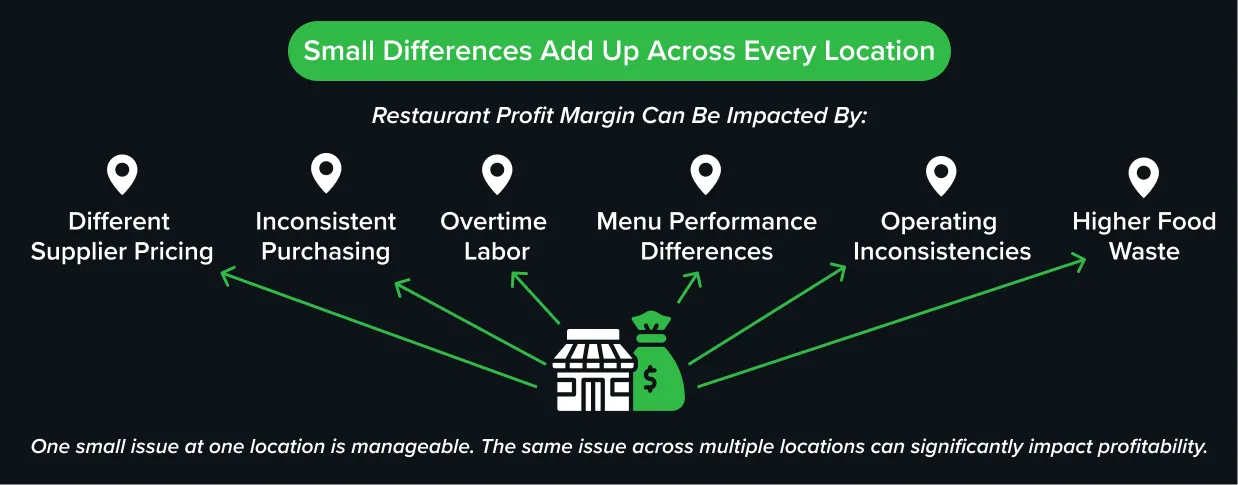
The goal isn’t to find the location that sells the most. It’s to understand why one restaurant consistently performs better than another.
Sometimes the difference comes down to food costs. Other times it’s labor scheduling, purchasing decisions, inventory management, or even small operational habits that develop over time. Individually, those issues may seem insignificant. Across an entire restaurant group, they can quietly reduce profitability.
Regularly reviewing profit margins helps leadership answer important questions, including:
- Which restaurants are consistently outperforming the rest of the organization?
- Are food, labor, and operating costs staying in line across every location?
- Is each restaurant following the same purchasing standards and supplier programs?
- Where are small operational issues starting to affect financial performance?
- Which locations would benefit from additional coaching or operational support?
The earlier those patterns become visible, the easier they are to address. Waiting until month-end reports or quarterly financials often means valuable time has already been lost.
For multi-unit restaurant groups, protecting restaurant profit margin isn’t about squeezing every possible dollar out of the business. It’s about creating consistency. When locations follow the same standards, purchasing decisions are aligned, and performance is measured the same way across the organization, leadership can spend less time reacting to problems and more time driving long-term growth.
Understanding Restaurant Profitability Metrics
Ask a group of restaurant operators how business is going, and chances are you’ll hear, “Sales are strong.”
That’s always good news, but revenue doesn’t automatically translate into profitability.
One location might be bringing in plenty of guests while quietly paying more for ingredients, scheduling more labor than necessary, or purchasing outside approved supplier programs. Another location with similar sales may be keeping more of every dollar it earns simply because it’s operating more efficiently.
That’s why restaurant groups track several financial metrics instead of relying on revenue alone. Each one tells a different part of the story, and together they provide a clearer picture of what’s really driving profitability across the organization.
Gross Profit Margin
Gross profit margin is often the first place operators look because it focuses on the relationship between sales and the cost of the food and beverages being served.
If gross margin starts slipping, it’s usually an early sign that something has changed.
Maybe supplier pricing increased. Maybe portion sizes have grown over time. Perhaps waste is creeping up or a menu item that used to perform well has become more expensive to produce.
Catching those trends early gives operators time to adjust before they begin affecting profitability across every location.
Operating Profit Margin
Operating profit margin looks beyond food costs and includes the expenses required to keep each restaurant running day after day.
Labor, occupancy costs, utilities, insurance, technology, and other operating expenses all become part of the conversation.
This is also where comparisons between locations become especially valuable.
Two restaurants might generate nearly identical sales, but one consistently delivers stronger results because managers are controlling labor more effectively, following purchasing standards, or operating more efficiently. Looking at operating margins side by side helps leadership identify what’s working and where additional coaching may be needed.
Net Profit Margin
Net profit margin answers the question every restaurant group eventually asks:
After everything is paid, how much does the business actually keep?
This number reflects the combined impact of every decision made throughout the organization. Purchasing, labor, menu pricing, occupancy costs, and overhead all contribute to the final result.
It’s also one of the best ways to evaluate whether growth is creating healthier financial performance or simply adding more complexity and expense.
EBITDA and Restaurant Financial Performance
Many multi-unit restaurant organizations also track EBITDA when evaluating overall business performance.
Because it removes factors like interest, taxes, depreciation, and amortization, EBITDA gives leadership another way to compare locations and measure operational performance on a more consistent basis.
It’s especially useful when discussing financial performance with lenders, investors, or ownership groups because it focuses more directly on how the restaurants themselves are operating.
No single metric tells the whole story. Looking at gross profit, operating profit, net profit, and EBITDA together gives operators a more complete understanding of where margins are improving, where they’re under pressure, and where attention should be focused next.
Benchmarking Restaurant Profit Margins Across Multiple Locations
Every restaurant operator wants to know how their business compares to everyone else.
Industry benchmarks can be helpful because they provide context, but they rarely tell the entire story.
A restaurant group with an 8% profit margin could be outperforming similar concepts in its market. Another business with the same margin may have room for significant improvement because its food costs, labor model, or purchasing practices are inconsistent across locations.
That’s why the most successful operators use benchmarks as a reference point, not the finish line.
The more valuable comparison is often happening inside your own organization. Understanding why one restaurant consistently outperforms another can uncover opportunities that no industry report will ever show.
Average Restaurant Profit Margin by Concept Type
Restaurant profit margins vary by concept because every business operates with a different cost structure.
In general, quick-service and fast-casual restaurants tend to report net profit margins between 6% and 10%, thanks to standardized menus, faster table turns, and lower labor costs. Full-service restaurants typically operate in the 3% to 5% range because they carry higher labor, occupancy, and operating expenses.
Those benchmarks provide helpful context, but they shouldn’t be the only measure of success. A restaurant group that consistently controls purchasing costs, standardizes operations, and manages supplier relationships can outperform industry averages over time.
QSR vs. Fast-Casual vs. Full-Service Benchmarks
Different restaurant segments naturally produce different margin expectations.
Quick-service restaurants often benefit from standardized menus, streamlined production, and lower labor requirements.
Fast-casual concepts typically invest more in ingredient quality, customization, and guest experience, creating a different balance between food and labor costs.
Full-service restaurants generally carry higher operating expenses because they require larger teams, broader menus, and table service.
Those differences matter when evaluating performance. Rather than asking which segment has the highest margins, it’s more productive to ask whether your restaurants are performing as well as similar brands operating under comparable conditions.
Franchise vs. Corporate-Owned Restaurant Performance
Ownership structure also plays a role in profitability.
Franchise operators often gain the advantage of established purchasing programs, operating procedures, and brand recognition. At the same time, they also manage royalty payments and franchise fees that company-owned locations don’t face.
Corporate-owned restaurant groups have more flexibility when it comes to purchasing strategies, supplier negotiations, and operational standards, but they’re also responsible for building those systems themselves.
Neither model guarantees stronger financial performance. In most cases, consistent execution has a much greater impact on profitability than ownership structure alone.
Factors That Influence Margin Benchmarks
Even restaurants with similar menus and service models won’t always produce the same financial results.
Profitability is influenced by hundreds of operational decisions, but a few areas tend to have the greatest impact:
- Supplier pricing and purchasing consistency.
- Food and beverage cost management.
- Labor scheduling and team productivity.
- Occupancy expenses and local market conditions.
- Menu pricing and product mix.
- Inventory management, rebates, indirect spend, and operational discipline.
Industry benchmarks provide useful perspective, but they shouldn’t be the only yardstick. For multi-unit operators, comparing locations against one another often reveals opportunities that are far more actionable than national averages.
The objective isn’t simply to match an industry benchmark. It’s to build an organization where every restaurant is operating with the same discipline, the same standards, and the same commitment to long-term profitability.
Key Factors That Impact Restaurant Profit Margins
Ask three restaurant operators why margins are under pressure, and you’ll probably get three different answers.
One will point to rising food costs. Another will blame labor. Someone else will tell you it’s occupancy costs or shrinking guest traffic.
The truth is, profitability usually isn’t driven by one expense. It’s the combined effect of dozens of decisions being made across every restaurant in the organization. That’s why successful multi-unit operators don’t focus on a single cost category. They look at the bigger picture and identify where small improvements can add up over time.
Food and Beverage Costs
Food and beverage costs are often the first place operators look, and for good reason. Even small changes in ingredient pricing or purchasing habits can have a noticeable impact when they’re multiplied across several locations.
Maybe produce prices increased. Maybe one restaurant is buying outside approved supplier programs. Or maybe portion sizes have gradually become less consistent. Individually, those issues might not seem significant. Together, they can quietly reduce margins.
When reviewing food costs, it’s worth asking questions like:
- Are all locations purchasing through approved suppliers?
- Is pricing consistent across the organization?
- Which menu items continue to deliver healthy margins?
- Are waste or spoilage trends showing up in certain locations?
The goal isn’t simply to spend less on food. It’s to make purchasing decisions more consistently so every restaurant benefits from the same standards, negotiated pricing, and supplier relationships.
Labor and Staffing Expenses
Labor remains one of the largest investments for any restaurant group, and one of the hardest to manage consistently.
Staffing needs change throughout the week. Hiring challenges continue in many markets, and overtime or inefficient scheduling can quickly affect profitability.
The strongest operators don’t look at labor as a number to cut. They focus on making schedules work smarter.
Reviewing labor performance across locations often highlights opportunities to improve productivity without compromising the guest experience. Cross-training employees, aligning schedules with demand, and sharing best practices between managers can all strengthen financial performance over time.
Occupancy and Operating Costs
Not every expense changes when sales increase or decrease.
Rent, utilities, insurance, equipment maintenance, and other operating costs continue regardless of how busy the dining room is. While many of these expenses are fixed in the short term, they’re still worth reviewing on a regular basis.
Comparing locations can uncover trends that deserve attention. One restaurant may have unusually high utility costs. Another may be spending more on equipment repairs than similar locations. Those differences don’t always point to a major problem, but they often identify opportunities to improve operational efficiency before costs continue to grow.
Marketing, Technology, and Administrative Expenses
Running multiple restaurants takes more than purchasing food and scheduling employees. Behind every successful operation is a long list of business expenses that support the day-to-day operation.
Marketing platforms, online ordering services, POS systems, accounting software, payroll providers, office supplies, uniforms, janitorial products, and other indirect purchases all contribute to overall operating costs.
These investments are often necessary, but they’re still worth evaluating. Are different locations using different vendors? Are teams taking advantage of negotiated contracts and available rebates? Are there opportunities to standardize indirect purchasing across the organization?
Looking beyond food and labor helps operators uncover savings that often go unnoticed. Over time, improving consistency across both direct and indirect spending can strengthen profitability without affecting the guest experience.
Strategies to Improve Restaurant Profit Margins
Most operators aren’t looking for one big change that magically transforms profitability. More often, stronger margins come from making small improvements in several areas of the business.
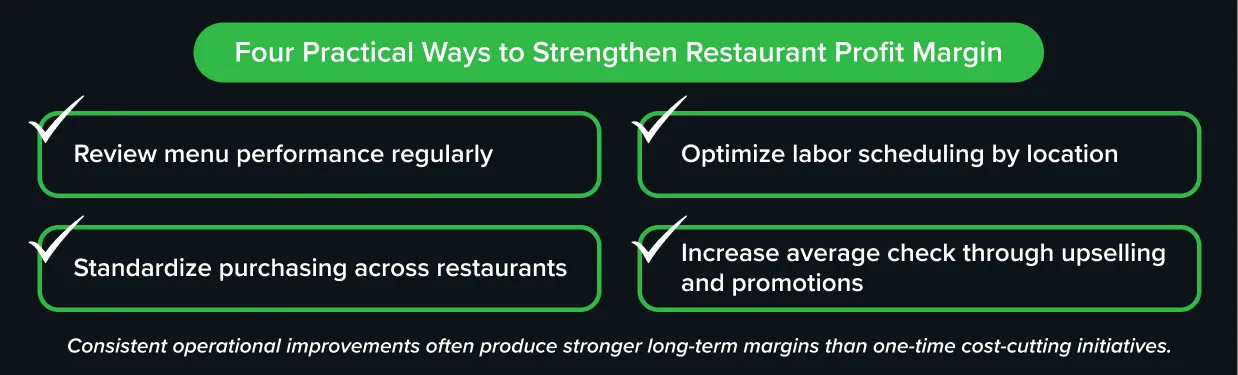
The key is focusing on the changes your team can actually control. While inflation, labor markets, and commodity prices may fluctuate, there are still plenty of opportunities to strengthen restaurant profit margin through smarter day-to-day decisions.
Improve Menu Mix and Menu Engineering
Not every item on the menu contributes equally to the bottom line.
Some dishes are customer favorites but generate very little profit. Others deliver strong margins but don’t get ordered often enough. Looking at menu performance through both lenses helps operators make better decisions about pricing, placement, and promotions.
As you review your menu, consider questions like:
- Which items consistently produce healthy margins?
- Are low-performing menu items still earning their place?
- Have ingredient costs changed enough to justify a pricing adjustment?
- Are high-margin items being promoted effectively?
A menu should evolve alongside your business. Regular reviews can uncover opportunities that aren’t always obvious during the daily rush.
Optimize Labor Efficiency
Building an efficient schedule isn’t just about reducing hours. It’s about having the right people in the right place when they’re needed.
Staffing based on actual sales patterns instead of habit can help restaurants avoid unnecessary labor costs without sacrificing service. Cross-training employees, reducing overtime where possible, and reviewing labor reports by location can also reveal opportunities for improvement.
When every restaurant follows similar scheduling practices, it’s easier to spot locations that may need additional coaching or operational support.
Reduce Operational Costs
Some of the biggest savings come from expenses that rarely get much attention.
One location may be paying more for the same products. Another might be ordering unnecessary inventory or relying on suppliers outside established purchasing programs. Indirect expenses like smallwares, cleaning supplies, uniforms, office products, and other operational purchases can also vary significantly from one location to the next. On their own, these issues may seem minor. Across multiple restaurants, they can have a noticeable impact on restaurant profit margin.
Operators who review purchasing activity regularly are often better positioned to identify:
- Price differences between locations.
- Opportunities to consolidate suppliers.
- Products that aren’t being purchased according to company standards.
- Spending patterns that deserve a closer look.
- Missed rebate opportunities or contract savings across the organization.
The goal isn’t simply to spend less. It’s to make purchasing decisions more consistent across the organization while maximizing the value of negotiated supplier programs, rebates, and indirect purchasing opportunities.
Increase Average Check Size
Growing sales doesn’t always require serving more guests.
Sometimes the biggest opportunity comes from increasing the value of each transaction.
Suggestive selling, limited-time offers, premium add-ons, bundled meals, and beverage pairings can all encourage higher average checks while improving the guest experience. Even modest increases can make a meaningful difference when they’re repeated thousands of times across multiple locations.
Healthy restaurant profit margins are usually built through steady, intentional improvements rather than dramatic changes. When menu performance, labor, purchasing, and guest spending all move in the right direction, those incremental gains begin to compound across the entire restaurant group.
Common Profitability Challenges for Multi-Unit Operators
Managing profitability across one restaurant is challenging enough. Multiply that across five, 25, or 100 locations, and even small inconsistencies can become expensive.
A purchasing issue at one restaurant may not seem like a big deal. The same issue happening across an entire organization is a different story.
The most successful restaurant groups don’t just react to declining margins. They look for patterns before they become bigger operational problems. That starts with understanding where profitability tends to slip.
Cost Variations Across Locations
No two restaurants will operate exactly the same, but large differences between locations are worth investigating.
Maybe one restaurant is paying more for the same products. Another consistently has higher food costs, while a third is purchasing items outside company standards. None of those situations automatically signals a major issue, but they all deserve a closer look.
When reviewing performance across your organization, ask questions such as:
- Are all locations purchasing through approved supplier programs?
- Is negotiated pricing being used consistently?
- Which restaurants regularly outperform the rest of the group?
- What operational habits make those locations more successful?
Comparing locations side by side often uncovers opportunities that aren’t obvious when each restaurant is reviewed on its own.
Labor Cost Inflation
Labor remains one of the biggest variables affecting restaurant profitability.
Wage increases, hiring challenges, employee turnover, and changing guest traffic patterns all make scheduling more difficult than it was just a few years ago.
While operators can’t control the labor market, they can create more consistent staffing practices. Reviewing schedules alongside sales trends, sharing successful approaches between locations, and monitoring productivity can help improve labor performance without sacrificing service.
The objective isn’t simply to schedule fewer hours. It’s to make sure every labor dollar is being used effectively.
Supply Chain Volatility
Restaurant purchasing rarely stays the same for long.
Commodity prices fluctuate. Freight costs change. Product availability shifts with weather, seasonality, and market conditions. Even long-standing supplier relationships can be affected by broader supply chain disruptions.
Rather than reacting to every price increase, many multi-unit operators focus on building purchasing strategies that provide greater stability over time. Contract compliance, supplier performance, purchasing visibility, and regular spend reviews all help restaurants respond more confidently when market conditions change.
For more insight into the challenges affecting restaurant purchasing, read our blog, Top 10 Supply Chain Risks Facing Restaurants Today.
Operational Inefficiencies
Not every margin problem comes from a major expense.
Sometimes profitability erodes because of small operational habits that develop over time. Extra inventory sits on the shelf. Duplicate products are ordered. Managers follow different purchasing processes. Rebate opportunities are missed because locations aren’t buying through negotiated programs. Indirect purchases gradually expand without anyone noticing.
None of those issues is likely to derail a restaurant on its own. Across multiple locations, however, they can quietly put pressure on margins year after year.
That’s why consistency matters. Standardized purchasing practices, regular performance reviews, and better visibility into spending make it much easier to identify problems early and keep every location moving in the same direction.
How to Measure and Monitor Profit Margin Performance
Most restaurant leaders don’t want surprises when the monthly financials arrive.
If margins are moving in the wrong direction, the goal is to spot the trend before it becomes a much bigger issue.
That doesn’t mean reviewing every report every day. It means creating a routine that gives leadership meaningful visibility into how each location is performing and where additional attention may be needed.
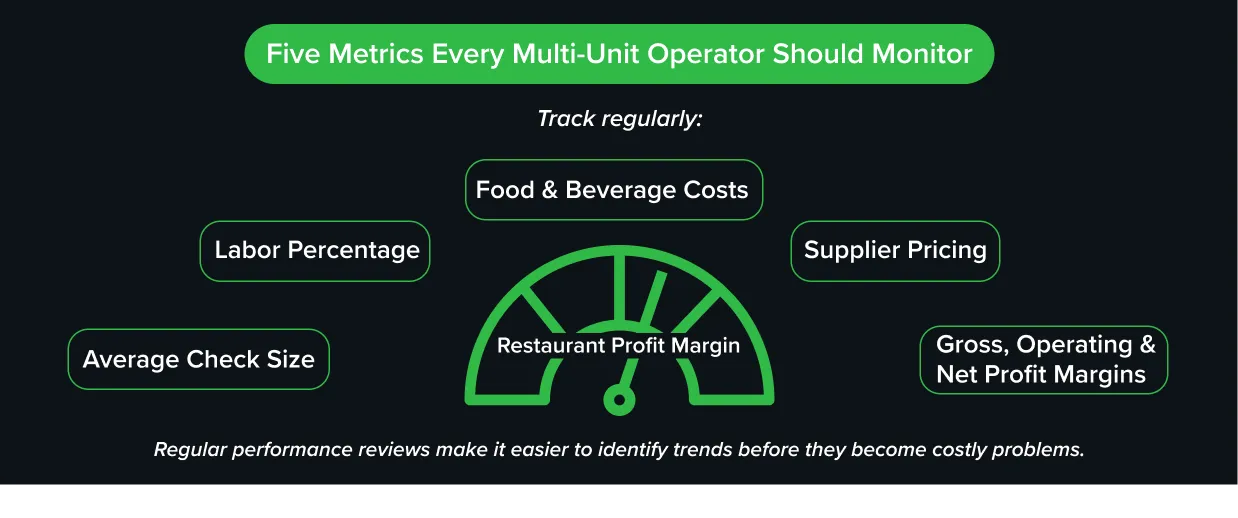
Many multi-unit restaurant groups regularly monitor:
- Food and beverage costs by location.
- Labor percentages and scheduling trends.
- Purchasing activity and supplier compliance.
- Contract utilization, rebate performance, and indirect spend.
- Average check size and menu performance.
- Gross, operating, and net profit margins.
Looking at these metrics together provides a much more complete picture than reviewing them individually.
For example, if food costs increase at the same time a location stops purchasing through negotiated suppliers, the reason behind declining margins becomes much easier to identify. The same applies when labor trends, menu performance, and purchasing data are reviewed side by side instead of in separate reports.
The goal isn’t to collect more data. It’s to use the information you already have to make better operational decisions, identify opportunities sooner, and help every restaurant perform more consistently over time.
How Consolidated Concepts Helps Improve Restaurant Profitability
Improving restaurant profit margin isn’t always about finding another place to cut costs. Often, it’s about creating more consistency across the organization.
As restaurant groups expand, purchasing naturally becomes more complicated. Different locations may buy from different suppliers, pricing can vary between markets, and managers often make decisions based on what’s available rather than what’s been negotiated.
Consolidated Concepts helps restaurant operators bring more structure to that process through national purchasing programs, supplier partnerships, and procurement expertise designed specifically for multi-unit organizations.
With a more strategic purchasing approach, operators can:
- Improve purchasing consistency across locations.
- Strengthen supplier relationships.
- Increase visibility into food and supply spending.
- Support better purchasing decisions as the business grows.
- Create opportunities to improve long-term profitability.
Every restaurant group has different goals, but having a consistent purchasing strategy gives leadership a stronger foundation for managing costs while supporting growth.
Final Thoughts
Building a profitable restaurant is an achievement. Building a consistently profitable restaurant group is where things become more challenging.
As your organization grows, so do the variables that affect financial performance. Purchasing, labor, menu pricing, supplier relationships, and day-to-day operational decisions all play a role in protecting your margins. The good news is that meaningful improvements rarely come from one dramatic change. They’re usually the result of making smarter, more consistent decisions over time.
The restaurant groups that consistently outperform their peers don’t wait until margins begin slipping to take action. They review performance regularly, look for trends across locations, and make adjustments before small issues become expensive ones.
If you’re looking for ways to create more consistency across your purchasing strategy and improve profitability as your organization grows, click here to contact Consolidated Concepts to learn how our purchasing programs, supplier network, and procurement expertise can help support your long-term goals.
FAQs
What Is a Good Restaurant Profit Margin?
A healthy net profit margin is typically 3% to 5% for full-service restaurants and 6% to 10% for quick-service and fast-casual concepts. Actual results vary by concept and operating costs.
How Do Restaurant Chains Calculate Profit Margin?
Most restaurant chains use this formula: Net Profit Margin = (Net Profit ÷ Total Revenue) × 100
What Factors Affect Restaurant Profitability the Most?
The biggest drivers are food costs, labor, supplier pricing, occupancy costs, purchasing consistency, menu mix, and operational efficiency.
How Can Multi-Unit Restaurants Improve Profit Margins?
Improve purchasing consistency, manage labor effectively, monitor food costs, maximize rebates, standardize indirect spend, and compare performance across locations.
What Is the Difference Between Gross and Net Profit Margin?
Gross profit margin measures revenue after cost of goods sold (COGS). Net profit margin measures revenue after all business expenses have been paid.
How Often Should Restaurant Profit Margins Be Reviewed?
Review profit margins monthly and monitor food costs, labor, purchasing, and supplier pricing throughout the month.