Category: Supply Chain Management

Restaurant Growth Strategy: How Operators Can Scale Profitably

Restaurant Growth Strategy: How Operators Can Scale Profitably

The restaurant industry is no stranger to challenges, and this year many operators anticipate facing the same hurdles that have defined recent years. Labor costs, food costs, and recruiting and retaining employees remain top concerns for both full-service and limited-service restaurant operators. Despite these challenges, growth is on the horizon—29% of operators plan to expand and open new locations in 2025.

So, how can multi-unit restaurant operators navigate rising costs, workforce struggles, and supply chain complexities while still driving profitability and expansion? The answer lies in leveraging strategic partnerships and advanced solutions designed to streamline operations and optimize costs. A well-planned restaurant growth strategy can help operators scale efficiently while maintaining financial health.

Rebates & Deviations: Reducing Food Costs at Scale 

Food costs continue to be a top concern for restaurant operators, and as commodity prices fluctuate, managing expenses becomes increasingly difficult. Through Consolidated Concepts, multi-unit operators gain access to powerful cost-saving programs, including rebates and deviations. 

  • Rebates: By leveraging the collective purchasing power of multi-unit operators, Consolidated Concepts negotiates exclusive rebates on essential ingredients and supplies. These rebates put money back into your business, helping to offset rising costs and support your restaurant growth strategy.
  • Deviations: Custom pricing agreements ensure you’re paying the most competitive prices across all your locations. This approach prevents price discrepancies and helps control costs, allowing you to expand without financial strain.

Data & Technology: Powering Smarter Growth

Having real-time access to purchasing data and analytics is crucial for making informed business decisions. Consolidated Concepts provides multi-unit operators with advanced procurement technology that delivers deep insights into spending patterns, cost trends, and supplier performance. 

  • Price verification tools help ensure that you’re being charged correctly for every invoice, eliminating overcharges and improving cost accuracy. 
  • Purchasing analytics provide real-time visibility into food and supply costs, allowing operators to make data-driven decisions that drive savings and operational efficiency. 
  • Forecasting technology helps operators anticipate cost fluctuations, making it easier to budget for future purchases. 

Supply Chain Management: A Growth Strategy Essential

Between ongoing supply chain disruptions and increased demand for quality ingredients, managing procurement has never been more complex. Consolidated Concepts helps multi-unit restaurant operators streamline their supply chains by optimizing vendor relationships, ensuring product availability, and improving overall efficiency. 

  • Strategic sourcing solutions help operators secure reliable, cost-effective ingredients while maintaining quality and consistency—an essential aspect of any restaurant growth strategy.
  • Distribution management services prevent stockouts, delays, and supply chain inefficiencies that could impact operations. 
  • Customized procurement strategies help multi-unit operators source the best products while balancing cost and quality. 

Produce Management: Elevating Freshness in Your Growth Plan

Consumers continue to demand fresh, high-quality ingredients, making produce management a top priority for restaurants. Consolidated Concepts provides operators with expert produce procurement services to help maintain consistency and reduce waste. 

  • Sourcing from a trusted network of suppliers ensures that operators receive the freshest, highest-quality produce year-round. 
  • Quality assurance support helps ensure that every shipment meets your restaurant’s standards. 
  • Price benchmarking tools allow operators to compare pricing across multiple vendors to ensure they’re getting the best deal—a key component of a cost-efficient restaurant growth strategy.

Custom Contracts: Aligning Pricing with Growth Goals

Every restaurant brand has unique needs, and off-the-shelf supplier agreements don’t always align with business goals. That’s why Consolidated Concepts works with multi-unit operators to create customized contracts that align with their purchasing priorities. 

  • Negotiated agreements help operators secure exclusive pricing and terms that align with their long-term growth strategies. 
  • Category management support ensures that operators are optimizing their purchasing in key areas like proteins, beverages, and disposables. 
  • Flexibility in supplier selection allows restaurant brands to work with vendors that best suit their operational needs. 

Indirect Spend Savings: Reducing Costs to Scale Smarter

Food costs aren’t the only expenses putting pressure on restaurant margins—indirect spend categories like equipment, utilities, and maintenance also contribute to rising operational costs. Consolidated Concepts helps operators reduce indirect spend through exclusive programs and partnerships. 

  • Discounted pricing on essential supplies including kitchen equipment, uniforms, linens, and more. 
  • Technology solutions for non-food procurement streamline purchasing for facilities management, cleaning supplies, and other operational needs. 
  • Energy efficiency programs help operators lower utility costs through optimized energy usage and rebate opportunities—a critical factor in sustainable restaurant growth.
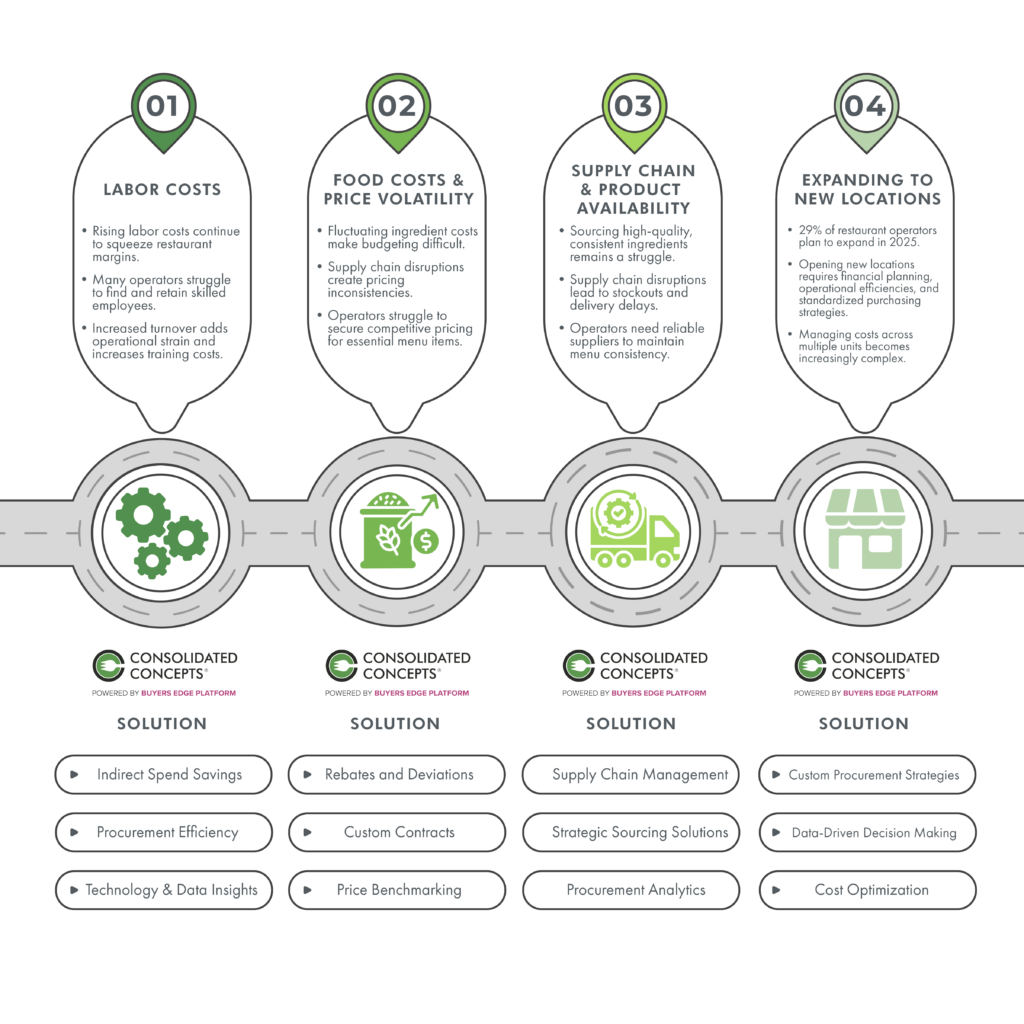
A clean and structured infographic with a restaurant industry theme, featuring icons for each challenge and solution related to labor costs, food costs, supply chain recruitment, and retention

Executing a Winning Restaurant Growth Strategy

With nearly a third of restaurant operators planning to expand in 2025, having a restaurant growth strategy in place is critical for success. Consolidated Concepts provides the tools, data, and supplier partnerships needed to scale efficiently while maintaining financial health. 

By leveraging rebates, data analytics, supply chain management, produce procurement, custom contracts, and indirect spend savings, multi-unit operators can address their biggest challenges while positioning their business for long-term growth.

Want to see how Consolidated Concepts can support your restaurant growth strategy? Fill out the form below and get in touch with our restaurant experts today!

How to Scale Your Restaurant Chain Without Wasting Money

How to Scale Your Restaurant Chain Without Wasting Money

Scaling a restaurant chain is an exciting opportunity—but without the right strategies, it can also lead to wasted money, inefficiencies, and unnecessary costs. Multi-unit restaurant operators must be strategic with purchasing, labor, and operations to maintain profitability while expanding. 

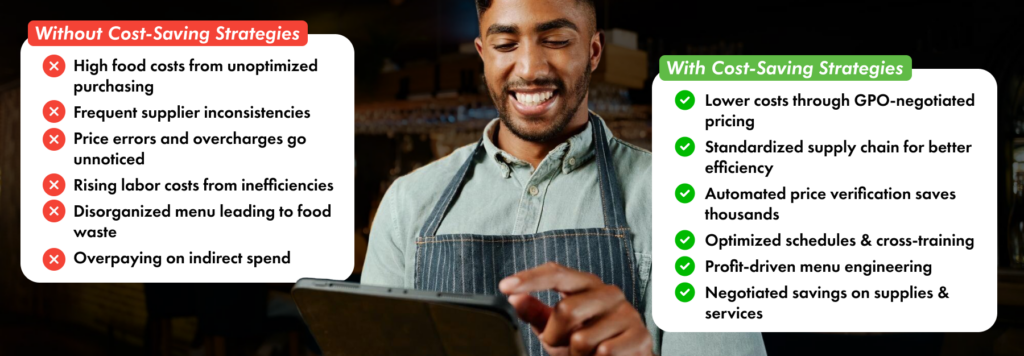
an infographic called Scaling Smart: What's the Cost of Inefficiency?

The good news? With the right cost-saving strategies, you can grow your restaurant brand without letting expenses spiral out of control. 

At Consolidated Concepts, we specialize in helping multi-unit operators optimize purchasing, supply chain management, and operational efficiency to reduce waste and increase profits.

How to Scale Your Restaurant Chain?

Here’s how you can scale your restaurant smartly while keeping costs in check. 

1. Leverage Group Purchasing Power for Better Pricing

As you expand your restaurant chain, your purchasing power grows—but are you using it effectively? The more locations you operate, the greater your ability to negotiate better pricing. However, many restaurant operators leave money on the table by not leveraging their full purchasing volume. 

Instead of sourcing independently, multi-unit operators should: 

  • Consolidate suppliers to secure volume-based discounts. 
  • Negotiate better vendor contracts based on chain-wide buying power. 

Savings Impact: Multi-unit operators can reduce food and supply costs by 10%-35% by leveraging strategic purchasing programs. 

2. Optimize Supply Chain Management to Cut Waste

A growing restaurant chain means more suppliers, more orders, and more opportunities for inefficiencies. Supply chain mismanagement—such as over-ordering, inconsistent inventory, or redundant suppliers—can quickly inflate costs. 

To avoid waste and inefficiency, operators should: 

  • Standardize ingredient selection across all locations to avoid excess inventory. 
  • Use data-driven demand forecasting to ensure accurate ordering. 
  • Streamline vendor relationships to prevent duplication and inconsistencies. 

By tightening supply chain processes, operators can reduce food waste, prevent stockouts, and save thousands annually. 

 3. Automate Price Auditing and Verification

Many multi-unit operators unknowingly overpay due to supplier pricing errors or invoice discrepancies. Without a system in place to verify pricing, you could be losing thousands of dollars per location. 

Instead of manually checking invoices, operators can: 

  • Monitor supplier compliance to catch overcharges and billing mistakes. 
  • Prevent margin erosion by tracking cost fluctuations in real-time. 

With automated price verification, restaurant chains can protect profits and prevent unnecessary overcharges. 

4. Control Labor Costs Without Sacrificing Service

Labor is one of the largest expenses in the restaurant industry, and as you expand, labor costs can skyrocket. However, reducing labor costs doesn’t have to mean cutting staff—it’s about working smarter, not harder. 

Multi-unit operators can save on labor by: 

  • Cross-training employees so staff can cover multiple roles, reducing the need for excess hires. 
  • Using technology to streamline scheduling and eliminate overtime costs. 
  • Investing in automation for time-consuming tasks like ordering, reporting, and invoicing. 

The key is balancing labor efficiency with customer experience—ensuring each location runs smoothly without excess labor costs. 

5. Engineer Your Menu for Profitability

Expanding your restaurant means more locations, more menus, and more opportunities for waste. Without proper menu engineering, operators risk higher food costs and lower margins. 

To optimize menu profitability, multi-unit operators should: 

  • Standardize recipes to keep ingredient costs consistent 
  • Promote high-margin items with strategic menu placement 
  • Minimize perishable inventory by incorporating shelf-stable and frozen options 

A well-engineered menu maximizes revenue per guest and prevents costly food waste. 

6. Reduce Indirect Spend on Non-Food Expenses

Beyond food and labor, indirect spend—such as cleaning supplies, linens, uniforms, and packaging—can quietly drain profits if left unmanaged. 

Multi-unit operators can slash indirect costs by: 

  • Negotiating better contracts on essential supplies. 
  • Consolidating vendors to eliminate redundant spending. 
  • Switching to energy-efficient equipment to lower long-term operational expenses. 

Many operators overlook indirect spend, but small savings across multiple locations add up to major cost reductions. 

7. Standardize Operations to Increase Efficiency

Scaling successfully requires operational consistency across locations. Inconsistent procedures lead to waste, inefficiencies, and unnecessary costs. 

To create operational efficiency, multi-unit operators should: 

  • Develop clear Standard Operating Procedures (SOPs) to streamline processes. 
  • Train managers to implement cost-control strategies across all locations. 
  • Use centralized reporting tools to monitor expenses and identify cost-saving opportunities. 

By standardizing best practices, restaurant chains can scale with efficiency—without financial waste. 

8. Invest in Technology to Scale Smarter

Restaurant technology is no longer optional—it’s a necessity for cost control and scalability. Multi-unit operators can save money and improve efficiency by investing in: 

  • Procurement software for supplier management and cost tracking 
  • Back-office integrations for real-time sales and inventory data 
  • AI-powered demand forecasting to optimize ordering and labor 

By embracing tech-driven solutions, operators can scale without unnecessary overhead costs. 

Scale Your Restaurant Smart with Consolidated Concepts

Growth doesn’t have to come with wasted money. By implementing smarter purchasing strategies, optimizing labor, reducing waste, and leveraging technology, multi-unit restaurant operators can scale profitably. 

At Consolidated Concepts, we help multi-unit operators reduce costs, negotiate better pricing, and optimize operations. Whether you need group purchasing power, supply chain solutions, or cost-saving strategies, we’ve got you covered. 

MDA-negotiation-

The Importance of Restaurants Assessing Master Distribution Agreements (MDAs) in Order to Reduce Costs and Improve Quality

Master Distribution Agreements are the cornerstone for most successful operations in the hospitality industry, at least in terms of optimum pricing and maintaining a solid and reliable supply chain. For restaurants, they provide a strategic and steady cost-saving agreement with their main broadline distributor. Or, at least, that’s what they are designed to do.

Once established, many restaurants maintain the same MDA for years, relying on what has developed into a comfortable relationship with their distributor. Yet this day in, day out, consistent steadiness can, like any relationship that has become somewhat stagnant, end up paralyzing a company’s forward movement and cost operators a percentage of their profits. Experts in procurement, and supply chain analysts, all agree that regular audits and assessments are key to long-term financial health and increased margins.

Here are a few key elements in MDAs that operators should pay attention to:

Contract Timeline

Many MDAs will contain an automatic renewal clause that allows distributors to renew a contract for a year, if they are not notified by the operator within 180 days of the contract termination. Know when your contract ends and take advantage of this opportunity to renegotiate. In addition, contracts that automatically renew often have a clause that allows for cost-of-living increases resulting in increased fees that many operators are unaware of.

When negotiating an MDA, ensure that there is a “no cause exit clause” which allows operators to terminate the agreement with a 60 or 90-day notice.

Auditing

Some contracts will limit the timeframe that a MDA can be audited. It’s important that you maintain the right to audit cost and obtain the actual manufacturer’s paid invoice. Allowances and product discounts should be included in your price. Keep in mind that auditing line-by-line can be extremely time-consuming. A third-party firm, such as Consolidated Concepts, has the software capabilities that make this act effortless, processing and organizing the needed data to accomplish an expert audit readily in real-time.

Drop Incentives

The bigger a load, the better pricing a distributor can normally provide. Make sure that your MDA contains this type of agreement. In essence, it states that as drop sizes increase, your product mark-up decreases. To take advantage of this, consider increasing your size while decreasing your frequency of deliveries with certain types of products.

GPOs

When assessing your MDA, check that it allows you to release data to a third party or Group Purchasing Organization. GPOs give restaurants the combined purchasing power of all of their members and can reduce restaurant costs by up to 30 percent. Dining Alliance is the largest GPO in the industry with a purchasing power of over $10 billion. They also offer a broadline program that includes fixed mark-ups, electronic weekly auditing, and over 350 manufacturer deviations and rebates

MDA Negotiation White Papers

Comparing MDAs

According to Barry Friends, a food industry consultant who spent over 20 years as an executive at three of the top five U.S. foodservice distributors, one of the biggest challenges facing restaurants in relation to MDAs is the lack of supply chain personnel as well as the disruption that can occur when sourcing food and operating supplies from just one broadline distributor. As he describes it, “No matter how much you (the operator) know, the distributors know more; they have all the power, and they are excellent at making their customers feel like they have a great deal.” This “great deal” may be far less than what they can actually offer. While costs are driven by the market, there are options that can be included in a MDA that can help reduce price volatility. What is the distributor’s base price, margin, and backend markup and service costs?

Leveraging an organization that works with hundreds of distributors across the nation, including specialized and smaller organizations, allows experts in the field to compare distribution agreements—an ability that makes a tremendous difference when optimizing a MDA.

As is evident, it takes years of experience in the procurement field to be able to address these types of issues with confidence. Consolidated Concepts helps restaurants by leveraging their expertise in supply chain management, operations, distribution, product management, and spend management, ultimately reducing costs while improving quality. As your business grows so too does the ability to negotiate better pricing. Remaining vigilant when it comes to the agreement with your broadline distributor can dramatically affect product costs.

For more information on this important topic, take a look at Consolidated Concept’s,  A Complete Guide to Your Master Distribution Agreement.

winter-supply-chain

Managing Your Restaurant Supply Chain in the Winter

The warm days of summer have given way to the crisp days of fall. In the not to distant future, meteorologists will be discussing arctic blasts, whiteouts, and blizzards that have left motorists stranded.

So, what does a restauranteur do when one of those stranded trucks is carrying their much-needed supply of fresh food? What contingencies are in place when rain-drenched California leads to a gap in the supply chain when it comes to fresh fruit, tomatoes, and artichokes?

If those in charge of operations haven’t bothered to look ahead, managers will find themselves apologizing to numerous unsatisfied customers and owners will find their profits falling.

While weather is hardly predictable, you can be certain that supply chains will be affected at some point in time by the coming winter. According to Resilinc’s Supply Chain Annual Report, 2018 saw global supply chain disruptions increase by 36 percent, in many cases due to extreme weather events.

Here are the steps you can take now in order to weather (pun intended) the storms ahead.

The Contingency Plan

Take an in-depth look at your needed supplies and the items on your menu that are most susceptible to a disruption in the supply chain. Then, develop a plan that takes into account weather variables that the winter season brings and find options when it comes to both supply and demand. Where there’s a will, there’s a way. Here are five points you’ll want to consider when developing your backup plan.

Substitutions

Accept the scenario that, at some point in the years or months ahead, products and ingredients that are key to your menu will be unavailable. Winter months can particularly disrupt those that have based their business model on the farm-to-table concept with a focus on sustainability and supply chain transparency. Locally sourced produce, meat, and seafood can be difficult to substitute when faced with a winter weather event.

On the other hand, produce derived from national suppliers can travel, on average, about 1,500 miles before arriving at its destination, making them more susceptible to weather-related events related to travel.

For these reasons, it’s important to develop long-term, strategic partnerships with both primary and secondary suppliers—both national and local. Look for suppliers located in different areas or those with varying growing techniques such as the use of greenhouses, warmed by the sun, or hothouses, heated by artificial sources.

After updating your supplier list, take a look at substitutions within your menu. When the summer of 2019 saw an avocado shortage that led to a 129 percent increase in pricing, some restaurants banned the delectable fruit altogether, switching out items such as guacamole with a cheese and bean-based dip or a “mockamole” made with green veggies and peas. Others chose to fool the public with “fake” guacamole made with calabacita, a Mexican summer squash. Probably not the best choice. 

Weather Alerts

Get a map out and pinpoint where all your key supplier’s manufacturing locations originate. Then, set up weather alerts for the areas that will most impact your supply chain. Once you have this visual in place, it’s much easier to find alternative suppliers in areas that would not be affected by the same weather events. The Business Continuity Institute (BCI) found that almost 70 percent of businesses did not have full visibility of their supply chain. Make sure that you fall into the 30 percent that do.

Build a Team

Being proactive requires developing a qualified team that is ready and trained to step up to the plate when a restaurant’s supply chain is threatened. Your supply chain management team should include disaster response—with each member understanding their role in managing and helping the organization through a disaster or weather-related event. One member may take the lead in contacting suppliers on the substitution list while another may procure space for protecting perishables should the disaster strike close to home.

Technology

Technology offers tremendous support in this area. Centrally storing all procurement data optimizes a restaurant’s ability to respond to supply chain disruption, particularly those with multiple locations. According to the BCI, organizations with technology embedded into their supply chain are much likelier to have business continuity arrangements.

Supplier management software can help a restaurant maintain real-time visibility into their supply chain.

Third Party Consultants

Another avenue that restaurants are turning to is working with third-party consultants that help them develop a supply chain that can stay ahead of weather-related opportunities and challenges. Consolidated Concepts specializes in streamlining the supply chain for multiunit brands through the use of technology, partnerships, and procurement specialists.  


Interested In Learning more? Enter your email address below to sign up for our Newsletter.