Category: Restaurant Savings

Restaurant Growth Strategy: How Operators Can Scale Profitably

Restaurant Growth Strategy: How Operators Can Scale Profitably

The restaurant industry is no stranger to challenges, and this year many operators anticipate facing the same hurdles that have defined recent years. Labor costs, food costs, and recruiting and retaining employees remain top concerns for both full-service and limited-service restaurant operators. Despite these challenges, growth is on the horizon—29% of operators plan to expand and open new locations in 2025.

So, how can multi-unit restaurant operators navigate rising costs, workforce struggles, and supply chain complexities while still driving profitability and expansion? The answer lies in leveraging strategic partnerships and advanced solutions designed to streamline operations and optimize costs. A well-planned restaurant growth strategy can help operators scale efficiently while maintaining financial health.

Rebates & Deviations: Reducing Food Costs at Scale 

Food costs continue to be a top concern for restaurant operators, and as commodity prices fluctuate, managing expenses becomes increasingly difficult. Through Consolidated Concepts, multi-unit operators gain access to powerful cost-saving programs, including rebates and deviations. 

  • Rebates: By leveraging the collective purchasing power of multi-unit operators, Consolidated Concepts negotiates exclusive rebates on essential ingredients and supplies. These rebates put money back into your business, helping to offset rising costs and support your restaurant growth strategy.
  • Deviations: Custom pricing agreements ensure you’re paying the most competitive prices across all your locations. This approach prevents price discrepancies and helps control costs, allowing you to expand without financial strain.

Data & Technology: Powering Smarter Growth

Having real-time access to purchasing data and analytics is crucial for making informed business decisions. Consolidated Concepts provides multi-unit operators with advanced procurement technology that delivers deep insights into spending patterns, cost trends, and supplier performance. 

  • Price verification tools help ensure that you’re being charged correctly for every invoice, eliminating overcharges and improving cost accuracy. 
  • Purchasing analytics provide real-time visibility into food and supply costs, allowing operators to make data-driven decisions that drive savings and operational efficiency. 
  • Forecasting technology helps operators anticipate cost fluctuations, making it easier to budget for future purchases. 

Supply Chain Management: A Growth Strategy Essential

Between ongoing supply chain disruptions and increased demand for quality ingredients, managing procurement has never been more complex. Consolidated Concepts helps multi-unit restaurant operators streamline their supply chains by optimizing vendor relationships, ensuring product availability, and improving overall efficiency. 

  • Strategic sourcing solutions help operators secure reliable, cost-effective ingredients while maintaining quality and consistency—an essential aspect of any restaurant growth strategy.
  • Distribution management services prevent stockouts, delays, and supply chain inefficiencies that could impact operations. 
  • Customized procurement strategies help multi-unit operators source the best products while balancing cost and quality. 

Produce Management: Elevating Freshness in Your Growth Plan

Consumers continue to demand fresh, high-quality ingredients, making produce management a top priority for restaurants. Consolidated Concepts provides operators with expert produce procurement services to help maintain consistency and reduce waste. 

  • Sourcing from a trusted network of suppliers ensures that operators receive the freshest, highest-quality produce year-round. 
  • Quality assurance support helps ensure that every shipment meets your restaurant’s standards. 
  • Price benchmarking tools allow operators to compare pricing across multiple vendors to ensure they’re getting the best deal—a key component of a cost-efficient restaurant growth strategy.

Custom Contracts: Aligning Pricing with Growth Goals

Every restaurant brand has unique needs, and off-the-shelf supplier agreements don’t always align with business goals. That’s why Consolidated Concepts works with multi-unit operators to create customized contracts that align with their purchasing priorities. 

  • Negotiated agreements help operators secure exclusive pricing and terms that align with their long-term growth strategies. 
  • Category management support ensures that operators are optimizing their purchasing in key areas like proteins, beverages, and disposables. 
  • Flexibility in supplier selection allows restaurant brands to work with vendors that best suit their operational needs. 

Indirect Spend Savings: Reducing Costs to Scale Smarter

Food costs aren’t the only expenses putting pressure on restaurant margins—indirect spend categories like equipment, utilities, and maintenance also contribute to rising operational costs. Consolidated Concepts helps operators reduce indirect spend through exclusive programs and partnerships. 

  • Discounted pricing on essential supplies including kitchen equipment, uniforms, linens, and more. 
  • Technology solutions for non-food procurement streamline purchasing for facilities management, cleaning supplies, and other operational needs. 
  • Energy efficiency programs help operators lower utility costs through optimized energy usage and rebate opportunities—a critical factor in sustainable restaurant growth.
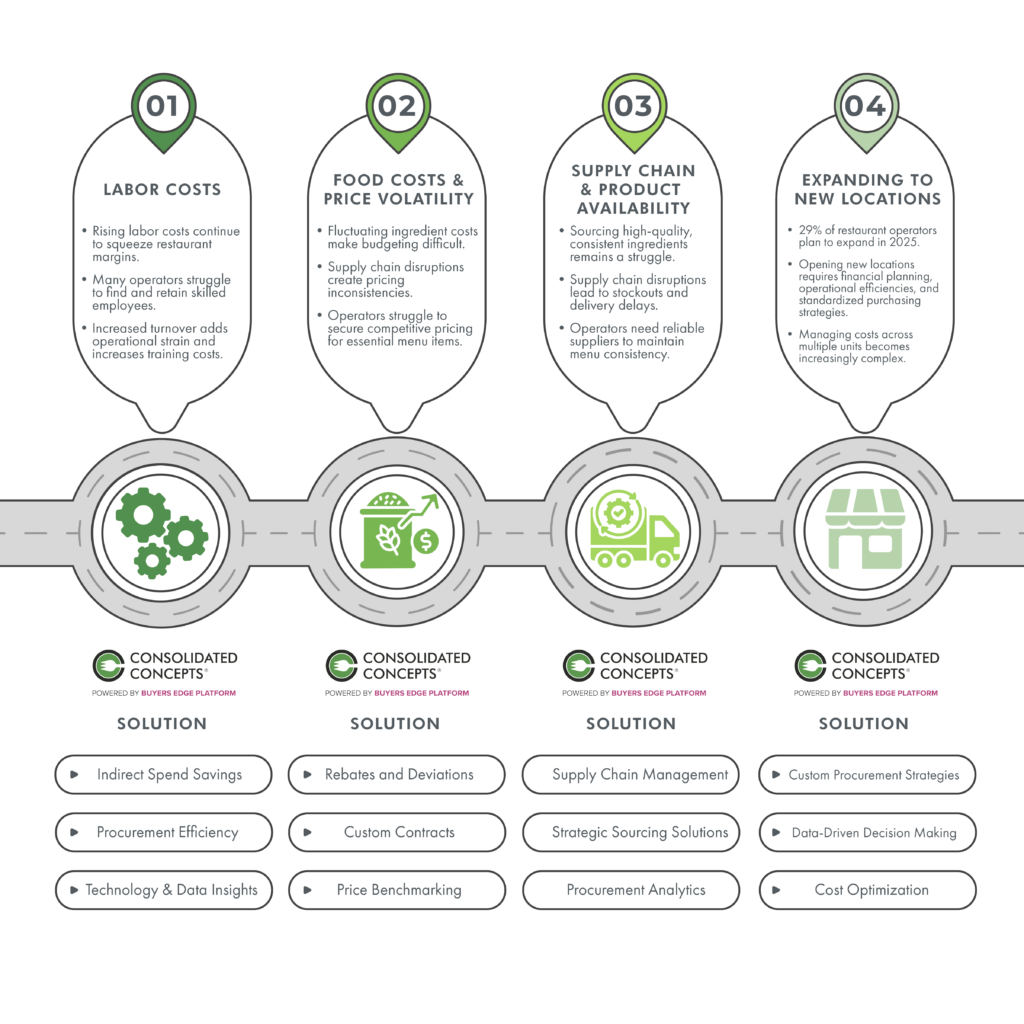
A clean and structured infographic with a restaurant industry theme, featuring icons for each challenge and solution related to labor costs, food costs, supply chain recruitment, and retention

Executing a Winning Restaurant Growth Strategy

With nearly a third of restaurant operators planning to expand in 2025, having a restaurant growth strategy in place is critical for success. Consolidated Concepts provides the tools, data, and supplier partnerships needed to scale efficiently while maintaining financial health. 

By leveraging rebates, data analytics, supply chain management, produce procurement, custom contracts, and indirect spend savings, multi-unit operators can address their biggest challenges while positioning their business for long-term growth.

Want to see how Consolidated Concepts can support your restaurant growth strategy? Fill out the form below and get in touch with our restaurant experts today!


The Smarter Way to Cut Costs and Improve Efficiency Without Hiring More Employees

The Smarter Way to Cut Costs and Improve Efficiency Without Hiring More Employees

With 32% of operators saying they need more employees to meet customer demand, the labor shortage continues to be a significant challenge across the industry. Multi-unit operators face an even greater burden, as maintaining consistency, managing costs, and optimizing operations across multiple locations requires a strategic approach.

Instead of letting these challenges slow your business down, Consolidated Concepts offers powerful solutions to help streamline operations, reduce costs, and ensure operational efficiency across your entire portfolio. 

3 Ways Consolidated Concepts Can Help Save Time and Money 

Rather than constantly hiring to keep up with demand, why not implement smarter operational strategies? Here’s how Consolidated Concepts helps multi-unit restaurant brands stay efficient and profitable despite labor shortages: 

1. Instant Cost Reductions—No Time-Consuming Negotiations

Finding the best deals across multiple locations takes time—but Consolidated Concepts does the work for you. We provide access to exclusive, pre-negotiated pricing, rebates, and supply chain optimization strategies that immediately reduce costs on food, supplies, and operational expenses. By leveraging our purchasing power, you can lower costs across all your locations while eliminating the manual work of price comparisons and contract negotiations.

2. Purchasing Intelligence—Total Visibility Across Locations

Are fluctuating food costs making it difficult to maintain profitability? Consolidated Concepts gives you real-time purchasing insights across all your units with a comprehensive restaurant technology stack. By eliminating the guesswork, you gain control over spending, identify cost-saving opportunities, and optimize purchasing strategies for greater efficiency across locations.

3. Supplier Optimization—We Handle the Search

Industry data shows that 63% of operators shopped for new suppliers last year, and nearly half of operators cut menu items due to rising costs. For multi-unit operators, finding and managing reliable supplier relationships can be an overwhelming task. That’s where Consolidated Concepts comes in. Our extensive network of trusted suppliers ensures you have access to quality products at competitive prices, saving you time and resources while protecting your menu integrity and brand consistency across all locations. 


How Consolidated Concepts Helps You Navigate Labor Shortages 

When labor is tight, every operational efficiency counts. Consolidated Concepts empowers multi-unit restaurant operators with tools to enhance efficiency and keep business running smoothly, regardless of staffing shortages. 

Cost Savings—More Efficiency, Less Waste 

Instead of spending hours researching supplier contracts or searching for rebates, Consolidated Concepts provides instant cost reductions tailored to multi-unit operators. These savings directly impact your bottom line, freeing up capital to invest in labor retention, technology, or menu innovation. 

Purchasing Transparency Across All Locations 

With Consolidated Concepts, you gain real-time visibility into purchasing data across your entire operation. This ensures you make informed, data-driven decisions that eliminate unnecessary spending, prevent over-ordering, and maintain consistency across locations—even when staffing levels are tight. 

Simplified Supplier Management 

With rising food costs and ongoing supply chain disruptions, maintaining strong supplier relationships is more critical than ever. Consolidated Concepts simplifies the sourcing process by connecting you with a vetted network of suppliers that meet your quality and pricing standards. Instead of reacting to market fluctuations, you can proactively secure cost-effective, reliable supply solutions that maintain menu stability and guest satisfaction. 

Transform Challenges into Competitive Advantages 

Labor shortages and rising costs don’t have to slow your business down. With Consolidated Concepts, multi-unit restaurant operators gain the insights, cost savings, and supplier solutions they need to navigate these challenges with confidence. From instant cost reductions to data-driven purchasing and supplier optimization, we help you run a leaner, more efficient operation while maintaining the high standards your customers expect. 

Ready to take control of costs and operations? Fill out the form below to contact Consolidated Concepts today to start optimizing your multi-unit restaurant strategy. Stay ahead of labor challenges, improve efficiency, and unlock greater profitability. 

people-inside-room-and-surrounding-table-1581554

How to Maintain Labor Efficiency in Slower Months

Now, with restaurants experiencing an unprecedented slowdown and even shutdowns in the face of a virus that has been declared a pandemic, operators are wondering not only how to keep the doors open, but also how to protect their staff and keep them employed until the public returns.

We couldn’t think of a better time to address the subject of how to maintain labor efficiency in slower months.

In addition to the unusual circumstances that surround us now, many restaurants experience offseason months. One of the biggest challenges these establishments face is how to keep their primary staff employed, retain a profitable business, and alter their budget in order to stay afloat until the busy summer or winter months descend.

In essence, there are two considerations: Controlling costs and increasing business. Let’s take a look at two factors that can ensure continued, profitable operations, even in the offseason.

Labor Controls

As with any business, putting labor controls and procedures in place is mandatory. In our current environment of labor pool shortage and minimum wage hikes, the average labor cost comes in at around 34 percent. Note the word, average. As we know, unlike multi-unit mega chains, independent owners operate restaurants that are very unique and are anything but average.

One benchmark that is a better target to aim for is your prime cost which equals your total cost of goods sold plus your total labor costs. This represents two of your biggest expenses, and controlling this number is one of the keys in maintaining restaurant health. Dividing your prime cost by your total sales reveals your prime cost as a percentage of sales, with a general target being anywhere from 55 percent for quick service restaurants to 65 percent for fine dining, full service establishments.

The benefit of this number is that you have two controls: food and beverage costs as well as labor costs. Controlling inventory, minimizing food waste, optimizing menu engineering, monitoring vendor pricing, and smart scheduling based on forecasts are all procedures available for optimizing control. Controlling food costs by working with an established GPO is one of your best solutions.

When sales are slow, the cost of labor will undoubtedly be higher. Manager’s salaries are maintained, leaving hourly employees the ones that bear the brunt of reducing labor costs. Minimum staffing levels, however, can ultimately impact customer service and lead to less brand loyal guests that will greatly affect a restaurant’s profitability in the long run.

It’s important to keep in mind that this number will change dramatically when the busy season erupts. In fact, labor can come in at close to 40 percent during the slow months and fall down to less than 20 percent during peak months. Developing a target for each month is the best approach to long-term success.

Keep these numbers in mind as we explore labor controls.

Over Managed

While good management is the key to successful operations, over-management can be a road to low profitability. How many times have you walked into a restaurant and seen management performing tasks that hourly employees are quite capable of?

Overtime

Overtime is one of the biggest contributors to high labor costs. If you find it difficult to manage labor so that this number is kept to a minimum, consider integrating an employee scheduling software system that takes into account forecasted sales. A popular brand among restaurants is 7Shifts.

Seasonal Employees

Consider maintaining your core yearly staff and hire for the peak seasons. Coolworks is a well-known site for hiring seasonal staff. You’ll want to start the process well before your season begins.

Train

A well-trained team not only ensures a high-quality product and exceptional service, it is also proven to increase your bottom line. Well-informed, incentivized servers are proven game-changers by increasing sales and enhancing customer experience. Employee recommendations can result in conversions 54 percent of the time. Unfortunately, only 5 percent of your staff is usually making these recommendations. Tipzyy, a mobile software platform, educates servers in areas such as pairings, upselling beverages, and more, and also rewards and recognizes your top performers.

Controlling Food & Beverage Costs

 While there are multiple procedures designed to control this all-important cost, working with a GPO year-round can help you weather the inconsistencies associated with offseason. Many can also help with offseason menu planning that minimizes food and beverage costs during the slow season while still maintaining the quality your customers have come to expect.


increase-profits-reducing-costs

Restaurant Industry Experts Discuss how to Increase Profits by Reducing Costs

Earlier in 2019, at the Restaurant Leadership Conference, industry leaders discussed the all-important fat bottom line. Instead of focusing on growing revenue, however, this discussion revealed important cost-cutting techniques designed to maximize savings and increase profits.

Let’s take a look at what these leaders consider the biggest impact on overall profit.

High Rents

Jason Morgan, the CEO of two emerging fast casual concepts–Original Chop Shop and Bellagreen—sees high rent as one of the biggest challenges that restaurants are currently facing. He believes that this is due, in large part, to the flood of money that hit the industry from the private equity sector over the last five years.

While some entrepreneurs and mega-corporations are willing to pay the price, others understand that, at a certain point, the risk is greater than the reward. Jason is one of those—a CEO who is willing to wait for second generation sites.

Which leads us to the solution for this pain point that many restaurants are facing—patience. Companies are waiting it out, allowing others to sign bad deals that will ultimately lead to second generation space.

Third-Party Delivery Fees

Like many in the restaurant industry, Jason sees third-party delivery fees as unsustainable. In his business, he’s seen these costs go from 100 to 300 base points over the last two years. The problem is that restaurants are feeling pressured into providing this service due to consumer demand, but, considering the rising fees, delivery using third-party services does little to fatten up the bottom line.

One solution is dispatch operations such as Olo. Using these dispatch companies, Jason shifted customers from third-party sites to the restaurant’s site, paying 10 percent per order instead of the commonly charged fee of 30 percent from third-party services. Customers simply order and pay on a restaurant’s existing digital ordering site, and the best-matched quote from an available delivery service provider pops up and is scheduled.

The Numbers

Jason Tipp, an entrepreneur in the Food Service industry and past CEO of Florida-based Pincho, a Latin American street food concept with 12 units, explained that the founders of this successful chain were not from the restaurant industry. Because of this, numbers such as prime costs and food cost were not prominent in their considerations. Once he came onboard, he stressed the importance of these numbers and developed stronger operations in order to reduce these costs.

One simple approach they took was enabling the general managers to really see the operations from the bones up in order to determine how to create a more efficient operation. They examined how long it took to do prep in the morning, how long it took to close a restaurant after the last guess was served, and how many employees were needed for these activities. From there, they were able to develop clear, cost-saving guidelines for their units.

Their other goal was to get their food costs in order—adding up the food they sell, the food they buy, and determining the percentage in sales, which required costing out all of the recipes. As Jason states, “You can’t ask a general manager to hit 28% food costs if the reality is based on input costs in your recipes that is 35%.”

Eric Sheen, CEO of Restaurant Partners Procurement, also see’s food cost as an operational issue. He puts it in terms of the 80/20 rule. In other words, only 20 percent is your actual cost while 80 percent is all operation controls. Therefore, it there is a food cost issue, the problem often lies in the operation, not the distributor.

One of their solutions is switching recipe measurements from ounces to grams, which is a more precise method. He also recommends investing in digital scales. Another area in operations that accounts for an increase in costs is pricing differentiation between the menu and the POS system. An example he uses to describe the impact that occurs when you don’t correlate the two is this: Iced tea was increased by 20 cents which was addressed on the menu, but not in the POS. Say you sell 50,000 iced teas—that’s $10,000 missing from the bottom line.

Another common error is not getting all the items, such as drinks, on the bill. To combat this, some POS systems won’t let your servers send an order to the kitchen before drinks are run up on the check. If the guests are only drinking water, you can put it in at zero charge.

There are a thousand tiny details that go into ensuring the highest profit margin. Another example Eric shared comes from an organization that sells 10 million pounds of chicken wings a year. They pulled out a couple of cases and found that the case count was at about 200, but their spec was for a 240-wing count. The wings had gotten bigger over the years, but the establishment sold by wing, not weight. They estimated that, over the last four years, they had lost about 1.4 to 1.8 million dollars a year.

Contracts

Vince Purves, President of Consolidated Concepts, the largest Group Purchasing Organization (GPO) for multi-unit operators in the U.S., is very familiar with distribution contract negotiation. He notes that it’s easy to negotiate your contract and then ignore it until it’s ready to expire some three years later. It is better, however, to remain engaged with your distributors throughout the year.

In actuality, the supply chain is affecting your cost of goods from multiple avenues including the shortage of drivers in the trucking industry to the price of fuel and insurance. There is much more to rising costs than just the cost of the product itself.

The question becomes: How do you hold distributors accountable to contract prices?

Vince finds that auditability is a key component. “Really make sure what you have from a contract standpoint, whether it’s your distribution or it’s your manufacturer cost contract, is truly and accurately in the system.” Don’t assume that distribution prices are correct. As with most data, it takes a person to key it in, and people are human and prone to mistakes. That’s one of the roles we assume at Consolidated Concepts, making sure our client’s systems are right, their prices are correct, and holding them accountable.” With increasing costs in real estate, products, and labor, it’s clear that restaurants looking to increase their profit margins must maintain tight operational guidelines and develop key relationships in the distribution sector. Consolidated Concepts can help reduce both food and distribution costs—keys to a fat bottom line.

Another avenue that restaurants are turning to is working with third-party consultants that help them develop a supply chain that can stay ahead of weather-related opportunities and challenges. Consolidated Concepts specializes in streamlining the supply chain for multiunit brands through the use of technology, partnerships, and procurement specialists.  


Interested In Learning more? Enter your email address below to sign up for our Newsletter.

pexels-photo-1249158

Blanket Contracts: Why It’s Good to Be Under the Blanket

When it comes to efficiently running your food service operation, more operators are joining Group Purchasing Organizations (GPOs).  GPOs and consultants offer various types of services and sources that help boost the bottom lines of their members. Some of these services support day to day operations while other services help impact cost savings. GPO services can include:

  • fully outsourced supply chain management
  • individual project-based services like location scouting or specific sourcing
  • custom contract negotiations for individually spec’d items
  • Master Distribution Agreement (MDA) negotiation
  • product recommendations and vetting

Among all of these services, however is one that can be incredibly beneficial, and easily attainable for operators: Blanket Manufacturer Contracts.

What is a Blanket Contract?

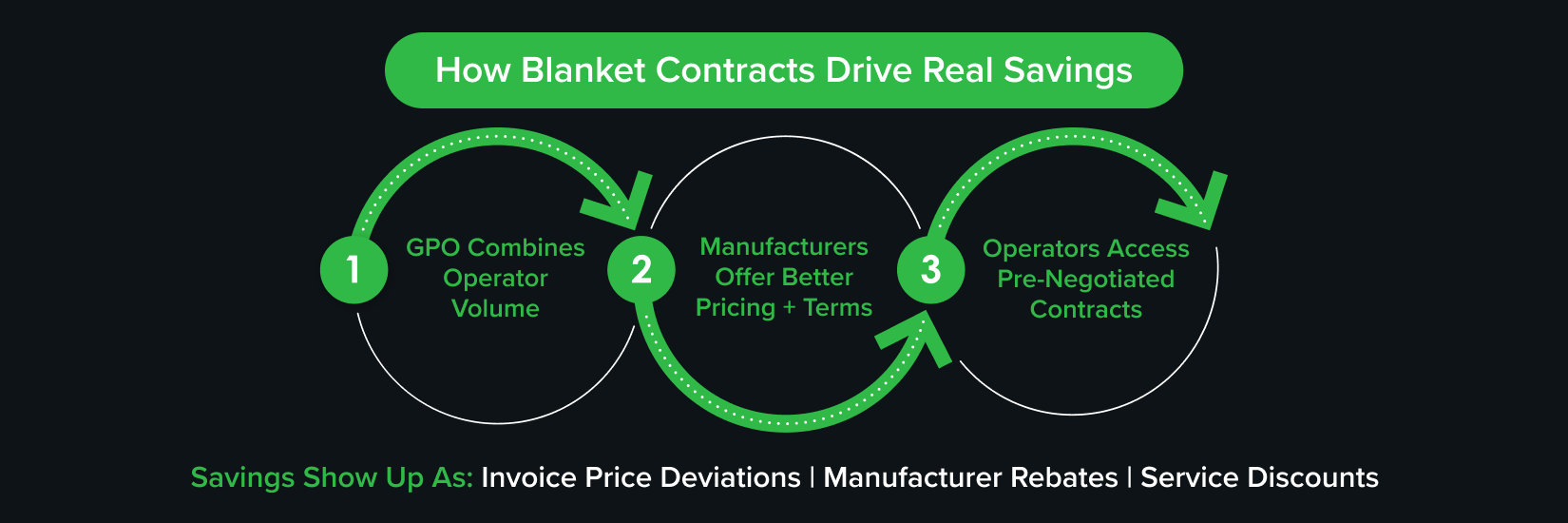
Blanket Manufacturer Contracts are valuable volume-based contracts that GPOs negotiate with manufacturers and service providers. GPOs like Consolidated Concepts have thousands of members. The large combined volume of the GPO’s membership appeals to food and supplies manufacturers who offer exclusive pricing and contract terms to GPO members. Members of the GPO get hundreds of contracts made available to them instantly, including broadline grocery products, produce, paper products and even chemicals. These volume-based contracts can mean major savings for the operator. Savings take three basic forms: deviations off invoice pricing, manufacturer rebates (paid monthly, quarterly or annually), or service discounts.

Graphic illustrating how GPO blanket contracts work, showing operator volume combined by a GPO, better manufacturer pricing and terms, and operator access to pre-negotiated contracts that lead to savings like rebates and discounts

Despite the natural appeal of blanket contracts, some food service operators are still hesitant when it comes to using a GPO to assume these contract benefits. After all, is it not possible to get the same contracts if operators just negotiate for themselves? As a decade-old GPO we’ve seen the hurdles and hardships that the DIY method can create for operators. First of all, negotiating and tracking direct manufacturer contracts costs major time (or consulting fees) for the operator and require a level of contract expertise in order to ensure operators aren’t snared into loopholes and skewed pricing. Secondly, contracts can also often prove restrictive. Operators may be bound by the terms of the contract and may have to meet minimums, agree to exclusivity clauses, or have limited choices when it comes to product selection.

How do operators take advantage of blanket contracts?

If an operator is already a member of a GPO, taking advantage of blanket contracts is a natural next step after joining. As a member or client of a GPO an operator should aim to get on as many of that GPO’s contracts as possible in order to reap the full benefits of GPO membership. Being a good user of blanket contracts requires the right perspective from the operator side. For example, if an operator has 20 loaded deviations and is on 20 contracts. In order to maximize their cost savings year over year on these contracts, a good goal may be to try and explore 10 more contract opportunities per year or to increase their contract utilization by 50% per year.

New contract opportunities are often easy to identify and join if an operator asks the right questions. One way to find about new contracts from a GPO is to request an invoice or usage analysis from the GPO’s analytics or account management teams. Break the contracts into categories and inquire about the best fits in each category: food, non-food, and indirect spend. Or, ask in a business review, “ What new contracts are available and what are some popular contracts that I’m not currently taking advantage of?” By staying in the loop on the new or existing contracts the GPO has access to, operators may be able to find deviations and rebates on items they’re already purchasing or looking to source.

How do you choose the right GPO for the best blanket contracts?

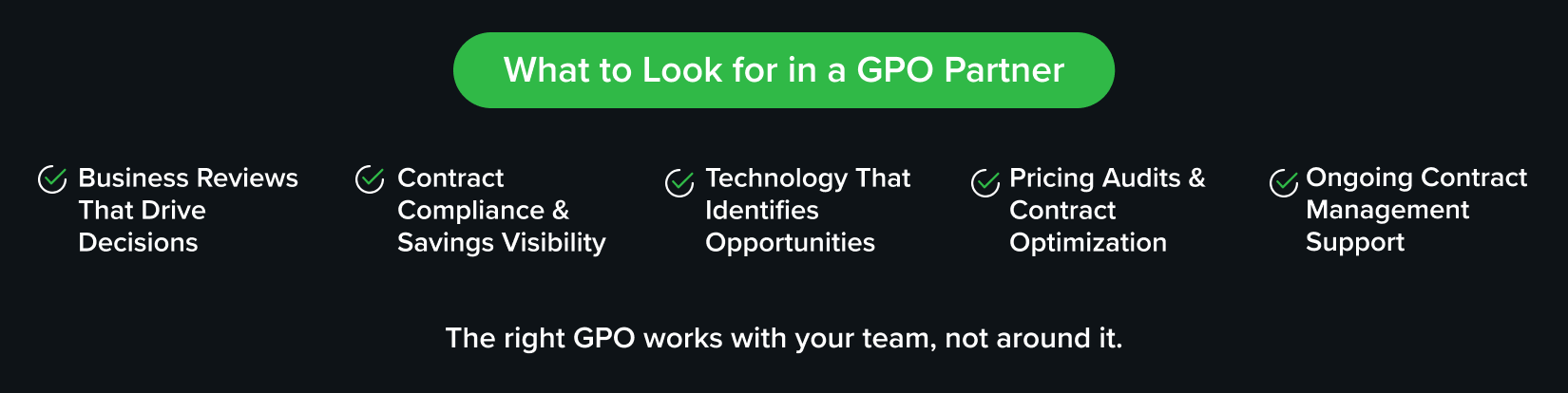
While many GPOs offer blanket contracts, finding the right GPO for a restaurant operation is integral. Select a GPO that has a core competency that includes blanket contracts. A great GPO will provide business reviews, compliance reviews, and savings analyses. Additionally, a GPO with the latest software and technology will be able to use that technology to identify contract opportunities for their clients, audit contract pricing, and recommend contract renewal and contract management strategies.

Graphic outlining key qualities of a strong GPO partner including business reviews, contract compliance and savings visibility, technology-driven insights, pricing audits, and ongoing contract management support

A good GPO will never pose a threat to a restaurant’s existing procurement team.  Rather, the GPO should offer extra contracts on top of the existing direct contracts that a CFO, VP of Supply Chain, or Procurement Director has already negotiated on their own. Blanket contracts help in-house staff be more effective at their jobs and are perfect for items for which they don’t have quite as much buying power. Take, for example, beverage napkins: an item that every operator buys in high-volume but is rarely considered a ‘core item. With a blanket contract, operators can utilize the GPO’s more aggressive volume-based pricing without going through the hassle of negotiating directly with manufacturers.

Want to know more about what makes a GPO right for you? Learn more about Consolidated Concepts here.