Cost pressure hasn’t gone anywhere. What has changed is how operators respond to it—and that shift is shaping multi-unit restaurant strategies for 2026.

This year, multi-unit leaders are less interested in blunt cost-cutting and more focused on margin protection—an approach that’s quickly becoming central to multi-unit restaurant strategies for 2026. That means identifying where profits are leaking quietly—pricing discrepancies, unverified distributor charges, inefficient purchasing decisions—and fixing those issues without compromising food quality or service.
The goal isn’t to be cheaper at all costs. It’s to be smarter, more precise, and more intentional with every dollar spent.
Prioritizing Supply Chain Stability Over Short-Term Wins
If the last few years taught multi-unit operators anything, it’s this: the cheapest option on paper can become the most expensive mistake in practice.
By 2026, many operators have stopped asking, “Who has the lowest price?” and started asking, “Who can actually deliver—every week, at scale, when things get weird?”
That shift shows up in how suppliers are evaluated today. Reliability matters. So does consistency across locations. Operators want to know that when volumes spike, menus change, or a region gets hit with shortages, their partners won’t disappear or scramble.
Transparency plays a big role here too. When markets move or costs change, operators would rather have early, honest communication than surprises buried in invoices weeks later.
The result? Short-term price wins matter less than predictable execution. For multi-unit restaurants managing dozens—or hundreds—of locations, stability isn’t a “nice to have.” It’s what keeps operations running smoothly and prevents small disruptions from turning into system-wide problems. This shift reflects a broader evolution in multi-unit restaurant strategies for 2026, where precision and visibility matter more than quick wins.
Centralizing Visibility Across Locations and Concepts
Fragmented data is one of the biggest pain points for multi-unit organizations. When each location or brand operates in its own silo, leaders lose the ability to see the full picture.
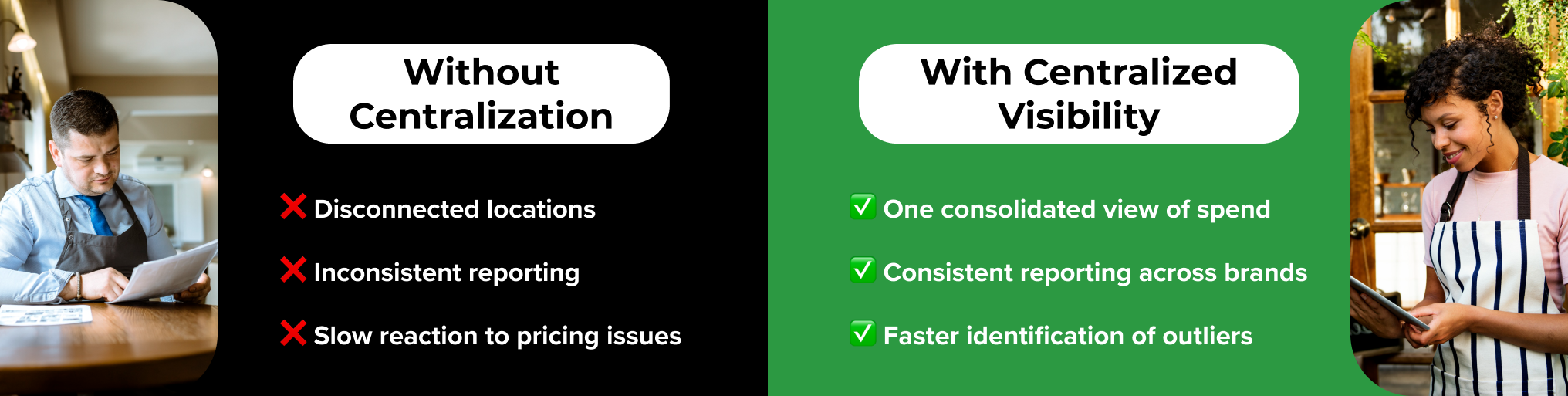
In 2026, operators want:
- One consolidated view of spend
- Consistent reporting across brands
- Faster insight into outliers and inefficiencies
If leadership can’t quickly answer where money is being spent, where pricing is off, or where behavior varies by location, decision-making slows—and margins suffer.
Making Labor Easier to Manage, Not Just Cheaper
Labor remains one of the most complex challenges in foodservice. The focus now isn’t just on wages—it’s on operational simplicity.
Multi-unit restaurants are rethinking:
- Menu complexity that slows execution
- Prep processes that require specialized labor
- Scheduling accuracy tied to real demand
Instead of adding more people, operators are redesigning systems so teams can do more with less friction. Efficiency has become a competitive advantage.
Treating the Menu as a Financial Tool
For multi-unit restaurants in 2026, the menu isn’t just a brand expression anymore—it’s one of the most closely watched financial levers in the business.
Operators aren’t debating what sounds good. They’re looking hard at what actually earns its keep. Which items carry the margin? Which ones are sensitive to price swings? And which dishes quietly become a problem every time a key ingredient spikes or labor gets tight?
This has led to more frequent menu reviews and smarter decisions behind the scenes. Items that are popular but unprofitable get reworked. Ingredients with volatile pricing get flagged. And in multi-concept groups, leadership looks for opportunities to align SKUs and suppliers where it makes sense—without forcing every brand into the same box.
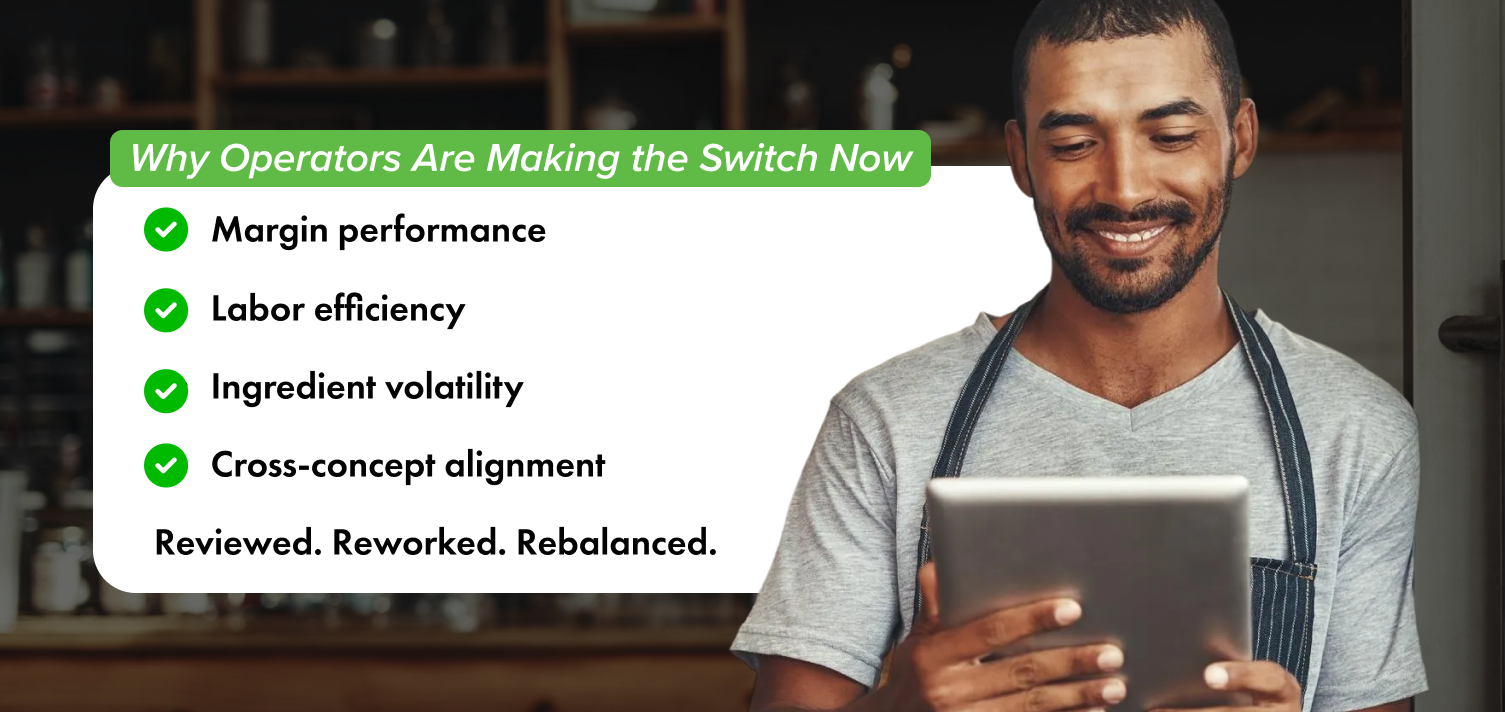
The menu still matters to the guest. But internally, it’s treated like what it really is: a living document that has to balance creativity, cost control, labor efficiency, and margin—week after week.
Elevating Procurement to a Strategic Function
Not that long ago, procurement lived in the background. Orders got placed, contracts got negotiated, and leadership only noticed when something went wrong.
That’s not how it works in 2026.
For multi-unit restaurants, procurement has moved into the spotlight because it touches everything—food costs, labor efficiency, supplier performance, and even how fast a brand can grow without breaking its systems.
Instead of reacting to price increases or scrambling when a supplier falls short, operators are using digital procurement to get ahead of problems. They’re looking at buying patterns, comparing performance across locations, and making intentional decisions about where scale actually creates leverage—and where it doesn’t.
The biggest change is mindset. Procurement isn’t just a function anymore. It’s part of how leadership protects margins, creates consistency, and keeps the operation from being caught off guard. When done well, it stops being a cost center and starts acting like a control center.
Expecting Technology to Reduce Workload
Technology fatigue is real. Operators are done with tools that promise insight but require constant manual effort.
In 2026, the expectation is clear:
- Systems should integrate cleanly
- Reporting should be automated and reliable
- Insights should be actionable without extra work
If technology doesn’t save time and improve decision-making, it doesn’t survive the budget review.
Building Systems That Scale Or Stabilize With the Business
Not every multi-unit restaurant is aggressively expanding, but every operator is thinking about scalability.
That includes:
- Processes that work at 10 locations and 100
- Systems that hold up through leadership changes
- Partners who understand multi-concept complexity
Whether the goal is growth or stabilization, the foundation has to be strong enough to support it.
Ultimately, the most effective multi-unit restaurant strategies for 2026 focus on control—over costs, data, partners, and decision-making.
Where Strategic Partners Fit In
By 2026, most multi-unit operators have learned the hard way that you can’t be an expert in everything. And trying to manage sourcing, supplier performance, pricing, and contracts on top of running the business usually means something gets missed.
That’s where the right partners come in.
Instead of adding more internal headcount, many operators lean on outside expertise to pressure-test decisions, spot issues they don’t have time to hunt for, and bring structure to areas that tend to sprawl as a business grows. It’s not about handing control away—it’s about having smarter inputs and fewer blind spots.
In an environment where costs move fast and complexity adds up quickly, the operators who stay in control are the ones who know when to bring in support. Not to chase trends or promises, but to keep the operation steady, scalable, and predictable—day in and day out.
Visit our website to see how Consolidated Concepts helps multi-unit restaurants protect margins, simplify procurement, and build systems that actually scale into 2026 and beyond.