Category: Blog

What Should Multi-Unit Restaurants Focus on in 2026?

Multi-Unit Restaurant Strategies for 2026: Where Operators Should Focus

Cost pressure hasn’t gone anywhere. What has changed is how operators respond to it—and that shift is shaping multi-unit restaurant strategies for 2026.

From Cost Cutting to Margin Protection

This year, multi-unit leaders are less interested in blunt cost-cutting and more focused on margin protection—an approach that’s quickly becoming central to multi-unit restaurant strategies for 2026. That means identifying where profits are leaking quietly—pricing discrepancies, unverified distributor charges, inefficient purchasing decisions—and fixing those issues without compromising food quality or service.

The goal isn’t to be cheaper at all costs. It’s to be smarter, more precise, and more intentional with every dollar spent. 

Prioritizing Supply Chain Stability Over Short-Term Wins 

If the last few years taught multi-unit operators anything, it’s this: the cheapest option on paper can become the most expensive mistake in practice. 

By 2026, many operators have stopped asking, Who has the lowest price? and started asking, “Who can actually deliver—every week, at scale, when things get weird?” 

That shift shows up in how suppliers are evaluated today. Reliability matters. So does consistency across locations. Operators want to know that when volumes spike, menus change, or a region gets hit with shortages, their partners won’t disappear or scramble. 

Transparency plays a big role here too. When markets move or costs change, operators would rather have early, honest communication than surprises buried in invoices weeks later. 

The result? Short-term price wins matter less than predictable execution. For multi-unit restaurants managing dozens—or hundreds—of locations, stability isn’t a “nice to have.” It’s what keeps operations running smoothly and prevents small disruptions from turning into system-wide problems. This shift reflects a broader evolution in multi-unit restaurant strategies for 2026, where precision and visibility matter more than quick wins.

Centralizing Visibility Across Locations and Concepts 

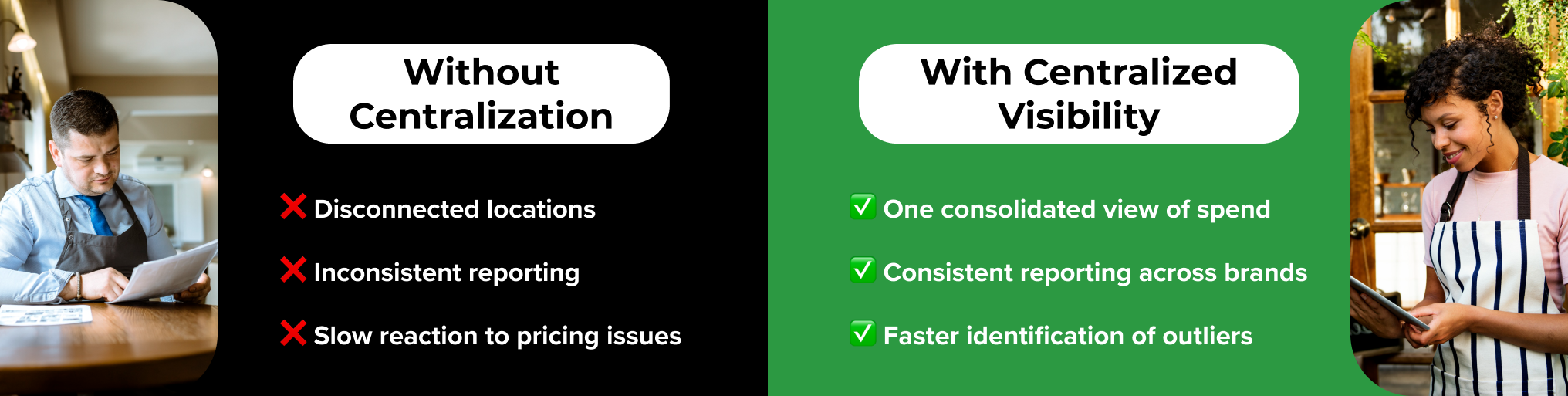
Fragmented data is one of the biggest pain points for multi-unit organizations. When each location or brand operates in its own silo, leaders lose the ability to see the full picture. 

From Fragmented Data to One Clear View

In 2026, operators want: 

  • One consolidated view of spend 
  • Consistent reporting across brands 
  • Faster insight into outliers and inefficiencies 

If leadership can’t quickly answer where money is being spent, where pricing is off, or where behavior varies by location, decision-making slows—and margins suffer. 

Making Labor Easier to Manage, Not Just Cheaper 

Labor remains one of the most complex challenges in foodservice. The focus now isn’t just on wages—it’s on operational simplicity. 

Multi-unit restaurants are rethinking:

  • Menu complexity that slows execution 
  • Prep processes that require specialized labor 
  • Scheduling accuracy tied to real demand 

Instead of adding more people, operators are redesigning systems so teams can do more with less friction. Efficiency has become a competitive advantage. 

Treating the Menu as a Financial Tool 

For multi-unit restaurants in 2026, the menu isn’t just a brand expression anymore—it’s one of the most closely watched financial levers in the business. 

Operators aren’t debating what sounds good. They’re looking hard at what actually earns its keep. Which items carry the margin? Which ones are sensitive to price swings? And which dishes quietly become a problem every time a key ingredient spikes or labor gets tight? 

This has led to more frequent menu reviews and smarter decisions behind the scenes. Items that are popular but unprofitable get reworked. Ingredients with volatile pricing get flagged. And in multi-concept groups, leadership looks for opportunities to align SKUs and suppliers where it makes sense—without forcing every brand into the same box. 

The Menu Is a Financial Lever

The menu still matters to the guest. But internally, it’s treated like what it really is: a living document that has to balance creativity, cost control, labor efficiency, and margin—week after week. 

Elevating Procurement to a Strategic Function 

Not that long ago, procurement lived in the background. Orders got placed, contracts got negotiated, and leadership only noticed when something went wrong. 

That’s not how it works in 2026. 

For multi-unit restaurants, procurement has moved into the spotlight because it touches everything—food costs, labor efficiency, supplier performance, and even how fast a brand can grow without breaking its systems. 

Instead of reacting to price increases or scrambling when a supplier falls short, operators are using digital procurement to get ahead of problems. They’re looking at buying patterns, comparing performance across locations, and making intentional decisions about where scale actually creates leverage—and where it doesn’t. 

The biggest change is mindset. Procurement isn’t just a function anymore. It’s part of how leadership protects margins, creates consistency, and keeps the operation from being caught off guard. When done well, it stops being a cost center and starts acting like a control center. 

Expecting Technology to Reduce Workload 

Technology fatigue is real. Operators are done with tools that promise insight but require constant manual effort. 

In 2026, the expectation is clear:

  • Systems should integrate cleanly
  • Reporting should be automated and reliable
  • Insights should be actionable without extra work 

If technology doesn’t save time and improve decision-making, it doesn’t survive the budget review. 

Building Systems That Scale Or Stabilize With the Business 

Not every multi-unit restaurant is aggressively expanding, but every operator is thinking about scalability. 

That includes: 

  • Processes that work at 10 locations and 100 
  • Systems that hold up through leadership changes 
  • Partners who understand multi-concept complexity 

Whether the goal is growth or stabilization, the foundation has to be strong enough to support it. 

Ultimately, the most effective multi-unit restaurant strategies for 2026 focus on control—over costs, data, partners, and decision-making.

Where Strategic Partners Fit In 

By 2026, most multi-unit operators have learned the hard way that you can’t be an expert in everything. And trying to manage sourcing, supplier performance, pricing, and contracts on top of running the business usually means something gets missed. 

That’s where the right partners come in. 

Instead of adding more internal headcount, many operators lean on outside expertise to pressure-test decisions, spot issues they don’t have time to hunt for, and bring structure to areas that tend to sprawl as a business grows. It’s not about handing control away—it’s about having smarter inputs and fewer blind spots. 

In an environment where costs move fast and complexity adds up quickly, the operators who stay in control are the ones who know when to bring in support. Not to chase trends or promises, but to keep the operation steady, scalable, and predictable—day in and day out. 

Click here to see how Consolidated Concepts helps multi-unit restaurants protect margins, simplify procurement, and build systems that actually scale into 2026 and beyond.

Why Multi-Unit Operators Are Rethinking How They Manage Purchasing

Multi-Unit Operators Are Rethinking How They Manage Purchasing

If you run a restaurant brand with more than a handful of locations, you already know this: the way you manage purchasing has gotten a whole lot messier than it used to be. There was a time when spreadsheets and long-standing supplier relationships carried most of the weight. You’d call your reps, check a few numbers, make a couple of decisions, and move on with your day. 

Those days? Gone. 

The industry is moving faster than ever. Costs bounce around like ping-pong balls. Distributor networks overlap. Your teams are stretched thin. And keeping track of what your units are paying, what they’re ordering, and whether anything is slipping through the cracks takes more energy than anyone wants to admit. 

That’s why so many multi-unit operators are rethinking the way they manage purchasing. 

The Trouble With “The Way We’ve Always Done It” 

Older procurement habits were built for calmer times. When an operator had three or four stores and the same rep for a decade, you could get by with emails, phone calls, and a few shared spreadsheets. 

But the second you start scaling — really scaling — those familiar processes start to work against you. 

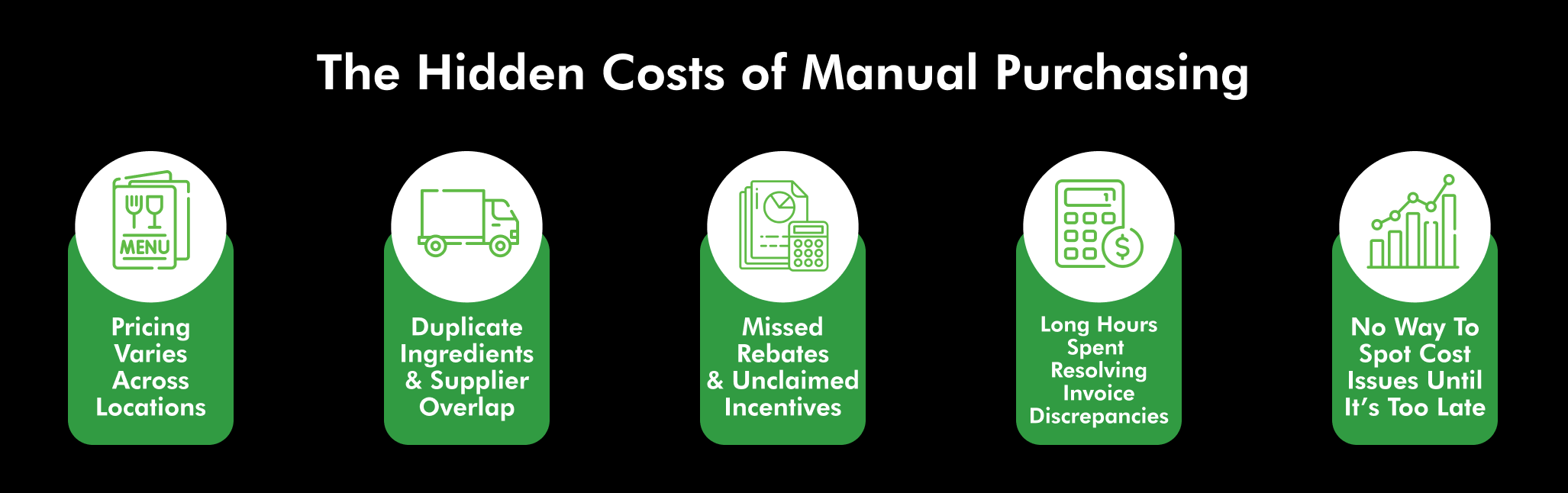
You see things like: 

  • Pricing that varies wildly between locations 
  • Units ordering the same ingredient from three different suppliers 
  • Rebates getting left on the table because no one has time to track them 
  • Hours spent sorting through invoices just to figure out what went wrong 

And the real danger? You don’t catch problems until after the money’s already spent. 

The Hidden Costs of Manual Purchasing

What Operators Are Turning to Instead 

Here’s the shift happening across the industry: operators want purchasing to be easier, clearer, and way more organized than what manual systems allow. 

They want one place to see their spend. One source of truth for pricing. One way to compare stores. One place where contracts, rebates, and product data actually line up. 

Not a dozen files. Not three versions of the same sheet. Not “I think this price is right… let me look it up… give me a minute… actually wait.” 

That need for clarity is what’s driving the move toward smarter, more structured purchasing support. 

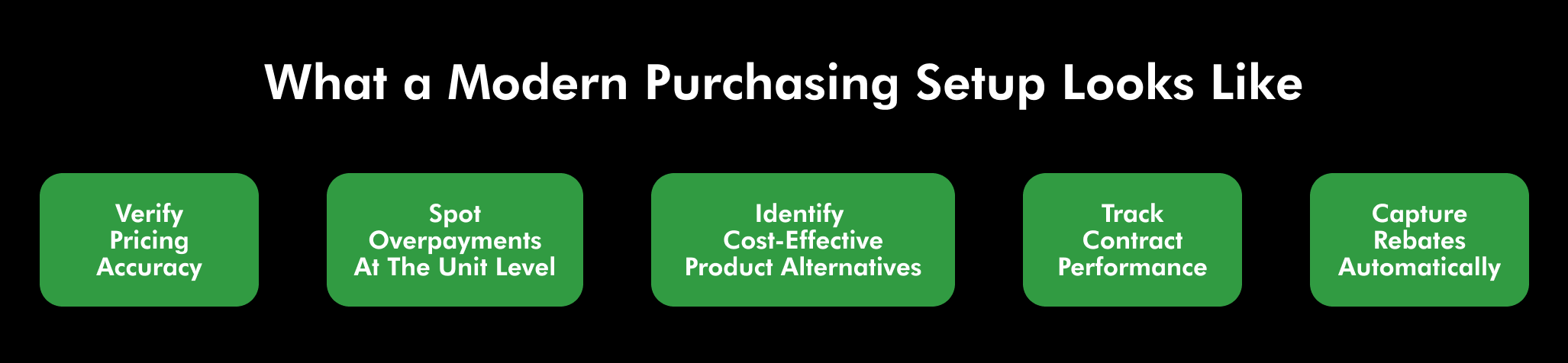
What a Modern Purchasing Setup Looks Like

What a Modern Purchasing Setup Actually Looks Like 

It’s not about replacing your people or turning everything into robots. It’s about giving your team better tools and better guidance so they can actually manage instead of chase paper. 

Think about a setup where you can: 

It’s the kind of structure restaurants dreamed about a decade ago but didn’t have the resources to build. 

The Cost of Holding Onto Outdated Processes 

It’s easy to assume, “We’ve always done it this way; it works.” 

But the quiet losses sneak in: 

  • A few missed rebate dollars here 
  • A couple of price discrepancies there 
  • A location ordering outside the contract 
  • A manager buying high-cost alternatives during shortages 
  • Extra hours spent chasing invoices or digging through emails 

None of this feels catastrophic in the moment. But by the end of the year? Operators see the damage — and it’s not pretty. 

Margins are tight enough. There’s no room for outdated systems to eat into them. 

The Game-Changer: Visibility 

Here’s the truth every multi-unit operator eventually bumps into: 

You can’t fix what you can’t see. 

The brands that outperform their competition aren’t just “getting better pricing.” They’re paying attention to why their costs move, which products drive spend, and where inconsistencies pop up. 

Better visibility helps operators catch things like: 

  • Stores paying different prices for the same item 
  • Units ordering too many variations of the same ingredient 
  • Menu items that create waste because they don’t sell 
  • Suppliers whose pricing no longer lines up with agreements 

Once you have that level of insight, decisions get easier. Negotiations get stronger. Growth gets smoother. 

Why Expertise Still Matters 

Even with better visibility, operators still need people who understand the behind-the-scenes work — distributor negotiations, category management, cost modeling, contract alignment, rebate programs, and all the moving parts that come with the way multi-unit operators manage purchasing. 

That’s where a partner like Consolidated Concepts changes the game. 

You get: 

  • Industry pros who know how to interpret your data 
  • Category experts who understand your menus and product mix 
  • Pricing analysts who can spot issues quickly 
  • People who know how to talk the same language as your distributors 

It’s not just tools. It’s not just dashboards. It’s the combination of insights + hands-on expertise that helps operators actually move the needle. 

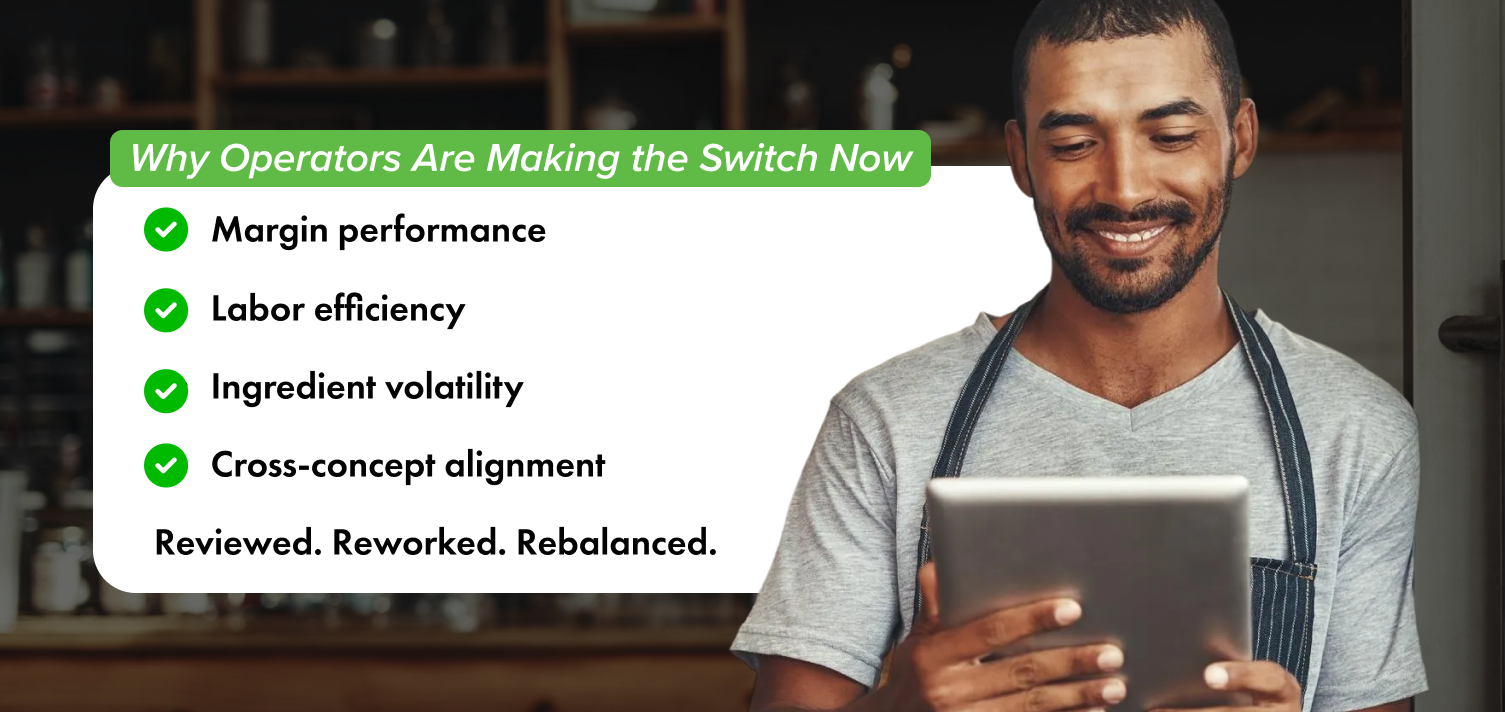
Why Operators Are Making the Switch Now

Why Operators Are Making the Switch Now 

Because the industry isn’t slowing down. 

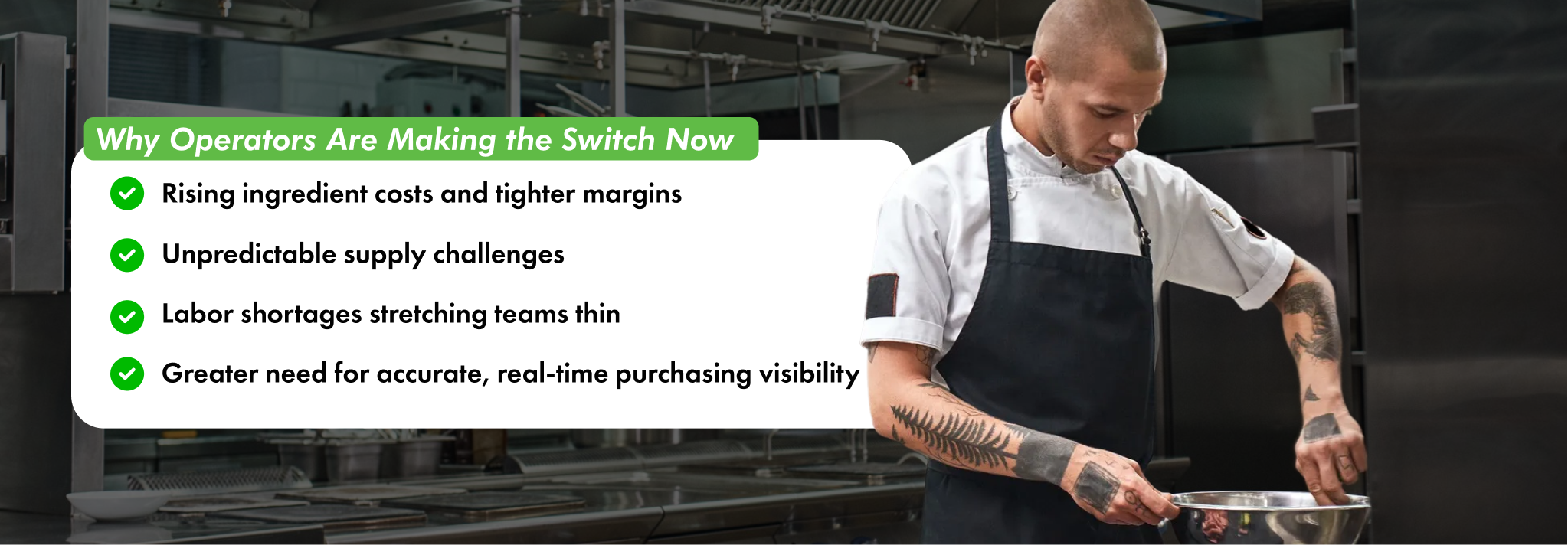
Costs are rising. Labor is tight. Supply chains feel unpredictable. And manual systems can’t keep up with what operators are being asked to manage. 

Upgrading the approach to the way you manage purchasing doesn’t mean throwing away what already works. It means adding structure and visibility so what does work can scale. 

The operators who lean into this shift aren’t just cutting costs; they’re positioning themselves to grow without losing control. 

The Bottom Line

For multi-unit operators, purchasing has become a major factor in whether a brand can scale profitably. 

If the system you’re using feels clunky, chaotic, or inconsistent, it’s a sign, not of failure, but of growth. 

A more structured purchasing strategy gives you: 

  • Clarity 
  • Control 
  • Predictability 
  • Stronger supplier performance 
  • Better food cost management 

And honestly? A little peace of mind, too. 

Because running multiple locations is hard enough. Your purchasing process shouldn’t be the thing slowing you down. 

Ready to tighten up purchasing, cut hidden costs, and give your operators the visibility they’ve been missing? Click here or fill out the form below to get started. 


Turn Data Into Action: Actionable Insights for Multi-Unit Restaurants

Turn Data Into Action: Actionable Insights for Multi-Unit Restaurants

Running a successful multi-unit restaurant operation takes more than great food and friendly service. It takes visibility into your spending, your suppliers, your savings, and your performance across every location. The best decisions start with the right data, but even more importantly, the right actionable insights for multi-unit restaurants. 

Because data alone doesn’t drive growth, acting on it does. 

“Actionable insights” are data points that tell a story—one that prompts you to make a decision or take a specific action. For example: 

  • A report showing ingredient price fluctuations isn’t just data; it’s an opportunity to adjust your menu pricing. 
  • A rebate dashboard showing missed opportunities isn’t just a number; it’s a chance to enroll in new savings programs. 
  • A category spend trend isn’t just visibility; it’s direction for your next negotiation strategy. 

For multi-unit operators managing dozens (or hundreds) of locations, actionable insights transform complexity into clarity. Instead of manually combing through spreadsheets or disconnected systems, your teams can see everything that matters in one place. 

That’s where Launchpad comes in. 

Turn Data Into Action

How Launchpad Delivers Actionable Insights for Multi-Unit Restaurants 

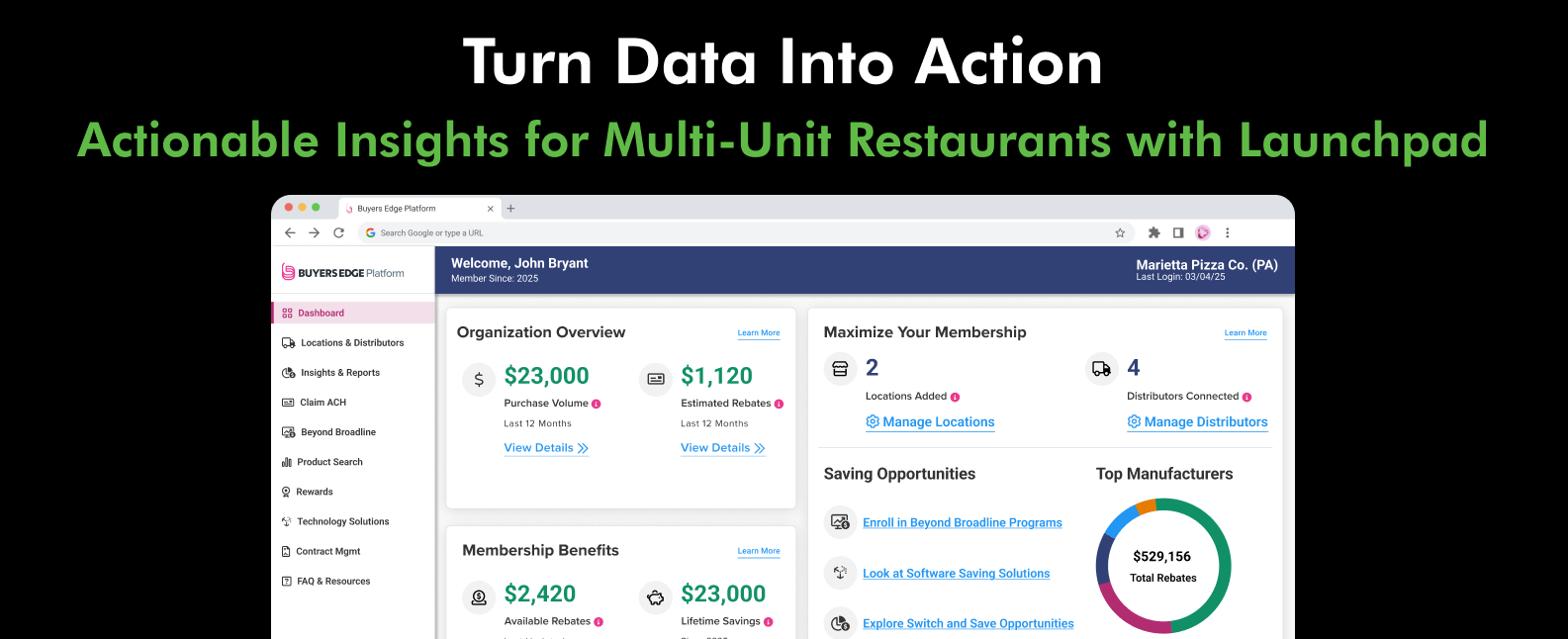
Launchpad is like the digital command center for Buyers Edge Platform, giving you access to the programs, savings, and visibility that help your brand thrive. 

Recently redesigned for an even smarter experience, Launchpad now helps multi-unit restaurant leaders instantly access and act on the information that drives profit, efficiency, and control. 

Here’s how Launchpad empowers your operation with actionable insights: 

1. See the Big Picture — and Every Detail 

When you log into Launchpad, you get a real snapshot of how your operation is performing. Right from the dashboard, you can check: 

  • How much your lifetime savings have grown across every location 
  • Which categories are driving the biggest impact or rebates 
  • How your spend is trending year over year, including inflation shifts 

The layout is easy on the eyes and built for speed, so you can move quickly between insights. It’s simple to spot what’s working, where you might be overspending, and where the next opportunity lies—all in one place. 

Ask yourself: Do your teams spend hours gathering data before they can even start strategizing? Launchpad eliminates that lag by putting insight front and center. 

2. Turn Visibility into Value 

Seeing your data is one thing. Acting on it is another. 

AI-driven Switch-and-Save recommendations identify better purchasing options that protect your margins without sacrificing quality. With each recommendation, you can make quick, confident choices that improve cost control. 

For multi-unit restaurants managing thousands of SKUs, these insights can mean the difference between reactive cost cutting and proactive margin growth. 

Example: If your poultry spend jumps 7% quarter-over-quarter, Launchpad can help you identify whether it’s due to market inflation, product mix, or missed contract compliance — and then guide your next move.

3. Discover Savings Beyond Broadline

Food may be your biggest expense, but it’s not your only one. 

Restaurant teams spend so much time managing food costs that it’s easy to miss other savings hiding in plain sight. Launchpad makes those easier to find with its Beyond Broadline Programs, giving you visibility into categories like: 

  • Linens and uniforms 
  • Cleaning and sanitation supplies 
  • Kitchen equipment and maintenance 
  • Office technology and operations services 

Savings for Restaurants Beyond Food

All it takes is a few clicks to explore programs, see how much you could save, and sign up right inside Launchpad. 

These insights help procurement leaders move beyond food cost management and capture efficiency in every operational area. 

4. Know Exactly Who to Call 

Data is powerful — but partnership is priceless. 

Each Launchpad dashboard now features your Client Manager’s contact card right on screen, making collaboration easier than ever. Your expert advisor is only one click away to help you interpret data, optimize contracts, or explore new programs. 

Because actionable insights become truly impactful when they’re paired with industry expertise. 

5. Prove ROI Across Every Location 

When you have a full picture of your data, you can finally show the results of your decisions. 

With Launchpad, you can keep an eye on your Lifetime Savings as they build in real time. You’ll see how every sourcing decision, supplier change, and rebate program adds up. Over time, those numbers tell a clear story—one your team can trust. And when it’s time to share results with leadership or investors, you’ll have real proof of the impact your strategy is making. 

Turning Insights Into Strategy 

Multi-unit restaurants face unique challenges: complex supplier networks, decentralized purchasing, and constant pressure to improve margins. That’s why transforming raw data into actionable insights isn’t just helpful — it’s essential. 

Here’s how leading operators use platforms like Launchpad to strengthen performance across their entire portfolio: 

  1. Standardize Reporting: Eliminate inconsistencies across locations by using centralized dashboards and shared data definitions. 
  2. Automate Price Verification: Ensure every invoice matches contracted pricing to avoid margin erosion. 
  3. Track Program Utilization: See which rebate programs are being underused and where new opportunities exist. 
  4. Evaluate Vendor Performance: Compare category spend, fulfillment rates, and delivery accuracy by distributor. 
  5. Leverage Benchmarking: Compare your KPIs against industry averages to identify gaps and opportunities. 

Each of these actions starts with a single foundation: clear, actionable insights for multi-unit restaurants. 

Why Actionable Insights Drive Better Decision-Making 

When you’re overseeing multiple restaurant locations, you don’t have time to sift through static reports. You need tools that translate information into impact. 

Actionable insights allow you to: 

  • Identify risks early (before they affect profitability) 
  • Accelerate decision-making across teams 
  • Ensure accountability across procurement and operations 
  • Measure what matters — not just what’s easy to track 
  • Continuously improve by learning from real data, not guesswork 

In short, actionable insights bridge the gap between information and execution. They empower leaders to move faster, smarter, and more strategically. 

Turning Insights Into Impact with Consolidated Concepts 

Our experts help multi-unit operators translate analytics into real operational improvements — from category optimization to custom contracts and produce management. 

With our end-to-end visibility, operators can: 

  • Reduce indirect spend and supplier redundancy 
  • Strengthen contract compliance 
  • Identify underperforming categories 
  • Capture missed rebate opportunities 
  • Drive efficiency across every business unit 

Because actionable insights only create value when they’re applied strategically — and that’s where Consolidated Concepts helps you connect the dots.

See Your Data Differently

Ready to Turn Your Data Into Action? 

If your current reporting tools only show you what happened, it’s time for a solution that shows you what to do next. 

Launchpad brings together your data, your programs, and your people in one streamlined platform — empowering your team with the actionable insights multi-unit restaurants need to control costs, strengthen supplier relationships, and grow profitably. 

See your savings, supplier performance, and program opportunities in one place — and turn your visibility into value. 

Log in to Launchpad today to explore the new experience or connect with Consolidated Concepts to see how actionable insights can reshape your multi-unit strategy. 


3 Strategic Ways Multi-Unit Restaurants Can Reduce Menu Fatigue

3 Strategic Ways Multi-Unit Restaurants Can Reduce Menu Fatigue

Is your restaurant unknowingly suffering from menu fatigue—where guests lose interest because nothing on your menu feels new or exciting?

Guests don’t just get tired of eating the same meals; they get tired of seeing the same menu. That lack of excitement is what the industry calls menu fatigue: when customers lose interest in your offerings because nothing feels new, different, or worth coming back for. 

Common Causes of Restaurant Menu Fatigue

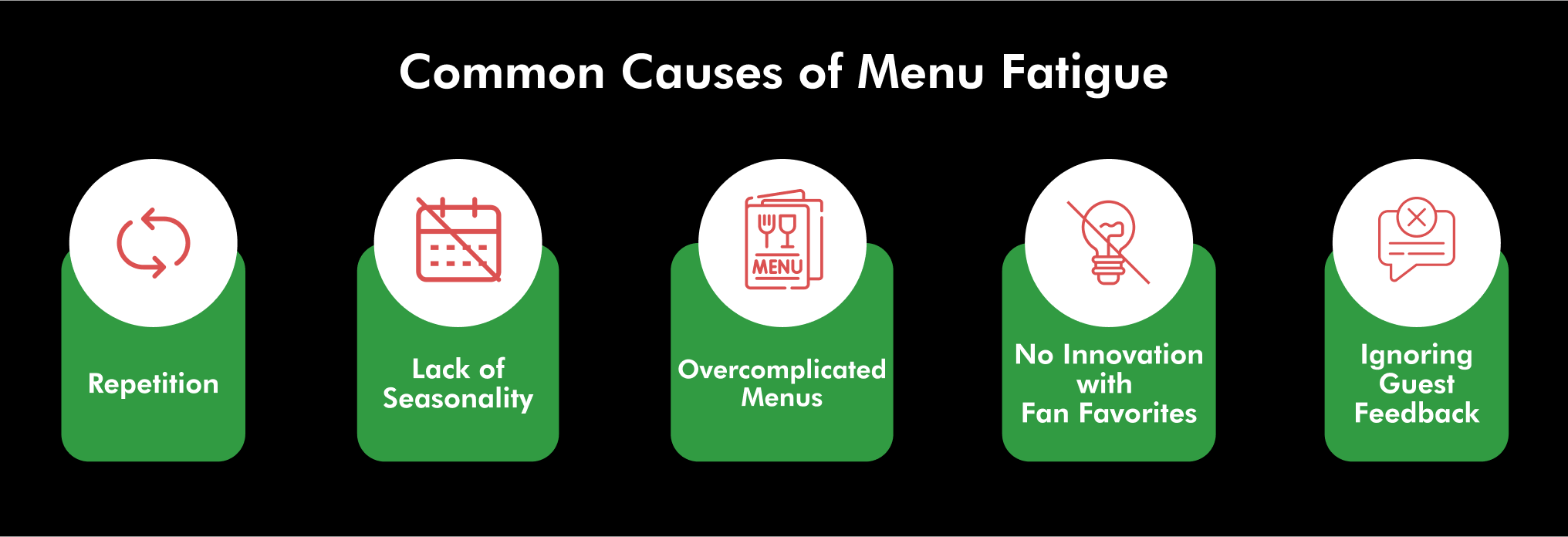
Common Causes of Restaurant Menu Fatigue Include: 

  • Repetition: Core menu items haven’t changed in months (or years). 
  • Lack of seasonality: Nothing reflects what’s fresh or trending during different times of year. 
  • Overcomplicated menus: Too many SKUs make it hard for guests to spot what’s new. 
  • No innovation with fan favorites: Top sellers never get an update, so even loyalists get bored. 
  • Ignoring guest feedback: Missed opportunities to bring back crowd-pleasers or trial new flavors. 

For multi-unit operators, menu fatigue isn’t just a guest experience problem—it’s a profitability problem. It shows up in lower traffic, smaller check averages, and weaker brand loyalty. And across dozens or hundreds of locations, those effects add up fast. 

So, how do you keep menus fresh without overwhelming your back-of-house teams or supply chain? Here are three strategies that deliver variety while still protecting your margins:

3 Strategic Ways to Reduce Menu Fatigue

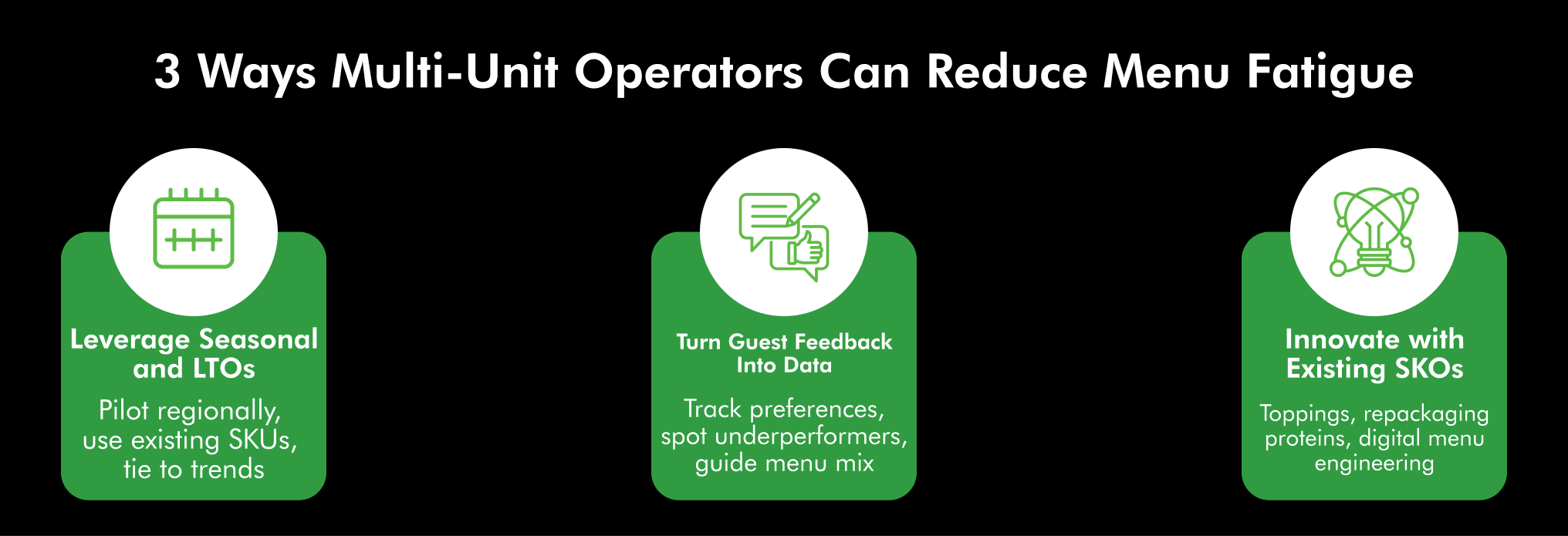
1. Leverage Seasonal and Limited-Time Offers (Without Disrupting Operations) 

Seasonal dishes and LTOs give guests something new to talk about and a reason to visit again. The key to addressing menu fatigue is to innovate without creating chaos behind the scenes. 

Best practices for multi-unit operators: 

  • Pilot seasonal items regionally before a full rollout 
  • Build LTOs around ingredients already in your purchasing system 
  • Tie promotions to cultural moments (comfort foods in winter, fresh vegetables in spring, global BBQ in summer) 

And here’s why it matters: According to the National Restaurant Association 2025 State of the Restaurant Industry Report,  87% of full-service restaurant customers say they’re likely to use daily specials or limited-time offers if available. That number holds strong across all generations, with Gen X (91%) and Baby Boomers (88%) leading the charge. In other words, LTOs aren’t just trendy, they’re a proven driver of guest traffic and loyalty.

2. Turn Guest Feedback Into a Data Asset 

Customer preferences aren’t guesswork. They’re data waiting to be tapped. Feedback collected from loyalty apps, surveys, and digital ordering platforms can tell you exactly where menu fatigue is setting in. 

What to track: 

  • Items customers say they’ve “had enough of” 
  • Dishes they’d like to see rotated back in 
  • Flavors trending in specific regions or demographics 

When paired with sales and product mix reports, this feedback becomes a roadmap for smarter menu adjustments. 

3. Innovate with Existing SKUs to Drive Higher Margins 

You don’t always need a brand-new dish. Sometimes the smartest move is giving existing menu items a twist. 

Quick wins that reduce fatigue: 

  • Add premium toppings or sauces to your top sellers 
  • Repackage proteins in new formats (sandwich to bowl, entrée to shareable app) 
  • Reframe high-margin dishes through better placement and digital menu engineering 

Pro Tip: Refresh your menu with custom sauces—no extra SKUs required. Chef Sebastian Rivera from Unilever Food Solutions shows how to take everyday pantry items and turn them into flavor-packed additions that elevate your top sellers: 


These small shifts refresh the guest experience while keeping operations streamlined. 

Scale Menu Innovation Without Losing Control 

Refreshing your menu is the fun part. Making it profitable across dozens (or even hundreds) of locations? That’s where things get complicated. 

Consolidated Concepts partners with multi-unit operators to take the guesswork and the wasted spend out of menu innovation. With our support, you can: 

  • Source seasonal SKUs at scale without supply chain headaches 
  • Negotiate stronger contracts for better pricing on new ingredients 
  • Track LTO performance with real data to see what deserves a permanent spot 
  • Optimize your menu mix to balance guest excitement with margin protection 

Menu fatigue is real, but it doesn’t have to eat into your bottom line. With the right strategy and the right partner, you can keep guests engaged, keep your teams efficient, and keep profits growing. Click here to partner with Consolidated Concepts, or fill out the form below to contact our restaurant experts today. 


How to Simplify Your Financial Consolidation Process

Here’s How to Simplify Your Financial Consolidation Process

Managing multiple concepts? Here’s how to simplify your financial consolidation process.

If you operate multiple restaurant concepts, you already know: the challenge isn’t just running a great business. It’s running several, each with its own P&L, operational quirks, and financial data. One might be a fast-casual burger joint, another a polished taqueria, and another a family-friendly pizza brand. All with different menus, team sizes, and peak hours. 

But at the end of the day, there’s one common denominator: they all roll up to your bottom line. That’s why having a streamlined process for financial consolidation for multi-unit restaurants is critical if you want clarity and control over your numbers.

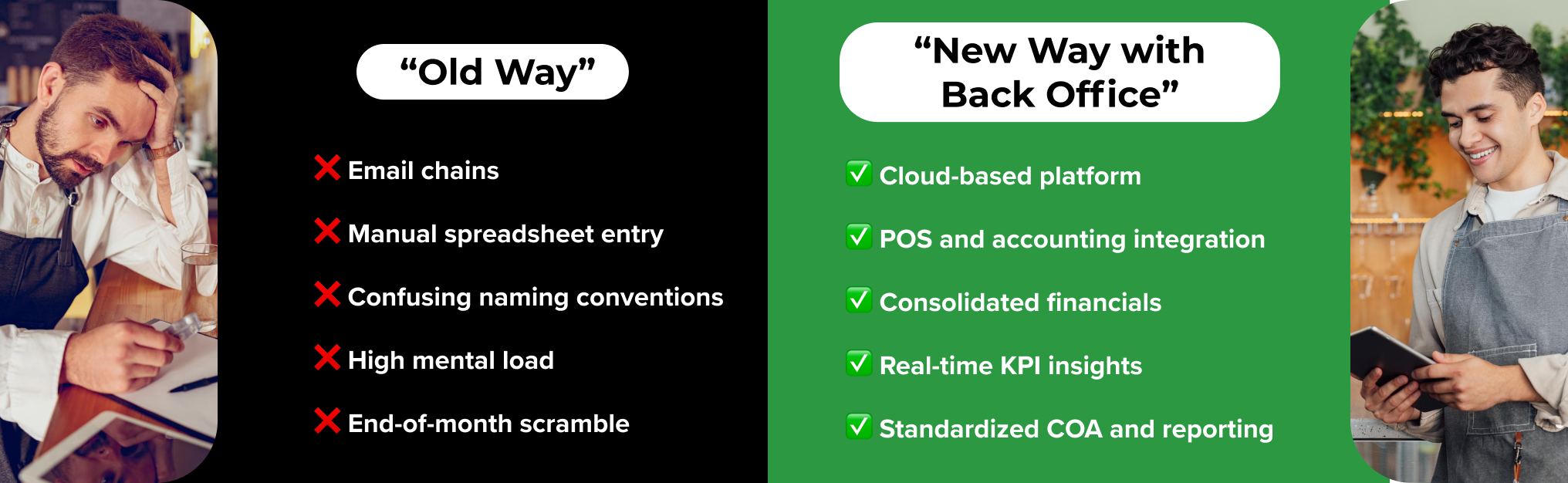
For growth-minded operators, getting a clear picture of that bottom line is easier said than done, especially if your financial consolidation process still includes spreadsheets, email chains, and last-minute manual work. If your back office feels more like a balancing act than a business engine, you’re not alone. 

Let’s walk through how top-performing operators consolidate and evaluate financial performance across multiple brands and how you can, too. 

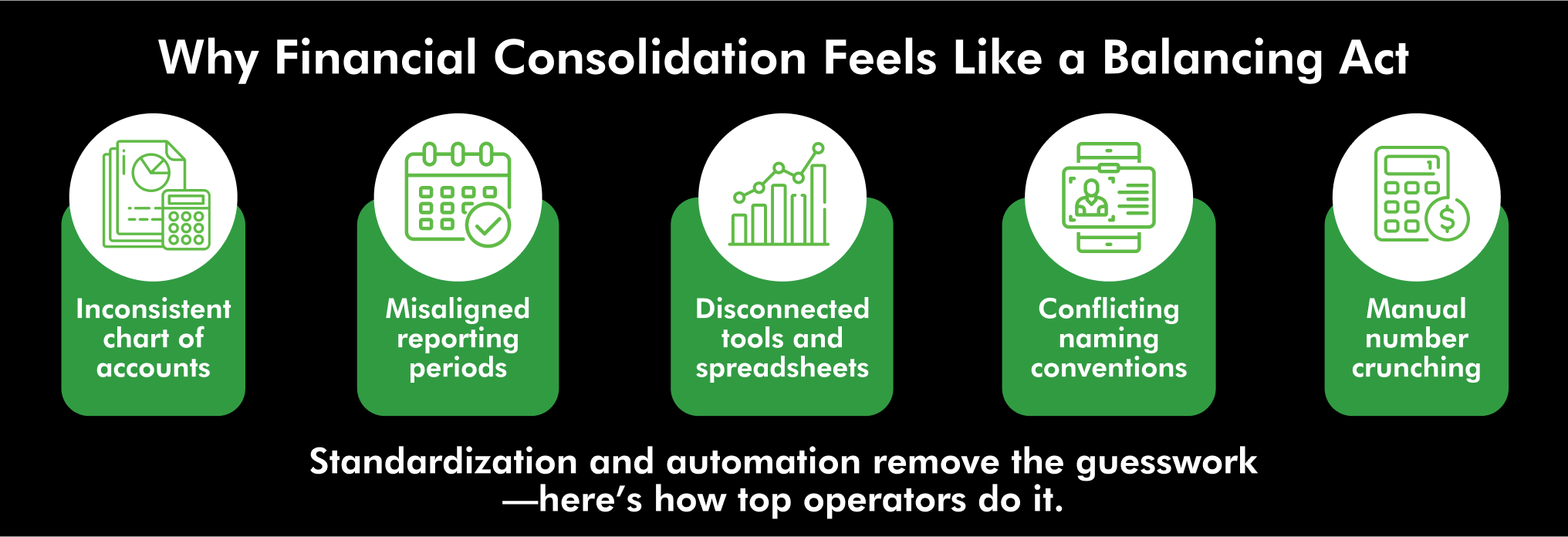
Why Financial Consolidation Feels Like a Balancing Act

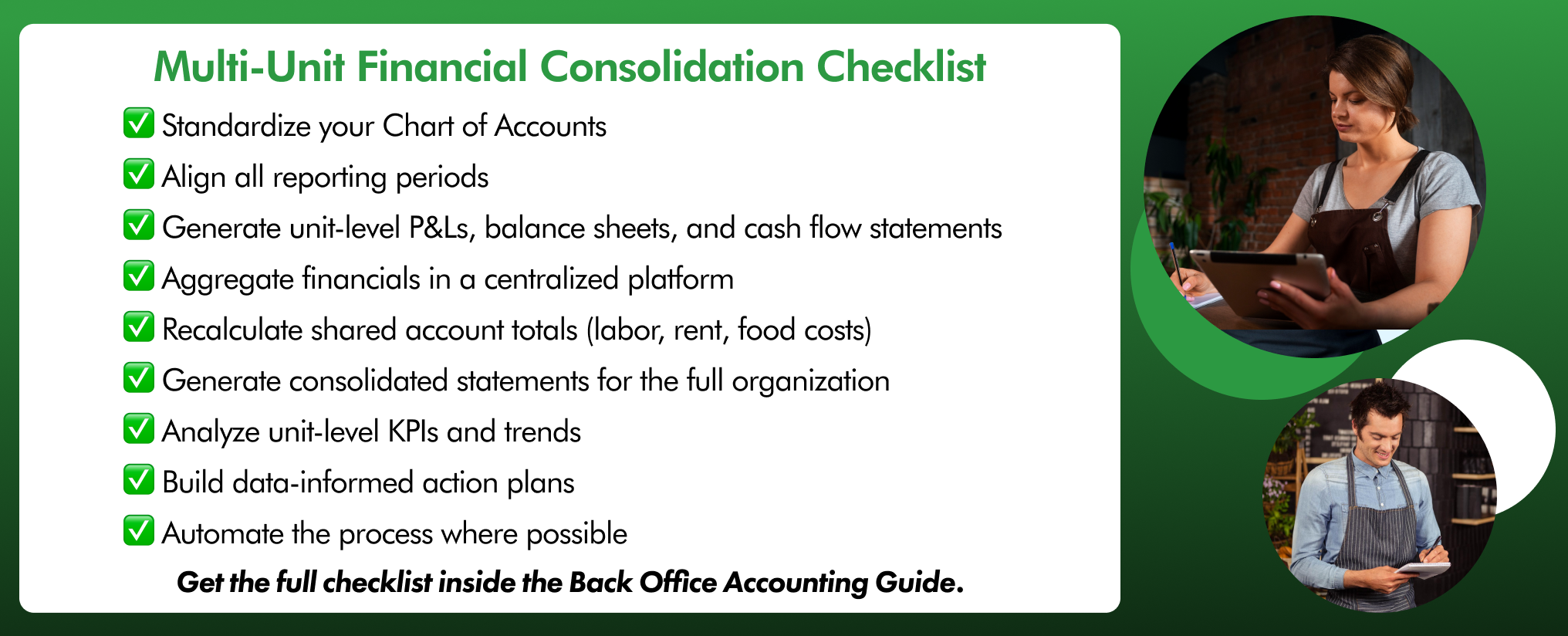
First, Standardize Your Chart of Accounts 

Before you can analyze anything, you have to speak the same financial language across all units. That starts with your Chart of Accounts (COA). 

It’s essential that your COA includes every category used across every brand or location, from food costs to linen services to third-party delivery fees. If one brand tracks beverage purchases under “Beverage Supplies” and another calls it “Bar Inventory,” you’ll spend hours just trying to match terms before you ever see the numbers. 

Pro Tip: Use a cloud-based centralized system that references the same COA across all locations. That way, every entry feeds into one standardized structure. 

Align Your Reporting Periods 

There’s nothing more frustrating than trying to compare financials from different units—only to realize one location is on a four-week period while another tracks by calendar month. 

Establishing a unified reporting schedule across all brands helps eliminate that misalignment. Communicate this schedule clearly with location managers and ensure they understand the deadlines and the importance of consistency. 

This one move can reduce the friction of your month-end or period-end wrap-ups significantly. 

Generate Financial Statements at the Unit Level 

Next, it’s time to dig into each brand or location’s individual performance. This means pulling: 

Each location should have these reports generated individually before any consolidation happens. Accuracy at the unit level is critical—if the individual statements are flawed, your consolidated financials will be, too. 

This is also a key opportunity to spot early indicators of performance trends—positive or negative—before you’re looking at rolled-up numbers. 

Bring It All Together 

Once your unit-level statements are clean, it’s time to consolidate. 

That doesn’t just mean copy-pasting line items into a mega spreadsheet. You’ll want to: 

  • Recalculate combined totals for shared accounts like labor, food cost, or rent 
  • Cross-reference brand-specific costs with systemwide ones 
  • Ensure all totals still balance and reflect actual operational activity 

With multiple locations, this part can feel like a full-time job—especially if you’re managing it with spreadsheets or disconnected software. 

Multi-Unit Restaurant Financial Consolidation Checklist

Generate a Consolidated Financial Statement 

Once your data is aggregated, use it to generate a true consolidated set of financials that reflects your organization as a whole. This is what allows you to speak to investors, make informed growth decisions, and forecast more accurately. 

Make sure the new, combined financials are: 

  • Balanced 
  • Accurate 
  • Reflective of operational realities 
  • Aligned with your strategic goals 

This is your chance to step back and assess your entire business, not just each store. 

Evaluate Unit-Level Performance 

Now that your financials are in order, it’s time to get analytical. Dig into unit-specific reports and track the KPIs that really matter: 

Each metric tells a story. Maybe one location is crushing sales but struggling with labor efficiency. Maybe another has strong food cost control but underperforms in average check size. When you know the story, you can write a better strategy. 

Identify What’s Working and What’s Not 

You’re now in a position to compare unit performance with intention. Look at: 

  • Best-selling and worst-selling items 
  • Promotional campaign effectiveness 
  • Overtime trends and labor inefficiencies 
  • Waste patterns or signs of theft 
  • Units that consistently over- or under-perform 

The goal? Build action plans for underperformers—and replicate winning tactics from your high-performers. 

One More Thing: Automate It 

Let’s be honest: even the best checklist still takes time. And if you’re scaling, that time adds up fast. Modern platforms designed for financial consolidation for multi-unit restaurants can eliminate hours of manual work and replace them with just a few clicks.

Take Control of Multi-Unit Financial Management

That’s why more multi-unit operators are investing in platforms like Back Office, which automates financial consolidation across all locations. It turns hours of reconciliation into just a few clicks, so you can spend less time crunching numbers and more time optimizing operations. 

The Bottom Line 

When you’re leading multiple restaurant concepts, you need more than intuition—you need visibility. Financial consolidation isn’t just about getting the numbers to add up. It’s about unlocking insights that help you scale smarter, faster, and with less friction. 

And if you’re looking for a streamlined way to build your consolidation process, complete with practical steps, real-world strategies, and tools that make the job easier, there’s a resource built specifically for multi-unit operators like you. 

Click here to take the complexity out of consolidation and get back to growing your business. 

Consistency, clarity, control—it all starts with how you manage your financials. 

Click here to learn more about how Consolidated Concepts helps multi-unit restaurants streamline financial consolidation and boost profitability.

How Emerging Concepts Can Improve Profitability During Growth

How Emerging Concepts Can Improve Profitability During Growth

Improve profitability during growth by taking control of your costs, streamlining operations, and setting your brand up for long-term success.

Growth feels good. New locations, more staff, higher visibility. But the bigger you get, the easier it is for profit margins to slip through the cracks. 

Emerging restaurant brands face a tricky challenge: how do you stay profitable when everything is moving fast? There are more orders to manage, more vendors to track, and more money going out the door. 

Good news, you can grow and stay profitable at the same time. You just need the right approach. 

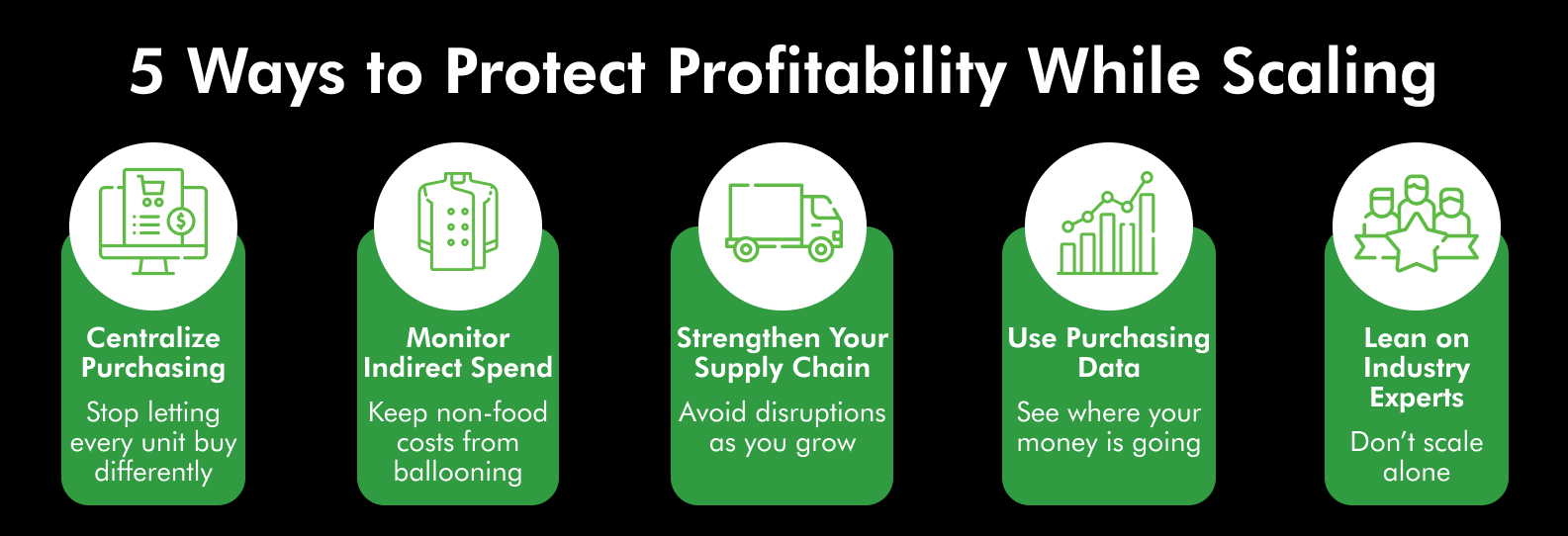
five real ways to protect your bottom line during a growth phase.

Here are five real ways to protect your bottom line during a growth phase.

1. Get Consistent With Your Purchasing

Every location doing its own thing? That gets expensive—fast. 

One of the simplest ways to gain control is to bring your purchasing under one roof. Create systems that help your team buy smarter and stay on track. 

Think about: 

  • Working with fewer vendors who offer better pricing 
  • Using contracts that lock in your costs 
  • Adding tools that show you what each location is spending 

You don’t need to micromanage everything. You just need to set up smart guidelines and stick to them.

2. Watch Out for Indirect Spend

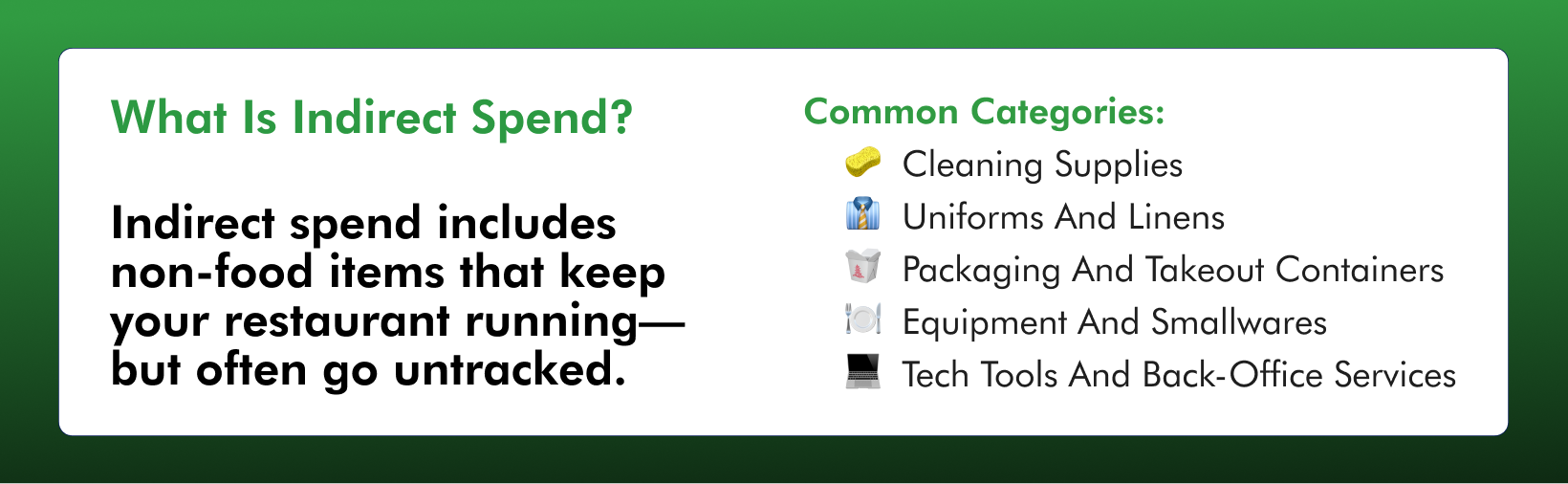
When most people think about restaurant costs, they focus on food. But non-food expenses can sneak up on you. 

Things like cleaning supplies, uniforms, and packaging eat into your margins. And when each unit orders on their own, prices can vary—and budgets can get messy. 

What Is Indirect Spend

Here’s what helps: 

It’s not about cutting corners. It’s about spending smarter.

3. Tighten Up the Supply Chain

The faster you grow, the more moving pieces you need to manage. If your supply chain is not solid, problems start to stack up. 

To avoid delays, shortages, or missed deliveries, now’s the time to: 

  • Look closely at your distribution model 
  • Explore regional programs that keep your shelves stocked 
  • Build a backup plan in case something falls through 

You don’t need to overhaul everything. Small improvements in logistics can make a big difference in day-to-day operations.

4. Use Your Data

Data is not just for big brands. It is a tool every growing restaurant should use. 

Start simple. Know what you are spending. Track what you are using. Pay attention to patterns. 

This helps you: 

  • Spot areas where you are overpaying
  • Catch when you’re off contract
  • Make better decisions about pricing and products 

Data tells a story. The more you listen, the easier it is to protect your margins.

5. Get Help From People Who’ve Done It Before

Running a restaurant is hard. Scaling one is even harder. That’s why having experienced partners matters. 

Work with people who understand restaurant growth—especially those who know the ins and outs of supply chains, sourcing, and vendor management. 

With the right team behind you, you can: 

  • Plan for the future with more confidence
  • Cut costs without cutting quality
  • Focus on your guests instead of spreadsheets 

It’s not about giving up control. It’s about gaining support where you need it most. 

smart growth starts with the right support

Growing your restaurant brand should feel exciting—not overwhelming. With better purchasing, tighter controls, and the right partners, you can scale your business while keeping profitability front and center. 

Click here to join Consolidated Concepts today and find out how we help emerging restaurant concepts reduce costs, manage vendors, and grow smarter. 


How to Develop Exciting Menu Items Without Sacrificing Margins

How to Develop An Exciting Menu Without Sacrificing Margins

Menu development isn’t just about adding new dishes—it’s about creating smart, profitable offerings that resonate with your guests and strengthen your brand.

Menu innovation is no longer optional—it’s essential. Diners are constantly looking for new flavors, unique experiences, and better value. Whether it’s the rise of plant-based eating, globally inspired dishes, or elevated comfort foods, consumer preferences are shifting fast. Staying relevant means keeping up—but not at the expense of your bottom line.

For multi-unit restaurant operators, the challenge isn’t if you should evolve your menu—it’s how to do it profitably.

The stakes are high:

  • Rising ingredient costs squeeze margins.
  • Labor challenges limit operational capacity.
  • Supply chain volatility disrupts consistency.
  • Competitive pressure demands constant differentiation.

So how do you create exciting new menu items and protect your margins?

That’s where Consolidated Concepts comes in.

At Consolidated Concepts, we help you walk that fine line between creativity and cost control. Through data-driven insights, strategic supplier partnerships, and smart technology solutions, we give you the tools to innovate confidently—without compromising profitability.

From ideation to execution, we help you turn bold menu development ideas into scalable, margin-friendly reality.

Menu Development That Makes Business Sense

  • Understand What Your Guests Really Want: Trends come and go, but data-backed insights last. We analyze customer preferences to help you introduce items that resonate—whether it’s plant-based alternatives, global flavors, or twists on classic favorites. It’s not about adding trendy dishes for the sake of it—it’s about strategic innovation that drives traffic and loyalty.
  • Engineer Menus for Profitability: New menu items shouldn’t come at the expense of your margins. We work with your team to optimize portion sizes, streamline ingredient usage, and set strategic pricing that protects profitability. Our menu engineering expertise ensures every dish is designed to deliver both guest satisfaction and financial performance.

Technology That Simplifies Menu Development

  • Real-Time Recipe Costing: No more guessing games. With recipe costing tools, you gain visibility into actual dish costs, empowering smarter decisions on menu adjustments, pricing strategies, and ingredient sourcing—all in real time.
  • Inventory and Ordering Optimization: Managing inventory across multiple locations can drain resources. Our technology solutions automate ordering and streamline inventory management, reducing waste, controlling spend, and ensuring consistency across your entire operation.

Operational Support That Drives Growth

  • Stronger Supplier Partnerships: Expanding your menu shouldn’t mean inflating your costs. We connect you with supplier partners that offer competitive pricing on high-quality ingredients. Through our network, you’ll tap into exclusive deals that protect your bottom line while enhancing your offerings.
  • Tailored Solutions, Scalable Success: Every restaurant concept is different. That’s why we don’t offer one-size-fits-all solutions. From menu development to supply chain optimization, we collaborate with you to create strategies that fit your brand’s unique needs and growth goals.

Let’s Bring Your Menu Ideas to Life—Profitably

When done right, menu innovation fuels customer excitement and business growth. Consolidated Concepts gives you the insights, tools, and partnerships to make it happen—without sacrificing your margins.

Ready to innovate smarter? Fill out the form below or click here to contact Consolidated Concepts to see how we help multi-unit operators scale success with fresh, profitable ideas. 


What’s Hot in 2025? Top Menu Trends for Multi-Unit Restaurant Operators

What’s Hot in 2025? Top Menu Trends for Multi-Unit Restaurant Operators

Staying competitive this year means more than just reacting to the latest fads—it means identifying menu trends with staying power and scaling them across your operations in a way that drives ROI. Multi-unit restaurant operators that embrace strategic innovation can strengthen their brand identity, deepen guest loyalty, and capture new market share. 

The National Restaurant Association’s What’s Hot 2025 Culinary Forecast highlights the menu trends shaping guest preferences this year. From global flavor exploration to value-forward offerings, these insights reveal what diners want—and how your operation can deliver. 

Here’s what’s hot for 2025—and how Consolidated Concepts helps multi-unit brands stay ahead of the curve: 

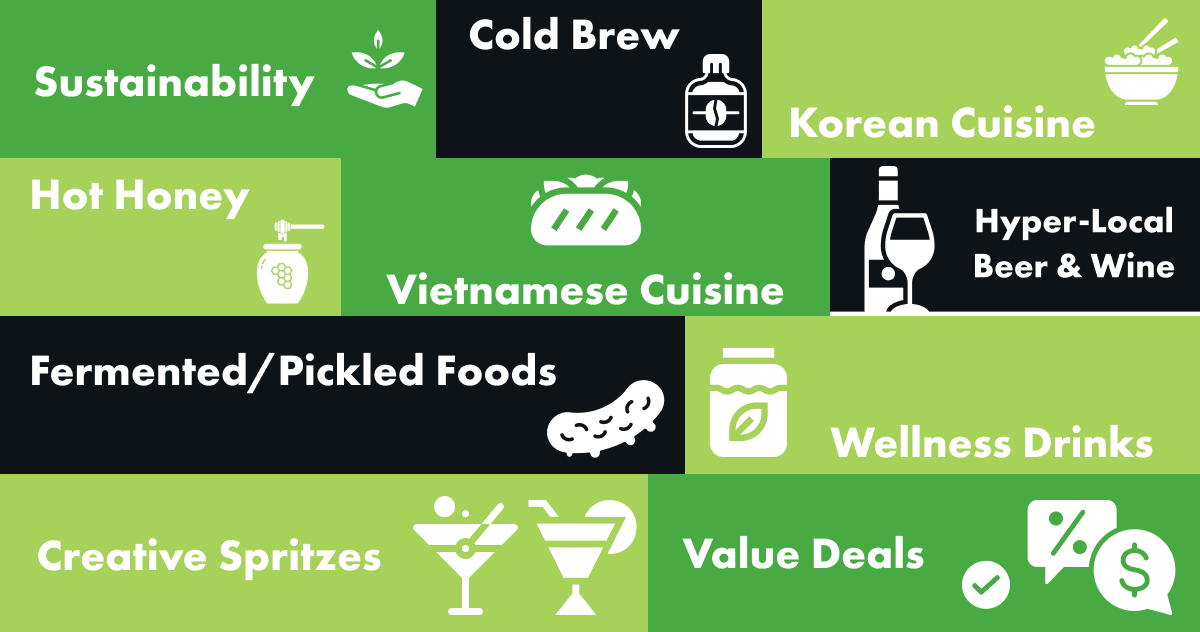
2025 restaurant trends displayed in an infographic

Sustainability That Scales 

From packaging to sourcing, sustainable practices are becoming a brand differentiator. But implementing them across locations? That takes strategy. Guests want to support restaurants that reflect their values, and investing in eco-conscious operations is key. 

Cold Brew, Evolved 

Coffee innovation continues—think nitro cold brews, flavor infusions, and coffee cocktails. These beverages can boost ticket averages from breakfast to late night and offer a high-margin addition to your beverage program. 

Korean Cuisine with Broad Appeal 

Dishes like bulgogi bowls and Korean fried chicken are moving into the mainstream. They deliver on flavor and can be adapted across formats, from fast casual to polished casual concepts. 

Hot Honey Everything 

This trend shows no signs of cooling off. Menu applications are endless—from chicken sandwiches to pizza to brunch items—and it offers a simple way to elevate familiar dishes with a bold flavor punch. 

Vietnamese Flavors on the Rise 

Fresh, customizable, and packed with flavor—Vietnamese dishes like pho and banh mi are a smart choice for health-conscious diners and dietary flexibility across concepts. 

Hyper-Local Beer & Wine 

While harder to scale, spotlighting regional partnerships with craft brewers and winemakers can boost guest engagement and brand loyalty—especially for locations that lean into local culture. 

Fermented and Pickled Ingredients 

These ingredients bring tang, texture, and gut-health appeal. From pickled onions on burgers to kimchi sides and fermented sauces, they’re trending across cuisines and formats. 

Wellness Drinks for the Win 

Functional beverages with adaptogens, probiotics, and immunity-boosting benefits are becoming menu must-haves. Guests are looking for drinks that do more—and are willing to pay for them. 

Creative Spritzes & Low-ABV Cocktails 

With an eye on wellness, diners are gravitating toward lighter, eye-catching beverages. Think botanical spritzes, non-alcoholic mixers, and fruit-forward refreshers that look just as good as they taste. 

Value Deals that Don’t Sacrifice Quality 

Diners are budget-conscious but still crave a great experience. Family-style portions, loyalty perks, and curated combo deals can boost perceived value while maintaining profitability. 

Stay Trend-Forward with Consolidated Concepts

Incorporating new menu trends across multiple units takes more than creativity—it takes coordination, cost control, and confidence in your supply chain. Consolidated Concepts gives you the tools and support to turn trends into scalable, sustainable success: 

Strategic Sourcing 

We connect you with vetted suppliers, contract support, and product alternatives to source trendy ingredients—like fermented foods, wellness beverages, and global flavors—at the right price and quality. 

Data-Driven Insights 

Know what your guests are craving and how your competitors are adapting. We deliver industry insights and purchasing intelligence to help you act with precision and stay ahead of shifting preferences. 

Contract Management & Rebate Optimization 

Trendy doesn’t have to mean pricey. We help you maximize rebates and contract compliance to bring innovation to your menu while protecting your margins. 

Culinary & Supply Chain Expertise 

From menu ideation to implementation, we support your teams with guidance on product rollout, cost modeling, and operational alignment across locations. 

Tech-Enabled Solutions 

Consolidated Concepts leverages data and technology to streamline procurement, manage inventory, and ensure consistency—from one unit to one hundred. 

Want to turn menu trends into profits this year? Let Consolidated Concepts help you scale innovation with confidence. Fill out the form below and contact us today to start planning your trend-forward strategy. 

Restaurant Growth Strategy: How Operators Can Scale Profitably

Restaurant Growth Strategy: How Operators Can Scale Profitably

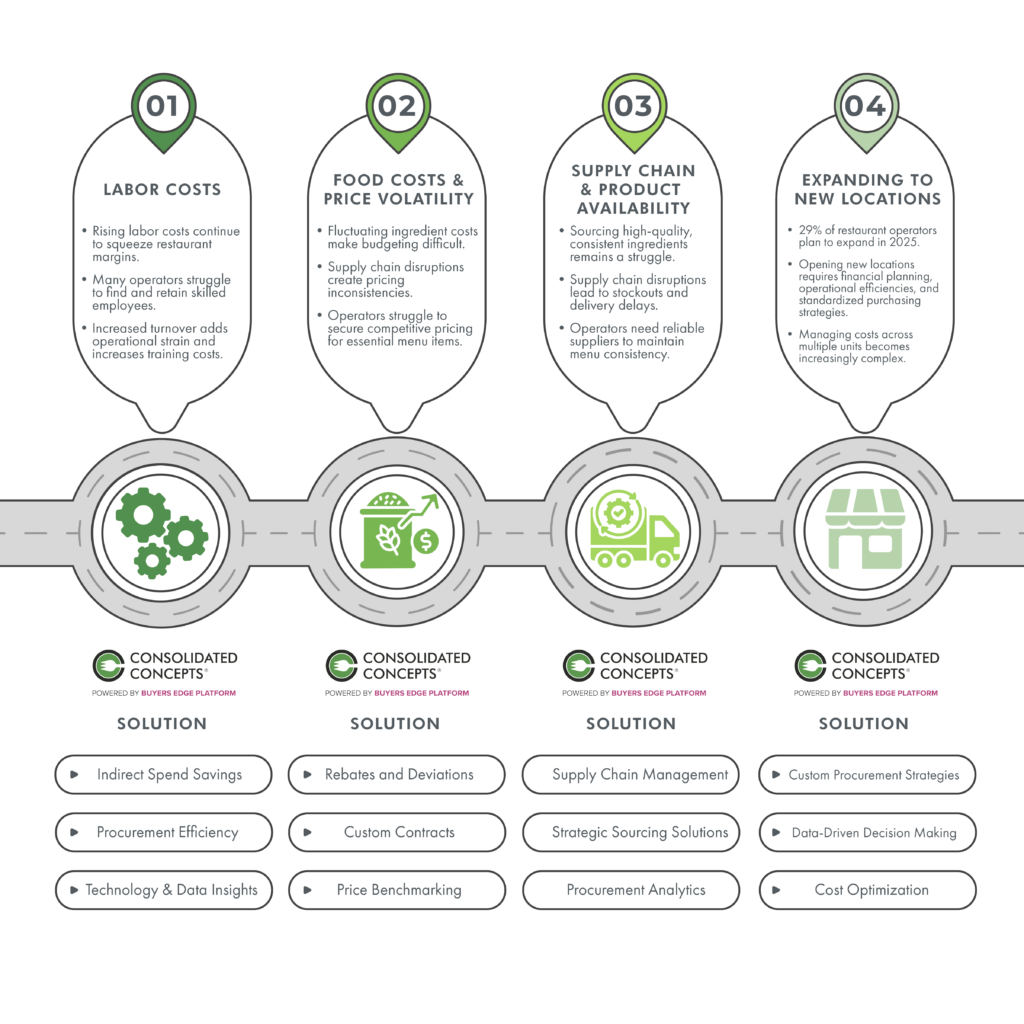
The restaurant industry is no stranger to challenges, and this year many operators anticipate facing the same hurdles that have defined recent years. Labor costs, food costs, and recruiting and retaining employees remain top concerns for both full-service and limited-service restaurant operators. Despite these challenges, growth is on the horizon—29% of operators plan to expand and open new locations in 2025.

So, how can multi-unit restaurant operators navigate rising costs, workforce struggles, and supply chain complexities while still driving profitability and expansion? The answer lies in leveraging strategic partnerships and advanced solutions designed to streamline operations and optimize costs. A well-planned restaurant growth strategy can help operators scale efficiently while maintaining financial health.

Rebates & Deviations: Reducing Food Costs at Scale 

Food costs continue to be a top concern for restaurant operators, and as commodity prices fluctuate, managing expenses becomes increasingly difficult. Through Consolidated Concepts, multi-unit operators gain access to powerful cost-saving programs, including rebates and deviations. 

  • Rebates: By leveraging the collective purchasing power of multi-unit operators, Consolidated Concepts negotiates exclusive rebates on essential ingredients and supplies. These rebates put money back into your business, helping to offset rising costs and support your restaurant growth strategy.
  • Deviations: Custom pricing agreements ensure you’re paying the most competitive prices across all your locations. This approach prevents price discrepancies and helps control costs, allowing you to expand without financial strain.

Data & Technology: Powering Smarter Growth

Having real-time access to purchasing data and analytics is crucial for making informed business decisions. Consolidated Concepts provides multi-unit operators with advanced procurement technology that delivers deep insights into spending patterns, cost trends, and supplier performance. 

  • Price verification tools help ensure that you’re being charged correctly for every invoice, eliminating overcharges and improving cost accuracy. 
  • Purchasing analytics provide real-time visibility into food and supply costs, allowing operators to make data-driven decisions that drive savings and operational efficiency. 
  • Forecasting technology helps operators anticipate cost fluctuations, making it easier to budget for future purchases. 

Supply Chain Management: A Growth Strategy Essential

Between ongoing supply chain disruptions and increased demand for quality ingredients, managing procurement has never been more complex. Consolidated Concepts helps multi-unit restaurant operators streamline their supply chains by optimizing vendor relationships, ensuring product availability, and improving overall efficiency. 

  • Strategic sourcing solutions help operators secure reliable, cost-effective ingredients while maintaining quality and consistency—an essential aspect of any restaurant growth strategy.
  • Distribution management services prevent stockouts, delays, and supply chain inefficiencies that could impact operations. 
  • Customized procurement strategies help multi-unit operators source the best products while balancing cost and quality. 

Produce Management: Elevating Freshness in Your Growth Plan

Consumers continue to demand fresh, high-quality ingredients, making produce management a top priority for restaurants. Consolidated Concepts provides operators with expert produce procurement services to help maintain consistency and reduce waste. 

  • Sourcing from a trusted network of suppliers ensures that operators receive the freshest, highest-quality produce year-round. 
  • Quality assurance support helps ensure that every shipment meets your restaurant’s standards. 
  • Price benchmarking tools allow operators to compare pricing across multiple vendors to ensure they’re getting the best deal—a key component of a cost-efficient restaurant growth strategy.

Custom Contracts: Aligning Pricing with Growth Goals

Every restaurant brand has unique needs, and off-the-shelf supplier agreements don’t always align with business goals. That’s why Consolidated Concepts works with multi-unit operators to create customized contracts that align with their purchasing priorities. 

  • Negotiated agreements help operators secure exclusive pricing and terms that align with their long-term growth strategies. 
  • Category management support ensures that operators are optimizing their purchasing in key areas like proteins, beverages, and disposables. 
  • Flexibility in supplier selection allows restaurant brands to work with vendors that best suit their operational needs. 

Indirect Spend Savings: Reducing Costs to Scale Smarter

Food costs aren’t the only expenses putting pressure on restaurant margins—indirect spend categories like equipment, utilities, and maintenance also contribute to rising operational costs. Consolidated Concepts helps operators reduce indirect spend through exclusive programs and partnerships. 

  • Discounted pricing on essential supplies including kitchen equipment, uniforms, linens, and more. 
  • Technology solutions for non-food procurement streamline purchasing for facilities management, cleaning supplies, and other operational needs. 
  • Energy efficiency programs help operators lower utility costs through optimized energy usage and rebate opportunities—a critical factor in sustainable restaurant growth.

A clean and structured infographic with a restaurant industry theme, featuring icons for each challenge and solution related to labor costs, food costs, supply chain recruitment, and  retention

Executing a Winning Restaurant Growth Strategy

With nearly a third of restaurant operators planning to expand in 2025, having a restaurant growth strategy in place is critical for success. Consolidated Concepts provides the tools, data, and supplier partnerships needed to scale efficiently while maintaining financial health. 

By leveraging rebates, data analytics, supply chain management, produce procurement, custom contracts, and indirect spend savings, multi-unit operators can address their biggest challenges while positioning their business for long-term growth.

Want to see how Consolidated Concepts can support your restaurant growth strategy? Fill out the form below and get in touch with our restaurant experts today!

The Smarter Way to Cut Costs and Improve Efficiency Without Hiring More Employees

The Smarter Way to Cut Costs and Improve Efficiency Without Hiring More Employees

With 32% of operators saying they need more employees to meet customer demand, the labor shortage continues to be a significant challenge across the industry. Multi-unit operators face an even greater burden, as maintaining consistency, managing costs, and optimizing operations across multiple locations requires a strategic approach.

Instead of letting these challenges slow your business down, Consolidated Concepts offers powerful solutions to help streamline operations, reduce costs, and ensure operational efficiency across your entire portfolio. 

3 Ways Consolidated Concepts Can Help Save Time and Money 

Rather than constantly hiring to keep up with demand, why not implement smarter operational strategies? Here’s how Consolidated Concepts helps multi-unit restaurant brands stay efficient and profitable despite labor shortages: 

1. Instant Cost Reductions—No Time-Consuming Negotiations

Finding the best deals across multiple locations takes time—but Consolidated Concepts does the work for you. We provide access to exclusive, pre-negotiated pricing, rebates, and supply chain optimization strategies that immediately reduce costs on food, supplies, and operational expenses. By leveraging our purchasing power, you can lower costs across all your locations while eliminating the manual work of price comparisons and contract negotiations.

2. Purchasing Intelligence—Total Visibility Across Locations

Are fluctuating food costs making it difficult to maintain profitability? Consolidated Concepts gives you real-time purchasing insights across all your units with a comprehensive restaurant technology stack. By eliminating the guesswork, you gain control over spending, identify cost-saving opportunities, and optimize purchasing strategies for greater efficiency across locations.

3. Supplier Optimization—We Handle the Search

Industry data shows that 63% of operators shopped for new suppliers last year, and nearly half of operators cut menu items due to rising costs. For multi-unit operators, finding and managing reliable supplier relationships can be an overwhelming task. That’s where Consolidated Concepts comes in. Our extensive network of trusted suppliers ensures you have access to quality products at competitive prices, saving you time and resources while protecting your menu integrity and brand consistency across all locations. 


How Consolidated Concepts Helps You Navigate Labor Shortages 

When labor is tight, every operational efficiency counts. Consolidated Concepts empowers multi-unit restaurant operators with tools to enhance efficiency and keep business running smoothly, regardless of staffing shortages. 

Cost Savings—More Efficiency, Less Waste 

Instead of spending hours researching supplier contracts or searching for rebates, Consolidated Concepts provides instant cost reductions tailored to multi-unit operators. These savings directly impact your bottom line, freeing up capital to invest in labor retention, technology, or menu innovation. 

Purchasing Transparency Across All Locations 

With Consolidated Concepts, you gain real-time visibility into purchasing data across your entire operation. This ensures you make informed, data-driven decisions that eliminate unnecessary spending, prevent over-ordering, and maintain consistency across locations—even when staffing levels are tight. 

Simplified Supplier Management 

With rising food costs and ongoing supply chain disruptions, maintaining strong supplier relationships is more critical than ever. Consolidated Concepts simplifies the sourcing process by connecting you with a vetted network of suppliers that meet your quality and pricing standards. Instead of reacting to market fluctuations, you can proactively secure cost-effective, reliable supply solutions that maintain menu stability and guest satisfaction. 

Transform Challenges into Competitive Advantages 

Labor shortages and rising costs don’t have to slow your business down. With Consolidated Concepts, multi-unit restaurant operators gain the insights, cost savings, and supplier solutions they need to navigate these challenges with confidence. From instant cost reductions to data-driven purchasing and supplier optimization, we help you run a leaner, more efficient operation while maintaining the high standards your customers expect. 

Ready to take control of costs and operations? Fill out the form below to contact Consolidated Concepts today to start optimizing your multi-unit restaurant strategy. Stay ahead of labor challenges, improve efficiency, and unlock greater profitability.